
When SSG.com was created in 2019 by merging E-Mart Mall and Shinsegae Mall under a single corporate entity, the strategic logic was consolidation: one platform, shared infrastructure, combined customer base, lower operational overhead. Seven years later, the same management structure has concluded that the logic no longer holds.
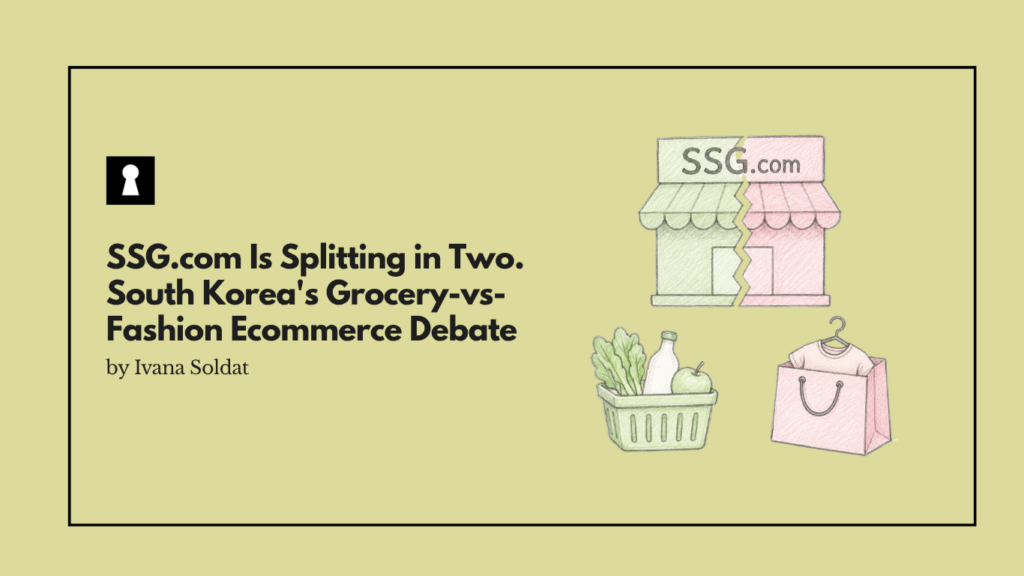
SSG.com’s board approved the spin-off plan this week. The businesses subject to the split include fashion, beauty, and lifestyle operations, which will be transferred to the newly established Shinsegae Mall. SSG.com will remain as the surviving entity focused on online grocery. The separation takes effect December 1, following an extraordinary shareholders’ meeting on October 30.
E-Mart Inc. currently owns 65% of SSG.com, while Shinsegae Inc. owns the remaining 35%. Following the split, both companies will hold the same respective stakes in both SSG.com and Shinsegae Mall. SSG.com’s capital will decrease to 14.05 billion won from 21.94 billion won, while the new Shinsegae Mall will have capital of 7.89 billion won.
Why Grocery and Fashion Cannot Share a Platform Strategy
The SSG.com split is a corporate acknowledgment of something ecommerce strategists have understood for years: grocery ecommerce and premium fashion ecommerce are structurally incompatible businesses when each is optimised to its full potential.
Grocery ecommerce competes on price, speed, assortment breadth, and logistics reliability. The customer decision is frequent, habitual, and largely unbranded. Loyalty is built through operational consistency rather than brand aspiration.
Premium fashion ecommerce competes on curation, brand prestige, editorial voice, and the quality of the discovery experience. The customer decision is infrequent, considered, and intensely brand-sensitive. Loyalty is built through aesthetic alignment and a sense that the platform understands the customer’s taste.
These two customer relationships require different UX, different merchandising logic, different marketing channels, different buyer relationships, and different success metrics. A platform optimised for grocery is poorly suited to premium fashion, where discovery, editorial context, and a sense of exclusivity are competitive advantages.
SSG.com’s official framing is diplomatic but accurate:
“We expect the split to enhance the expertise of each business and enable us to respond more swiftly to market changes based on independent decision-making systems.”
The Korean Ecommerce Competitive Context
South Korea’s ecommerce market is one of the most competitive in the world. Coupang dominates through its Rocket Delivery same-day logistics infrastructure. Naver Commerce leverages search dominance. Kakao Commerce operates through messaging app integration. And in fashion specifically, Musinsa, 29CM, and W Concept have built dedicated platforms with younger, style-conscious audiences that SSG.com’s conglomerate positioning has struggled to reach.
SSG.com has been caught between two simultaneous competitive pressures: on the grocery side, Coupang’s Rocket Fresh and quick commerce operators pushing the competitive bar higher; on the fashion and beauty side, dedicated platforms with stronger cultural resonance outcompeting a grocery app’s fashion section.
The spin-off gives Shinsegae Mall independence to compete with dedicated fashion platforms on their own terms, different branding, different editorial voice, different influencer and brand partnerships, without being constrained by the operational needs of grocery.
The Customer Continuity Question
The split creates potential friction for customers who currently use SSG.com for both grocery and fashion. Customers will still be able to access Shinsegae Mall through the SSG.com app, which partially addresses this concern. But whether a unified loyalty programme, unified cart, and unified checkout experience will survive the corporate separation is not fully answered in the announcement.
South Korean consumers, like their counterparts in every market EcomWatch has covered this month, have decreasing loyalty to platforms that add friction. The operational efficiency of separate corporate entities needs to deliver a customer experience that is at least as seamless as the current unified platform, or the split will lose customers to platforms that have not fragmented their experience.
A Pattern Emerging Across Asian Ecommerce
The SSG.com split is the latest in a series of Asian ecommerce restructurings reflecting the same underlying tension: conglomerate platforms built for breadth are being separated into focused entities built for depth.
Alibaba has been splitting into multiple independently operated business units since 2023. JD.com has similarly segmented its logistics, healthcare, and retail businesses. The Sendo Vietnam shutdown we covered this month was partly a consequence of a single platform trying to compete across too many categories without the focused resources that specialist competitors brought to each one.
The grocery-versus-fashion split at SSG.com is a more narrowly scoped version of the same strategic recognition: the platform that tries to be everything to everyone increasingly loses to the platform that is the best possible version of something specific.
Our Take
South Korea Just Got a New Premium Fashion Ecommerce Platform. Sort Of.
The SSG.com spin-off gives the Shinsegae Group a genuine opportunity to build a premium fashion and lifestyle destination that can compete with Musinsa and 29CM on cultural resonance and editorial quality, rather than being perpetually positioned as “the fashion section of a grocery app.”
Whether that opportunity is realised depends on execution: whether Shinsegae Mall can build a distinct brand identity, recruit the right brand partners, and create a discovery experience that feels premium rather than corporate. The corporate separation is the easy part.
Building something that a style-conscious Korean consumer chooses over Musinsa is the harder problem, and December 1 is the starting gun, not the finish line.