
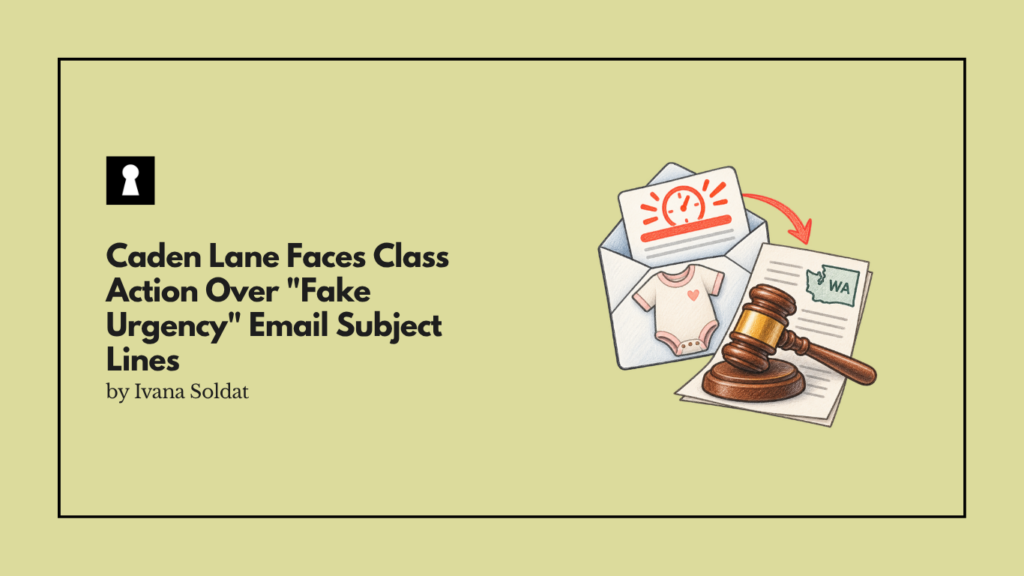
The core of the complaint, filed by plaintiff Divya Gautam in the U.S. District Court for the Western District of Washington, centers on the timing of promotional communications.
Gautam alleges that Caden Lane sent marketing emails with subject lines explicitly stating that a promotion would end on a specific date or time, only to extend or continue the sale after that deadline passed.
The lawsuit argues that these messages are designed to artificially push consumers to open emails and make purchases under the false pretense of a limited-time offer, rather than reflecting the actual duration of the promotion.
A Massive Wave Of CEMA Litigation
This lawsuit is not an isolated incident but rather part of a broader, coordinated legal strategy targeting ecommerce retailers. The current wave of litigation traces directly to the Washington Supreme Court’s 2025 decision in Brown v. Old Navy, LLC, which held that Washington’s Commercial Electronic Mail Act (CEMA) prohibits any false or misleading information in a commercial email subject line, not just emails that attempt to hide their commercial nature.
Following that ruling, plaintiffs have filed nearly 100 similar lawsuits against retailers across various industries, specifically targeting subject lines announcing sales that end “today,” “tonight,” or as a “last chance,” followed by later emails extending the offer.
The 2026 Statutory Shift Caps Potential Damages
For retailers monitoring this trend, a crucial detail is a recent legislative change that alters the financial risk calculus.
While older legal commentary widely cited CEMA damages at up to $500 per violating email, a 2026 amendment to RCW 19.190.040 reportedly changed the statutory damages to $100 or actual damages, whichever is greater.
According to legal analysts, this amended version applies to cases commenced on or after June 11, 2026. While this significantly reduces the maximum theoretical liability per email compared to previous years, the volume of emails sent by large retailers means the aggregate risk remains substantial.
The Battle Over Federal Preemption And Commerce Clause Defenses
Retailers are not accepting these claims passively. A common defense strategy in these CEMA cases is to argue that the federal CAN-SPAM Act preempts state-level email laws, and that applying Washington law to out-of-state senders violates the dormant Commerce Clause. However, early court rulings have largely favored plaintiffs on this front.
Courts have noted that the federal CAN-SPAM Act explicitly exempts state laws that prohibit “falsity or deception” in commercial email, allowing state-level deception claims like CEMA to proceed alongside federal regulations.
Our Take
Fake Urgency in Subject Lines Is Now a Legal Risk for Ecommerce Brands
For years, ecommerce growth teams have relied on “fake urgency” as a low-cost, high-yield lever to boost email open rates and conversion. This lawsuit serves as a stark warning that regulatory environments are finally catching up to aggressive growth-hacking tactics.
If a brand’s automated email subject line promises a deadline that the landing page ignores, it is no longer just a marketing optimization; it is a documented legal vulnerability.
Retailers must immediately audit their automated email flows and promotional calendars to ensure that subject line claims are strictly synchronized with actual promotional mechanics.
In the current legal climate, honesty in subject lines is no longer just a brand value; it is a risk management imperative.