
Google announced a suite of agentic commerce updates, positioning them as essential tools for retailers preparing for the 2026 holiday season.
The company is making AI performance insights generally available across five markets, launching a beta program for Business Agent integration within YouTube ads, and expanding Universal Commerce Protocol capabilities for select merchants. These announcements arrive at a critical inflection point for the industry, as Adobe Analytics reported that AI-referred traffic to US retail sites grew 693 percent year over year during the 2025 holiday season.
The central tension in Google’s strategy is not whether consumers use AI for shopping research, but whether they trust these systems enough to complete transactions without leaving the AI environment. Google is betting heavily that it can solve both problems simultaneously through protocol standardization and enhanced measurement tools.
AI Performance Insights Finally Give Merchants Visibility Into Black Box Discovery
AI performance insights in Merchant Center are now generally available to businesses in Australia, Canada, India, New Zealand, and the United States. This feature shows retailers how their share of voice compares with other brands across Google experiences including AI Mode and AI Overviews. The rollout represents a significant expansion from the beta testing phase that began in July 2026 with select US accounts.
For merchants operating in the dark about how their products appear in conversational AI results, this visibility addresses a genuine pain point. Google claims that merchants adopting core Merchant Center feed best practices see an average 5 percent increase in conversions the following month. During testing with Lululemon, conversational attributes supplied by the retailer were incorporated 50 percent of the time in relevant product recommendations in AI Mode.
The metric that matters most remains elusive though. Google does not publish AI-referred traffic as a share of total retail visits, and no primary source provides this figure. Adobe Analytics tracks growth rates but explicitly notes the base remains modest despite the dramatic percentage increases. Without knowing what portion of total traffic comes from AI sources, the 5 percent conversion lift claim lacks meaningful context for budget allocation decisions.
Merchants connecting loyalty-program data to Merchant Center can now surface member-specific pricing and benefits across Google surfaces. Minted members searching for holiday cards see their Minted More pricing inline, which Google presents as a friction reduction. This capability works only if the underlying product data is accurate and comprehensive, which brings us back to the unglamorous work of feed optimization that most retailers still neglect.
YouTube Becomes the Next Frontier for Conversational Product Research
Google is inviting eligible US retailers to participate in a beta that embeds Business Agent directly into YouTube ads. Viewers can ask detailed product questions and receive tailored answers without leaving the YouTube interface, moving from video inspiration to research within the same experience. This builds on the Business Agent functionality Google introduced in Search earlier in 2026.
YouTube has more than 2.5 billion active users, making it one of the largest potential audiences for agentic commerce. The platform already serves as a research destination where shoppers discover products through creator content and reviews. Adding conversational assistance within ads attempts to capture purchase intent at the moment of discovery rather than forcing users to navigate away to a brand website or search engine.
The beta limitation to US retailers suggests Google is proceeding cautiously with this integration. No participation numbers have been disclosed, and there is no public data on how many retailers have signed up or what early engagement metrics look like. YouTube ads currently represent a smaller portion of most retailers’ media budgets compared to search, so the immediate revenue impact may be limited even if the technology performs well.
What Google is not saying is whether this YouTube integration will eventually include direct checkout capabilities. The current description focuses on research and question answering, stopping short of transaction execution. Given the poor performance of native in-chat checkout in other contexts, this restraint may reflect lessons learned from competitors rather than technical limitations.
Universal Commerce Protocol Expands but Adoption Remains Tightly Controlled
UCP-powered checkout capabilities are gradually rolling out in the United States, with Australia and Canada expected to follow early next year. Merchants using the hub can now enable cart transfers to their own websites and enhanced checkout-flow testing, with analytics promised soon. Tapestry integrated UCP-powered checkout to make Coach and Kate Spade products purchasable across Google Search including AI Mode and the Gemini app.
The protocol itself is open source and was co-developed with Shopify, Etsy, Wayfair, Target, and Walmart. More than 20 partners including payment providers and major retailers have endorsed it. Yet the checkout feature enabled by UCP remains available only to select merchants who meet unspecified eligibility requirements and express interest through a form.
This selective availability contrasts sharply with Google’s messaging about democratizing agentic commerce. The gap between the open specification and the restricted implementation suggests Google is prioritizing quality control and risk management over rapid scale. For smaller retailers hoping to access these capabilities before the holiday rush, the timeline offers little comfort.
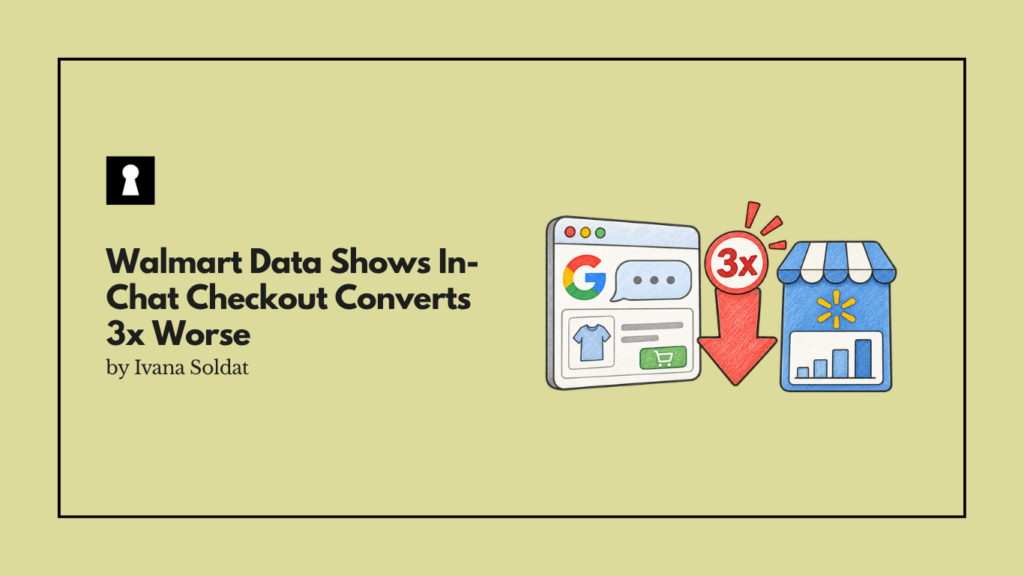
Walmart’s involvement in developing UCP carries particular significance given its subsequent experience with OpenAI’s competing approach. Walmart EVP Daniel Danker told Wired that conversion rates for products sold directly inside ChatGPT were three times lower than those requiring users to click out to Walmart’s website. This single data point from one of the world’s largest retailers should give pause to any platform pushing native in-chat checkout as the future of commerce.
The Walmart Cautionary Tale Google Chooses Not to Highlight
OpenAI launched Instant Checkout in ChatGPT on September 29, 2025, allowing users to purchase items from participating retailers without leaving the chatbot interface. By March 2026, OpenAI had pulled back from this approach, stating that the initial version did not offer sufficient flexibility and shifting toward merchant-owned checkout experiences.
Walmart’s exclusive data revealed the reason behind this retreat. Conversion rates for in-chat purchases ran approximately three times worse than normal click-through transactions to Walmart.com. The specific figures cited in subsequent analysis showed a 1.18 percent conversion rate for in-chat checkout compared to roughly 3.5 percent for traditional flows, with 77 percent abandonment in the chatbot experience.
Etsy provided additional context to Wired, stating it did not see large volume from Instant Checkout but did find value in referral traffic that directed users to its platform. The pattern emerging from these early experiments suggests that consumers want AI assistance with discovery and comparison but prefer to complete transactions on familiar retailer interfaces where they have established trust and saved payment information.
Google’s UCP implementation differs from OpenAI’s withdrawn Instant Checkout in that it keeps the merchant as seller of record and allows customization of the checkout experience. Customers remain in the secure Google Pay flow using saved payment methods from Google Wallet. Whether this architectural difference produces materially better conversion rates remains untested at scale, since Google has not released any performance data from its UCP pilot merchants beyond the Tapestry announcement.
The absence of Walmart from Google’s list of UCP launch partners is notable given Walmart’s role in co-developing the protocol. Walmart has instead focused on building its own Sparky assistant and integrating AI capabilities into its owned properties rather than relying on third-party platforms for transaction execution. This strategic divergence between protocol development and actual deployment deserves scrutiny from retailers evaluating where to invest their agentic commerce resources.
Product Feed Quality Determines Agentic Commerce Success Regardless of Protocol Choice
Google emphasizes that accurate and detailed product data remains fundamental to ecommerce success even as attention shifts to AI agents. The company’s claim that merchants adopting core Merchant Center feed best practices see a 5 percent conversion increase provides a concrete baseline for investment justification. Conversational attributes submitted by retailers get incorporated into AI Mode recommendations half the time according to Google’s Lululemon test.
These attributes include fit information, material details, care instructions, and other contextual data that helps AI systems answer shopper questions accurately. Retailers submitting richer product data gain advantages in both traditional search and AI-driven discovery because the same structured information feeds multiple surfaces. The work required to optimize feeds for agentic commerce overlaps substantially with existing SEO and marketplace optimization efforts.
Loyalty program integration adds another layer of complexity and opportunity. Connecting loyalty data to Merchant Center enables member-specific pricing displays across Google surfaces. This requires retailers to maintain synchronized customer databases and ensure real-time price accuracy, which many mid-market merchants still struggle with in their own ecommerce operations.
The competitive advantage in agentic commerce will accrue to retailers who treat product data as a strategic asset rather than an operational afterthought. Brands with clean, comprehensive, and regularly updated feeds will appear more frequently and accurately in AI recommendations regardless of which protocol dominates the market. Those cutting corners on data quality will find themselves invisible to the very systems Google promises will drive the next wave of ecommerce growth.
Infrastructure Readiness Matters More Than Platform Allegiance
Anthropic released commerce agent blueprints in mid-2026, providing reference implementations for retailers to build their own shopping assistants on Claude. These blueprints handle product search, comparison, and cart-building within a retailer’s owned properties but explicitly exclude payment execution, leaving transactions to existing checkout systems. This approach mirrors Forrester’s assessment that most agentic experiences remain conversational with humans driving final decisions.
The infrastructure race extends beyond AI labs to payment networks. Visa announced Agent Scoring and an Agentic Registry to help identify agents and assess their behavior. Mastercard developed Agent Pay focusing on agent identity, verifiable intent, and task-specific permissions. Both companies are building trust layers that sit between agent decisions and payment execution, recognizing that security and accountability must scale with autonomy.
Deloitte’s survey of 13,500 European consumers found that while more than half already use AI for shopping, willingness to delegate actual checkout tasks collapses to just 8 percent. In the United States, Visa CEO Ryan McInerney reported that roughly three-quarters of consumers do not trust agentic platforms to make payments autonomously. Trust increases to 61 percent when a recognized payment brand is involved, suggesting that established financial institutions may serve as credibility anchors in the agentic commerce ecosystem.
Retailers face a strategic choice between building owned AI experiences and integrating with third-party platforms. Home Depot expanded its Magic Apron assistant to all 2,000 US locations, connecting digital discovery with local inventory and in-store navigation. Tesco is testing an AI meal-planning assistant that moves from recipes to basket creation. These brand-owned approaches preserve customer relationships and first-party data while leveraging AI capabilities.
Google’s strategy assumes that retailers will accept reduced control over the customer journey in exchange for access to its massive user base and AI infrastructure. The Walmart data suggests this trade-off may not deliver the conversion rates retailers need to justify the investment. Building owned capabilities while maintaining selective integrations with platforms like Google may prove more resilient than betting entirely on third-party agentic commerce solutions.
Our Take
Google is Selling Infrastructure for a Future that Consumers are Not Yet Ready to Inhabit
Google’s agentic commerce announcements read like a vendor trying to create urgency around tools that solve problems retailers do not yet have at scale. The company is expanding measurement capabilities and checkout protocols while independent data from Walmart shows that native in-chat checkout converted three times worse than traditional ecommerce flows.
This disconnect between Google’s optimistic roadmap and actual consumer behavior should give every operator pause before reallocating significant resources toward agentic commerce integration.
The real opportunity lies in optimizing product feeds and structured data for AI discovery, which improves performance across both traditional search and emerging AI surfaces. Retailers should invest in feed quality and conversational attributes because these enhancements work regardless of which protocol wins the standards war. Chasing native checkout features inside AI platforms ignores the clear signal from early experiments that consumers prefer to complete transactions on familiar retailer interfaces.
Watch the holiday season data closely. If Google’s UCP pilots generate conversion rates comparable to Walmart’s disappointing in-chat experiment, expect a quiet pivot away from transaction execution toward discovery and advertising monetization. The infrastructure being built today will matter, but not in the way Google’s press releases suggest.
Prepare your product data, protect your first-party customer relationships, and let the platforms fight over who controls the moments before purchase.