
Despite the breathless hype surrounding autonomous AI agents completing purchases on behalf of consumers, the actual data reveals a significant trust gap. Shopify’s own 2026 Global Holiday Retail Report admits that only one-third of shoppers currently trust an AI agent to autonomously buy on their behalf.
The reality is that consumers are using AI strictly as an advanced research and comparison tool, stopping well short of handing over their credit card details to a black-box algorithm. Merchants celebrating “agentic sales” are actually seeing the culmination of traditional, human-driven research funnels that merely happened to originate from an AI chat interface.
Niche Brands Benefit From Natural Language, Not Traditional SEO
The most compelling argument for agentic search is its ability to democratize discovery for niche brands that lack massive SEO budgets. Traditional search engines require consumers to speak the language of keywords, whereas AI agents can parse natural language problems.
For example, the hypoallergenic apparel brand Cottonique reported that its AI-referred sales grew 276 percent year over year, contributing to a 52 percent increase in total sales. Similarly, clean beauty brand ILIA saw its AI-referred sales nearly triple year over year.
This validates the premise that AI levels the playing field for brands solving specific, highly descriptive consumer pain points that traditional keyword matching often misses.
The ‘Legibility’ Tax: Restructuring Data For Machine Consumption
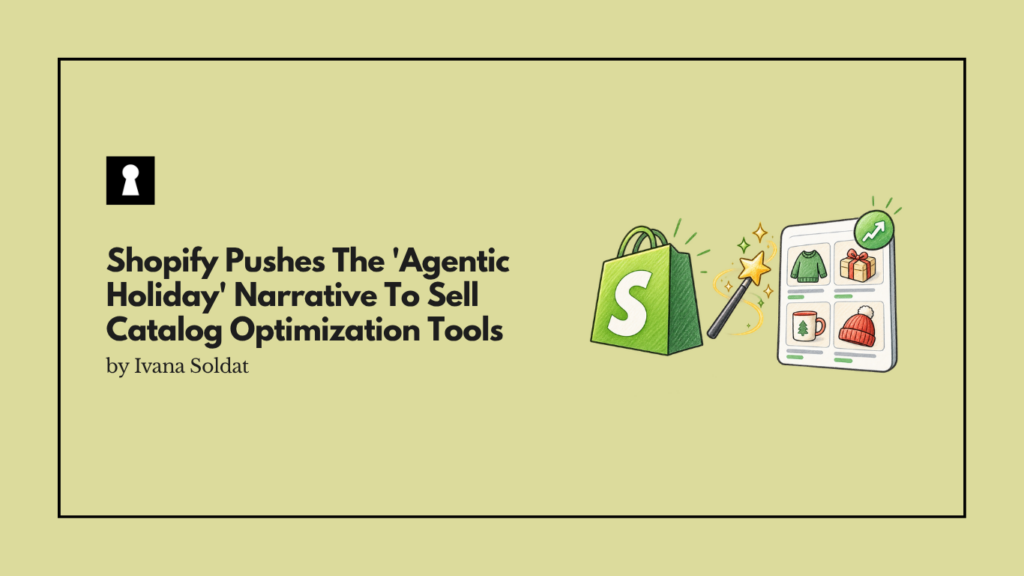
Shopify’s underlying message is that being “agentic-ready” requires a fundamental overhaul of how a brand presents itself online. The platform explicitly promotes its Shopify Catalog and Agentic Storefronts as the necessary foundation for this new era.
Brands like Stanley 1913, which reportedly saw five times as many AI-referred orders in the U.S. compared to the previous year, achieved this by expanding their optimization efforts beyond their own websites to include PR, social media, and data analytics.
This creates a new “legibility tax.” Merchants can no longer just optimize for human readers; they must meticulously structure their product data, brand narratives, and value propositions so that machine learning models can easily parse, trust, and recommend them.
Value Over Discounts In The Age Of Algorithmic Comparison
As AI agents become adept at instant price comparison, the reflexive merchant response of deep, race-to-the-bottom discounting becomes increasingly dangerous. Shopify highlights Material Kitchen, a culinary brand that focuses on value and purpose rather than just slashing prices.
The platform’s research indicates that 35 percent of shoppers choose products that are the best possible version for their needs, even if they are not the cheapest option.
To win in an agentic environment, brands must ensure that their unique value propositions – such as ethical sourcing, superior materials, or charitable partnerships – are clearly documented in machine-readable formats across the web, giving the AI agent a compelling reason to recommend them over a cheaper alternative.
Our Take
Algorithmic Discovery is a New, Highly Technical Layer of it
Shopify’s “agentic holiday” campaign is a masterful piece of vendor marketing designed to create urgency around a technology that is still in its infancy. While the 276 percent growth in AI-referred sales for niche brands is impressive, it represents a tiny fraction of overall ecommerce volume. Merchants should absolutely ensure their product data is clean, structured, and accessible to AI crawlers.
However, they must not fall for the trap of believing that feeding their catalog into Shopify’s proprietary agentic tools is a magic bullet for holiday sales.
If your brand’s value proposition cannot be clearly articulated to a human being, no amount of algorithmic optimization will convince an AI agent to recommend it.