
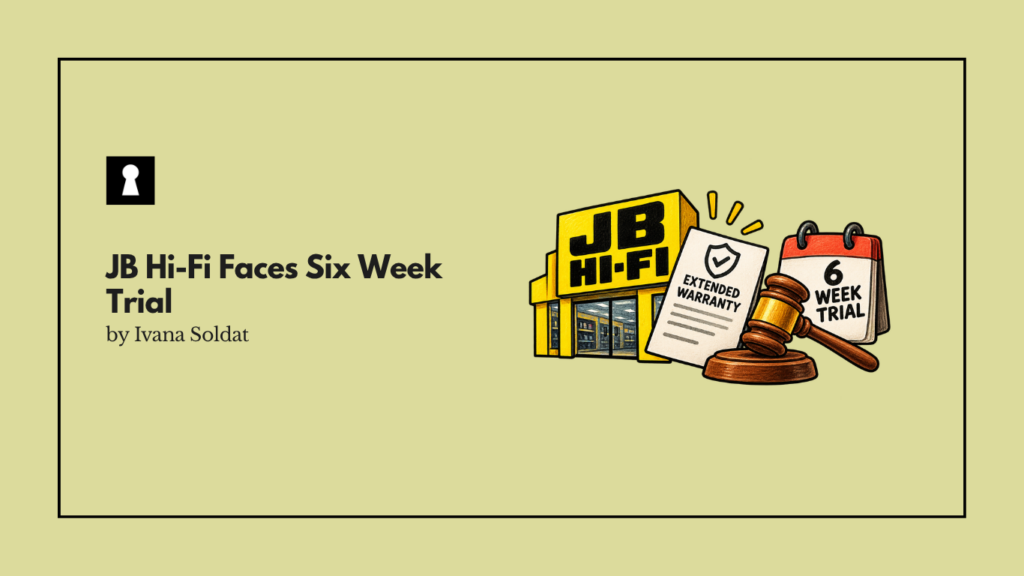
The retail electronics sector has long relied on extended warranties as a high-margin revenue stream. However, a landmark class action trial that began on October 5, 2026 in the Supreme Court of Victoria is challenging the fundamental value proposition of these add-ons.
The proceedings cover extended warranties sold both in-store and online between January 1, 2011, and December 8, 2023. Claimants argue that customers were charged for protection that provided little to no additional value beyond the statutory rights they already possessed under Australian consumer law.
JB Hi-Fi has firmly denied the substance of these claims, with its formal defence filed on August 31, 2026.
The Statutory Rights Baseline Versus Paid Add Ons
The core of the dispute rests on consumer comprehension. The Australian Competition and Consumer Commission (ACCC) explicitly states that basic consumer rights, such as guarantees of acceptable quality and fitness for purpose, arise automatically and cannot be overridden or removed by an additional warranty.
The initial phase of this trial focuses on three representative cases: a refrigerator and warranty purchased in-store in 2020, a television and warranty bought online in 2023, and a laptop and warranty purchased in-store in 2016.
The commercial question for retailers is straightforward: what specific uncertainty does a paid plan resolve once the customer fully understands their ordinary, legally mandated rights?
For a paid warranty to be ethically and commercially sound, it must offer verifiable actions – such as guaranteed diagnostic deadlines, free transport for bulky items, or expedited replacement services – that clearly exceed the baseline statutory obligations. Selling a vague promise of “peace of mind” without defining these tangible benefits creates a dangerous gap between customer expectation and actual service delivery.
The Omnichannel Consistency Challenge
For large omnichannel retailers, ensuring clarity across every customer touchpoint is a massive operational hurdle. The terms of an extended warranty must be perfectly aligned across the digital product page, the online checkout process, the in-store conversation with a sales adviser, and the final order confirmation.
The mere existence of a lengthy, legally dense terms and conditions document does not prove that a consumer understood the critical difference between their mandatory statutory rights and the optional paid support they were purchasing. Retailers that rely on high-pressure sales tactics or ambiguous scripting to drive warranty attachment rates are building a fragile revenue model.
A more sustainable approach requires testing customer comprehension through clear, post-purchase confirmations rather than treating informed consent as a mere box-ticking exercise.
The Commercial Trade Off: Attachment Rates Versus Brand Trust
Selling an additional service inherently creates a potential conflict between immediate revenue generation and long-term brand trust. If a customer experiences a product breakdown and only then discovers that the expensive warranty they purchased offers no meaningful advantage over a standard manufacturer claim, the retailer risks permanently damaging that relationship.
Warranty attachment rate is a commonly tracked sales metric, but without equally rigorous tracking of claim fulfillment rates, resolution times, and customer satisfaction post-claim, it can incentivize staff to prioritize short-term commissions over honest customer advice. Public information does not currently permit a full calculation of the financial impact of this lawsuit on JB Hi-Fi, but the reputational risk of being perceived as selling redundant protections is substantial.
Our Take
JB Hi-Fi’s Warranty Problem Is an Industry Problem
The JB Hi-Fi warranty trial is a wake-up call for the entire consumer electronics retail sector. Extended warranties are not inherently predatory, but they must be designed and sold with absolute transparency.
Retailers must clearly distinguish between automatic consumer rights and the specific, tangible benefits of a paid plan. If a warranty cannot be justified by verifiable, value-added services that go beyond the legal baseline, it should not be sold.
Companies that continue to rely on consumer confusion to drive attachment rates will eventually face the dual penalties of regulatory action and irreversible brand erosion.