
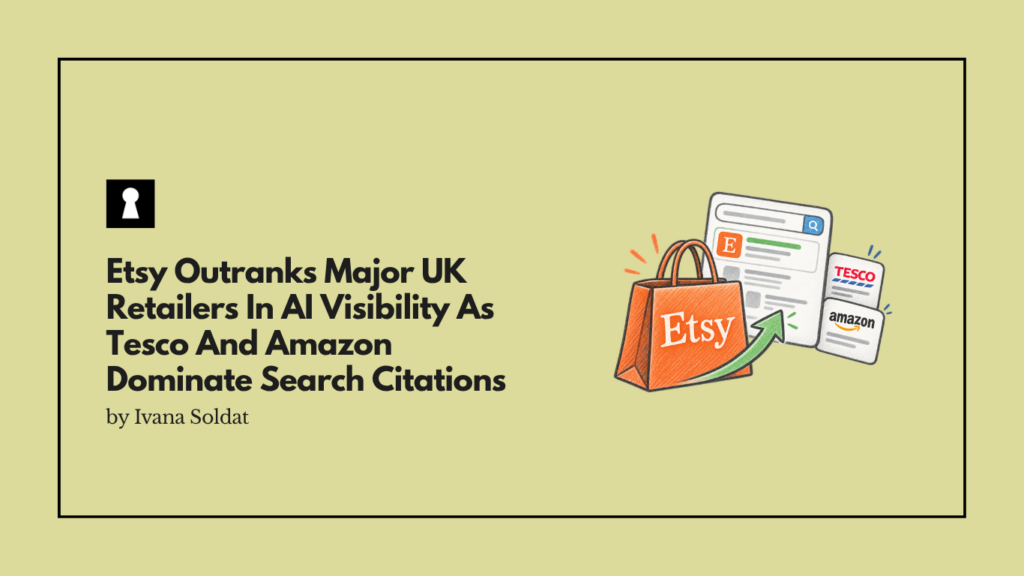
According to the H2 2026 edition of the Semrush AI Visibility Index, Amazon was the retail brand mentioned most frequently in AI-generated answers over the year leading up to September. However, on Google’s Gemini platform, Tesco prevailed as the most cited retailer.
Most strikingly, the data reveals that Etsy is more visible on AI than all UK-owned retailers bar Tesco. This demonstrates that platforms with highly structured, unique, and review-rich product data are naturally favored by large language models over traditional, monolithic retail catalogs.
The Stark Disparity In Citation Rankings
The gap between optimized platforms and legacy UK retailers is staggering. While Tesco secured a respectable 25th place in ChatGPT citations, major competitors like Asda ranked a dismal 606th.
This massive disparity highlights that simply having high web traffic or strong brand recognition in the physical world does not automatically translate to visibility in AI search. Generative engines prioritize domains that consistently provide direct, structured, and easily citable answers to specific user queries, a format that marketplace models like Etsy inherently support through user-generated reviews and detailed artisan descriptions.
Why Marketplaces Win The AI Attribution Game
Etsy’s high visibility is not an accident; it is a byproduct of its marketplace architecture.
Millions of unique, long-tail products paired with authentic buyer reviews create a dense web of natural language that AI models easily parse and recommend.
In contrast, traditional retailers often rely on standardized, manufacturer-provided product descriptions that blend together across the web, making it difficult for AI to distinguish one retailer’s offering from another’s. When an AI assistant is asked for unique handmade gifts, the structured, review-backed data of a marketplace is a far more reliable source than a generic big-box retailer’s inventory.
The Urgent Need For Generative Engine Optimization
The fact that a major UK supermarket chain ranks 606th in AI citations is a glaring warning sign for the industry. As consumer behavior shifts from traditional keyword search to conversational AI queries, retailers that fail to adapt their content strategies will become invisible.
Generative Engine Optimization (GEO) requires brands to restructure their product data, invest in authoritative content, and ensure their domain is recognized as a trusted source by AI models. Waiting for AI search to mature before acting is a strategy for obsolescence.
Our Take
Algorithmic Invisibility is the New Market Share Loss
The Semrush AI Visibility Index is a wake-up call for traditional retail. The fact that Etsy outranks nearly every major UK-owned retailer in AI citations proves that the rules of digital discovery have fundamentally changed.
Legacy brands can no longer rely on domain authority built over decades of traditional SEO. If your product data is generic, your reviews are sparse, and your content is not structured for machine readability, you are effectively invisible to the next generation of shoppers.
Retailers must treat AI visibility not as a niche marketing experiment, but as a core pillar of their digital survival strategy.