
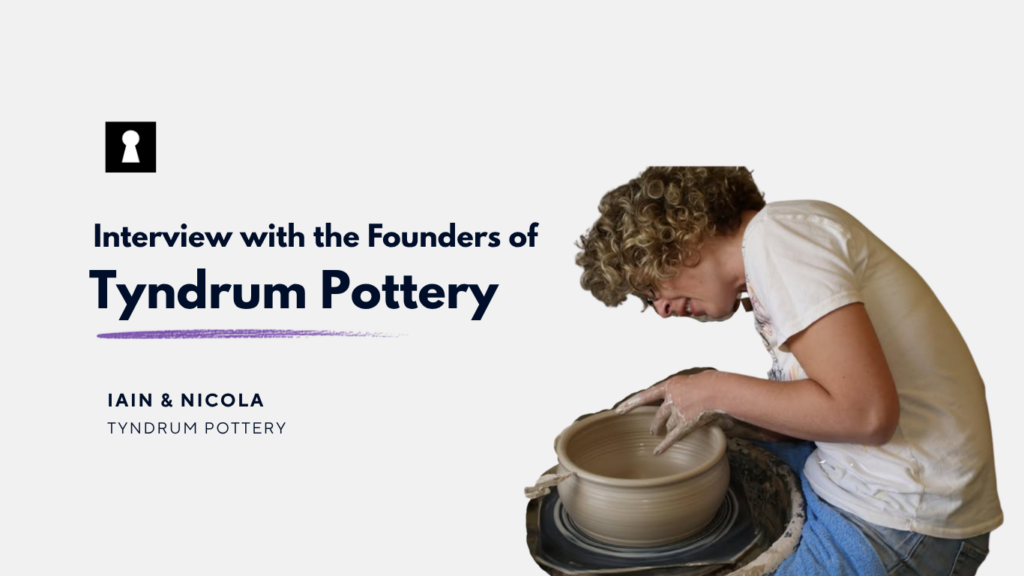
Today I sat down with Nicola & Iain behind Tyndrum Pottery, a family-run ceramics studio in the Scottish Highlands.
Nicola and her husband cashed in their savings and sold their properties to build a life around pottery, teaching and their twins, Penny and Charlie.
What started as a shared dream has grown into a business that pans its own gold from Highland rivers, mixes decades of ceramic knowledge with an engineering background, and sells everything from everyday mugs to gold lustre pieces, alongside workshops, festivals and a destination pottery under construction in Glen Lochy.
A Dream Before It Was a Business
Ivana: What was the original idea behind Tyndrum Pottery?
Nicola (Founder of Tyndrum Pottery): The original idea was never simply to start a pottery business. It began with a dream of creating a different way of life. Nicola had always wanted to build a pottery where she could create, teach and share her passion for ceramics. After our twins were born, we found ourselves thinking much more about the kind of life we wanted to build as a family, and the Highlands offered that opportunity.
We cashed in our savings and sold our properties to make it happen. We didn’t begin with a detailed blueprint, we began with a shared set of values, to create beautiful ceramics, live closer to nature and build something our family could be proud of.
One Income Stream Was Never Going to Be Enough
Ivana: Why build several revenue streams instead of staying a local studio?
Nicola: We knew we wouldn’t have enough to build everything we envisioned, so we had to think carefully about how the pottery could become a sustainable business rather than simply a studio. Online sales, workshops, festivals and demonstrations all became part of the picture, each supporting the others.
The business plan was rewritten several times as we learned more about ourselves, our customers and what Tyndrum Pottery could become. Rather than forcing the business to fit an original plan, we let the plan evolve around what we discovered.
Growth Without Losing the Human Element
Ivana: Handmade products are hard to scale. How do you think about growth?
Nicola: We’ve never measured growth by how many pots we can produce. Growth is about building a stronger business while protecting the quality of the work. We rely on a mix of online sales, workshops, festivals and demonstrations, so no single stream carries the pressure of mass production.
Where we do embrace efficiency is behind the scenes, improving processes without changing the finished piece. We have no interest in automating the creative parts. Every glaze and every firing still carries the small variations that make handmade ceramics special. Those aren’t imperfections to eliminate, they’re part of what people are buying.
Selling Something People Can’t Touch
Ivana: What’s been the hardest part of selling ceramics online?
Nicola:Pottery is an incredibly tactile experience. At a market, someone picks up a mug, feels its weight, runs their fingers over the glaze. Online, you lose all of that, so photography, honest descriptions and the story behind the work have to do that job instead.
Perhaps the biggest lesson has been that people don’t just buy products online, they buy confidence. They want to know who made the piece, where it came from, and that it will arrive exactly as described. Building that trust takes time, consistency and openness.
The Mistake of Waiting for a Finished Plan
Ivana: What’s one mistake other founders could learn from?
Nicola:Thinking we had to have everything figured out before moving forward. We spent a lot of time trying to write the perfect business plan and predict exactly what Tyndrum Pottery would become. That simply wasn’t possible. A business plan shouldn’t be a fixed set of instructions, it’s a living document that evolves as you learn.
We also learned not to wait until something feels finished before sharing it. People genuinely enjoy seeing the process unfold, including the failures. Don’t chase perfection, chase progress.
What’s Next for Tyndrum Pottery
Ivana: What’s next?
Nicola: Our biggest focus is completing our new pottery in Glen Lochy, the destination we’ve been working towards for years. Alongside that, we’ll keep developing new products using local materials, including a range of whisky cups we’re calling Drampots, still in development because that’s how we work.
But if there’s one thing we’ve learned, it’s that the business has to support our family, never the other way around. If, years from now, we’ve built a pottery we’re proud of and given our children a wonderful childhood along the way, we’ll consider Tyndrum Pottery a success.
Conclusion
What stands out from talking to Nicola and her husband is how little they’ve rushed, and how much of the business exists specifically because it wasn’t rushed. A gold lustre process built on years of failed tests. A sustainable studio designed around how they actually work. A business plan rewritten as many times as it needed to be.
Tyndrum Pottery sells mugs, bowls and gold-flecked pieces, but the deeper product is patience, a business built at the pace of the landscape it comes from.
Thank you to the Tyndrum Pottery family for sharing their story with us.
You can find out more about Tyndrum Pottery at tyndrumpottery.com or at:
https://www.tiktok.com/@tyndrumpottery
https://www.instagram.com/tyndrumpottery
https://www.facebook.com/tyndrumpottery
If you’re building an ecommerce brand and want more stories like this one, subscribe to EcomWatch newsletter for weekly reporting and founder interviews from across the industry.