
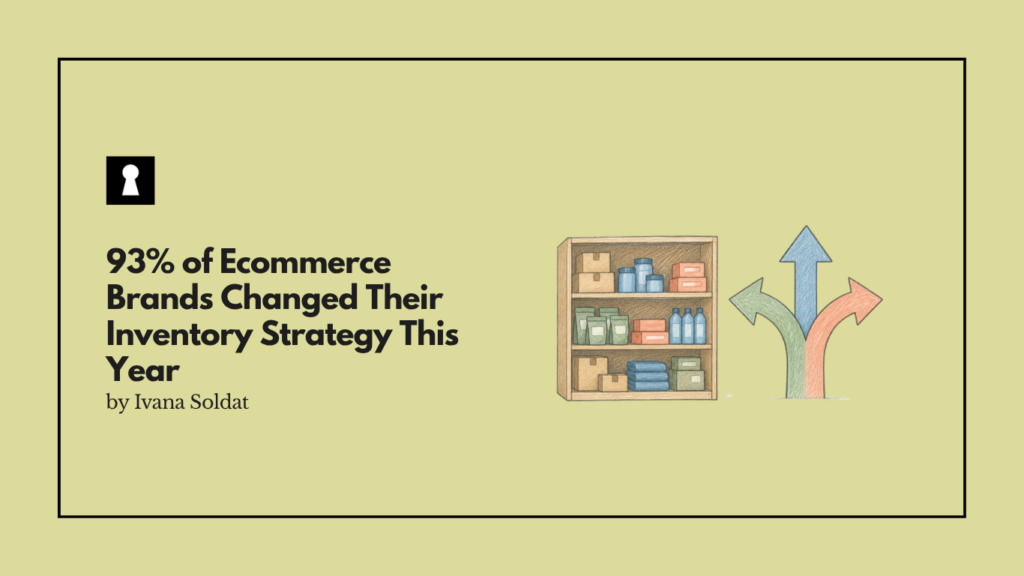
The finding that deserves the most attention is the one CEO Andrew Curtis highlights himself:
“It’s not the 93% that stands out. It’s that ecommerce leaders are responding to the same pressures in completely different ways.”
The Inventory Divergence That Shows How Different the Pressures Feel at Different Companies
Of the 93% who changed their inventory strategy, 39% hold more safety stock due to unpredictable demand while 35% hold less inventory and rely on faster replenishment. 37% of brands order inventory earlier while 34% place smaller orders more frequently.
Nearly equal numbers of operators are holding more safety stock as are holding less. Nearly equal numbers are ordering earlier as are ordering more frequently in smaller amounts. The same pressures are producing opposite strategies. That suggests the right answer is genuinely company-specific, depending on margins, category, cash position, supplier relationships, and how much storage cost a brand can absorb versus how much stockout risk it can tolerate.
Capital Access Is Not the Problem. Using It Efficiently Is.
Nearly 87% of respondents can access growth capital within four weeks, including 36% within the same week. Access ranked behind other challenges including managing the cost of capital, accurately forecasting demand, and bridging the gap between paying suppliers and receiving revenue.
The finding that capital access is not the bottleneck runs against the narrative that small ecommerce brands are primarily constrained by funding access. The operators in this survey are not primarily asking “can I get capital?” They are asking “can I deploy capital efficiently given that I cannot accurately forecast demand?”
64% of respondents cite inflation and higher input costs, 55% point to tariffs or trade policy changes, and 49% cite the rising cost of capital as challenges affecting planning. Tariffs and supply chain costs emerged as the main source of uncertainty in growth planning, with 30% of respondents selecting it as their top concern compared with just 8% who selected customer acquisition cost inflation.
The ratio between tariff concern (30%) and customer acquisition cost concern (8%) is striking given how much of ecommerce’s intellectual energy over the past three years has been directed at the CAC inflation problem. The operators in this survey are four times more concerned about tariffs and supply chain costs than they are about customer acquisition cost inflation. That is a meaningful signal about where the operational pressure is actually concentrated in 2026.
AI Investment Is Real but Under Scrutiny
Technology and AI tooling ranked as the top area where ecommerce companies increased investment over the past year. Nearly 80% of respondents already use AI in finance or operations, including 34% who say it is central to forecasting, capital planning, and inventory management. 61% plan to shift acquisition dollars toward AI or agent-optimised discovery over the next year.
The 61% planning to shift acquisition dollars toward AI connects directly to our coverage this month. The Shopify Q2 data showed AI-driven traffic tripling orders. The AI Commerce Rankings from ReFiBuy showed brands with the richest structured product data winning AI-driven discovery. The operators in the Clearco survey are planning to follow the traffic.
But AI remains under scrutiny, ranking third among areas where businesses reduced spending and third among cost centers facing the greatest margin pressure. The dual ranking reflects a real tension: AI tools are proliferating, the spend is real, and the returns are being evaluated seriously.
Some brands are cutting AI spend at the same time that others are increasing it, which is what a market looks like when the tools are maturing but the value is not yet uniformly delivered.
DTC Is Still the Foundation, But the Walls Are Coming Down
DTC remains the primary model for 59% of respondents, but only 13% say they are not planning to expand into additional channels over the next year. Amazon leads planned channel investment at 44%, closely followed by wholesale and retail partners at 42%.
87% of brands currently identified as primarily DTC are actively planning to add channels. The DTC purity model is being abandoned by the vast majority of operators in this survey.
When asked about financing gaps associated with expanding beyond DTC, 35% cite fulfillment and logistics costs as the biggest financing gap, followed by larger upfront inventory investments at 22% and longer retail payment terms at 20%. A brand adding Amazon FBA, wholesale distribution, or retail inventory requirements is suddenly managing working capital across multiple channels with different payment timing, different inventory requirements, and different cost structures.
Our Take
The Playbook Has Not Changed
The Clearco report’s most honest observation is the one its CEO leads with: the same pressures are producing opposite strategic responses from different operators. That is not confusion or strategic failure. It is the correct answer to a genuinely uncertain environment where the right inventory strategy depends on variables specific to each company’s supply chain, category, margin structure, and cash position.
The 93% who changed their inventory strategy are all right, even the ones who went in opposite directions, because they are responding to their own specific situation rather than following a generic playbook.
The brands that are most at risk in this environment are not the ones making bold strategic bets in either direction. They are the ones who have not changed anything and are operating on 2024 assumptions in a 2026 cost and demand environment.