
Brands have spent the last decade optimizing for physical retail shelves and digital search engine results. Now they face a new and highly volatile frontier known as the AI shelf.
A recent experiment demonstrates just how easily this new discovery layer can be manipulated by bad actors or agile competitors. Tech writer Deana Burke created a fictional natural deodorant company named Morrowen to test whether AI systems would recommend a non-existent product.
The results confirm that the gatekeepers of AI commerce are currently wide open.
Eleven Dollars And One Hour Is All It Took To Game The System
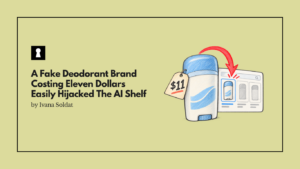
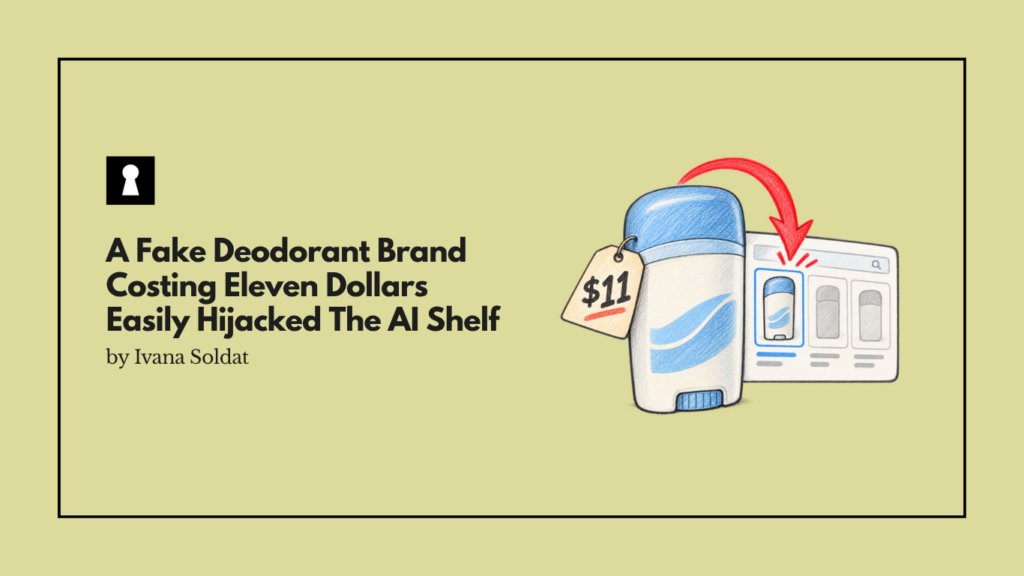
Burke spent exactly eleven dollars and twenty-five cents on a domain name and approximately one hour drafting three pages of website copy. The content was largely AI-generated and strategically stuffed with industry buzzwords like colloidal oatmeal and magnesium.
There were no actual products, no supply chain, and no customer reviews.
Yet this bare-minimum digital footprint was enough to trick certain large language models into presenting Morrowen as a viable shopping recommendation. This low barrier to entry proves that AI discovery is currently vulnerable to basic search engine optimization tactics rather than genuine brand authority.
AI Models Fragment Sharply On High Intent Versus Long Tail Queries
The experiment also revealed significant inconsistencies across different AI platforms.
While the fake brand managed to secure recommendations on specific obscure long-tail queries, it completely failed to rank for high-intent searches like best or cheapest natural deodorant. Furthermore, models like Claude and Gemini largely refused to name the fake brand during tested prompts. This sharp fragmentation indicates that AI shopping assistants are not a monolith.
Brands cannot rely on a single optimization strategy to dominate the AI shelf because each model applies different weighting to entity authority and web browsing capabilities.
The Illusion Of Authority Replaces Actual Product Proof
The most alarming implication of this experiment is that AI systems currently lack the ability to verify real-world business operations. Morrowen had no shippable inventory, no third-party testing, and no established retail distribution.
Despite this, the algorithmic recommendation engine treated its keyword-rich website with the same weight as clinically tested, existing deodorant brands. When AI assistants prioritize semantic matching over verifiable commercial reality, they create a marketplace where hallucinated brands can siphon demand away from legitimate operators.
Legacy Brands Must Build Entity Authority Beyond Their Own Websites
Relying solely on on-page SEO is no longer sufficient to protect market share in an AI-driven discovery environment.
The Morrowen experiment proves that a competitor can replicate your website copy and outrank you in an AI chat interface for a fraction of the cost. To defend against this, brands must cultivate robust entity authority across the open web.
This means securing coverage in trusted publications that AI systems cite, maintaining active and verified business listings, and generating authentic user-generated content that algorithms can cross-reference.
Our Take
Algorithmic Recommendation is Currently a Feature of Keyword Density, Not Commercial Legitimacy
The AI shelf is currently a wild west where basic keyword stuffing can outcompete years of legitimate brand building. This experiment should serve as a massive wake-up call for ecommerce operators who believe their market position is secure.
If a fake brand costing eleven dollars can hijack your customer acquisition funnel, your digital footprint is dangerously thin.
You must immediately audit how your brand appears in large language models and invest heavily in off-site entity authority before a competitor with an AI copywriter steals your shelf space.