
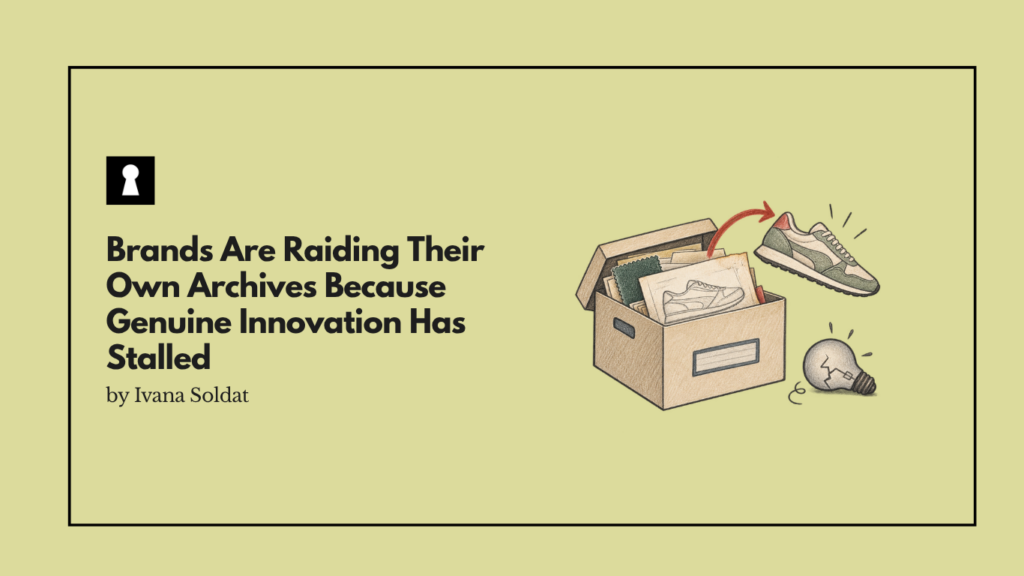
Re-releasing old products is a financial no-brainer. The research and development costs are effectively zero, the manufacturing tooling already exists, and the marketing narrative writes itself. Vera Bradley, for instance, recently launched its Remix Collection, featuring the Original 100 Handbag and Original Duffel in archived preppy prints.
More strikingly, a bespoke collection of just 50 Original 100 handbags featuring archival rose and rodeo motifs sold out in under three minutes, driven almost entirely by Gen Z and new consumers. This proves that artificial scarcity applied to legacy designs is a highly effective, low-risk revenue generator.
Crocs Proves Retro Silhouettes Still Carry Cultural Weight
Crocs, a brand that launched in 2002 and is approaching its 25th anniversary, is similarly leaning into its past. The company recently relaunched the Crocband Clog, a retro, sporty silhouette that originally debuted in 2009.
According to Crocs’ leadership, this specific archival dive was chosen because its low-profile, sports-heritage aesthetic aligned perfectly with current cultural trends.
By pairing these archival revamps with collaborations like Florence by Mills and Oracle Red Bull Racing, Crocs attempts to dress up old inventory as fresh, collaborative streetwear.
The Generational Gamble Of Archival Mining
The underlying assumption driving this trend is that Gen Z actively craves the aesthetics of the early 2000s and 1980s. Vera Bradley’s chief brand officer noted that younger consumers are looking for special patterns that they cannot necessarily find anymore.
While the three-minute sell-out suggests this is working for hyper-limited drops, scaling this strategy is dangerous. Nostalgia is a finite resource.
If a brand’s primary growth lever becomes re-releasing its own history, it implicitly admits that its current design pipeline lacks the cultural resonance required to stand on its own.
Repackaging The Past Is Not A Substitute For Future Vision
Brands are also digging deeper into obscure archives to manufacture novelty, such as Vera Bradley promoting a historic “Vera Bear” icon or repurposing an old interior lining as a new holiday print called Chelsea Plaid.
While this generates short-term social media buzz and satisfies a collector mindset, it does not build long-term brand equity. It trains consumers to wait for a “vintage drop” rather than engaging with the brand’s current, full-price core assortment.
Our Take
Is Your Best Launch a Rerun?
Mining the archives is a brilliant short-term tactic for margin expansion and social media engagement, but it is a dangerous long-term brand strategy.
When legacy companies celebrate selling out of 50 vintage-style bags or a 2009 clog silhouette, they are celebrating the monetization of past glories, not the creation of future value.
True brand vitality requires designing products that define the next decade, not just repackaging the last one. If your most exciting product launch is a retrospective, your innovation engine is broken.