
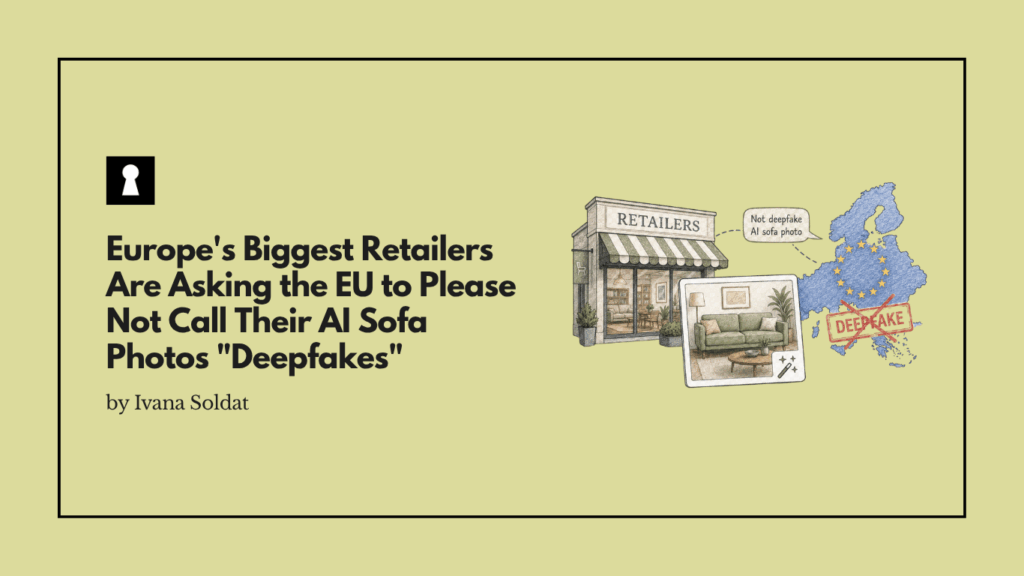
The European Union AI Act has a deepfake problem, and it has nothing to do with politicians’ faces or forged video evidence. It has to do with a sofa.
Specifically, under Article 50 of the AI Act, which becomes enforceable on August 2, 2026, any company that deploys AI to generate or substantially manipulate images, audio, or video content “constituting a deep fake” must clearly disclose that fact.
The penalties for non-compliance sit at up to €35 million or 7% of global revenue for the most serious violations, with transparency violations carrying penalties up to €15 million or 3% of global annual turnover. And the problem for Europe’s retail industry, which has spent the last two years rebuilding its entire content production pipeline around generative AI, is that a CGI render of a living room staging a sofa technically fits that definition.
Eurocommerce, the trade association whose membership roster reads like a who’s who of European and global retail, Amazon, H&M, IKEA, Inditex, and many others, sent a letter to EU tech commissioner Henna Virkkunen this week asking her to exempt AI-generated advertising from being caught under that deepfake provision. The group’s director general Christel Delberghe put it plainly: an AI-generated product image not intended to mislead users shouldn’t be lumped in with the kind of synthetic content the deepfake rules were actually designed to police.
A Regulation Written for Disinformation That Now Applies to Furniture Catalogues
The core tension here is a drafting problem more than a policy one. The AI Act’s Article 50 transparency obligations require that deployers using AI to create deepfakes disclose that the content has been artificially generated or manipulated, rules built to tackle synthetic media used to deceive: fabricated video of public figures, manipulated audio in political contexts, that kind of thing.
The rules were never obviously aimed at a retailer rendering a product on a neutral background using generative AI instead of renting a photography studio. But the law as written doesn’t make that distinction, and with August 2 approaching fast, every brand that’s quietly migrated its content production to generative AI is suddenly staring at a compliance gap.
The scale of that gap is not trivial. Zalando has said its use of AI for marketing image generation cut content production costs by 90%. H&M and Zara, both Eurocommerce members, have been openly using AI-generated model clones for campaign imagery. If the disclosure requirement applies as written, a very large share of every major European retailer’s ad inventory published after August 2 would need to be labeled as AI-generated content.
Eurocommerce’s letter argued that applying the rule that broadly would dilute the value of the disclosure itself, if every product photo on the internet carries a label, the label stops meaning anything.
Six Weeks, No Guidance, and a Very Expensive Deadline
What makes this particularly uncomfortable is the timing. The European Commission published draft guidelines on Article 50’s scope, and a Code of Practice on AI-generated content is being developed, with a final version expected ahead of the August 2026 deadline.
Retailers are being asked to achieve compliance with a rule whose practical scope hasn’t been definitively clarified by the regulator, in a window short enough that any last-minute guidance would land with almost no runway to implement. The Commission didn’t respond to Reuters’ request for comment on Eurocommerce’s letter.
Our Take
The Lobby Isn’t Wrong, But It Probably Shouldn’t Have Waited Until Six Weeks Out To Say So
Eurocommerce’s underlying argument is reasonable, there is a genuine and meaningful difference between a deepfake designed to deceive and an AI render of a kitchen splashback, and a regulation that treats both identically is a badly scoped one.
But the industry now asking for a carve-out is the same industry that spent two years aggressively adopting generative AI for content production while quietly hoping the regulatory definition would never land on their doorstep. It did.
And the ask to the Commission is essentially: we built our entire content pipeline on this technology, please don’t make us tell anyone. The EU probably should fix the definition. But retailers don’t get to be surprised it came to this.