
For years, the business model of platforms like Temu, Shein, and AliExpress was built on a very specific tax quirk: packages valued under €150 arriving in Europe faced no customs duty at all. That gap, the so-called de minimis exemption, kept prices jaw-droppingly low, let Chinese logistics networks flood European letterboxes, and quietly drove a category of shopping that European retailers and tax authorities have been complaining about ever since. July 1 is when the gap closes, and the closing is messier than anyone planned.
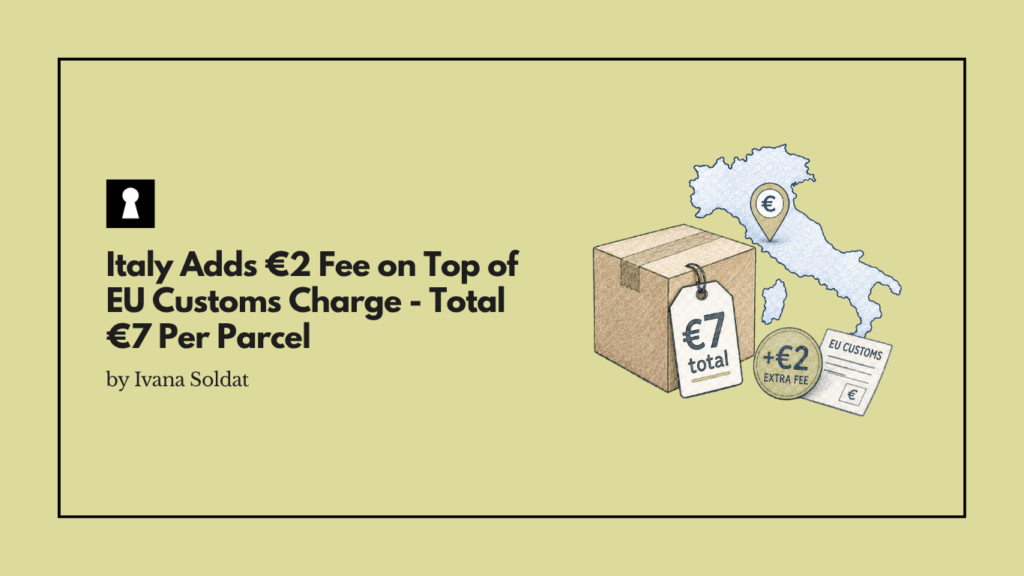
Two separate charges land on the same day. The first is Italy-specific: a new €2 handling contribution on every incoming parcel valued under €150, introduced through the most recent Italian Budget Law and designed to cover the administrative costs the Agenzia delle Dogane incurs processing all that low-value cross-border volume.
The second is EU-wide: the formal end of the de minimis customs exemption, replaced by a flat €3 duty on those same sub-€150 packages. The two were not coordinated. They just happen to collide on the same calendar date.
Then, on November 1, a third charge arrives, a EU management commission, currently pegged at roughly €2, which would bring the cumulative per-parcel tax burden to around €7 on goods that might cost €6 to begin with.
When the Tax Costs More Than the Thing You Bought
The arithmetic here is the problem. A €7 fixed charge applied to a €10 order is a 70% tax rate. Applied to a €6 order, it exceeds the value of the product entirely.
Netcomm, Italy’s main e-commerce industry body, is already pushing back hard, with its president Roberto Liscia publicly calling the €7 figure disproportionate relative to the value of goods it targets. Netcomm has been joined by Federlogistica and Federdistribuzione in calling for a suspension of the measures, with concerns centered on competitive damage to the Italian market, harm to logistics operators, and the straightforward consumer math of paying more in taxes than in product cost.
The industry’s fear isn’t abstract. It has a recent, concrete datapoint to point at: France. When Paris implemented a similar charge structure in March 2026, the reported result was that 90% of parcels subject to the new fees stopped routing through French customs altogether, rerouted through other European entry points, reclassified, or simply restructured by the platforms to avoid the tax trigger.
The lesson France accidentally provided is that if the tax is high enough relative to parcel value, the platforms don’t absorb it and consumers don’t pay it, the packages just go somewhere else, and the revenue the tax was supposed to generate doesn’t materialize anyway.
The Platforms Are Not Going to Just Eat This
The assumption baked into both the Italian and EU-level measures seems to be that Temu and Shein will shoulder the cost or pass it on to consumers and accept lower volumes. That assumption is probably wrong.
These are platforms that spent years engineering supply chains, logistics networks, and pricing models specifically to exploit the de minimis gap, they have both the infrastructure and the incentive to route around a fixed per-parcel charge, especially when the alternative is watching a €7 tax turn a €9 impulse buy into a €16 one that nobody clicks on.
What’s more likely: a period of rerouting and reclassification chaos, price increases on the lower end of the catalog where the tax becomes genuinely prohibitive, and a wave of compliance complexity for the smaller European e-commerce operators who can’t restructure their logistics on short notice the way the Chinese mega-platforms can.
Two Weeks Away, No Suspension in Sight
With July 1 ten days out, there’s no sign the measures will be paused. Netcomm is asking, the logistics federations are asking, and the concerns about France’s experience are documented and public, but the Italian government introduced the €2 fee via Budget Law as a revenue and cost-recovery mechanism, and the EU-level de minimis reform has been years in the making and politically backed across member states as a competitive fairness measure for European retailers.
Our Take
Nobody Banned Temu. They Just Made a €6 Order Cost €13.
The policy intent here is defensible, the de minimis loophole genuinely distorted competition and let a category of cross-border retail operate tax-free in ways domestic retailers never could.
But the execution is a textbook example of what happens when a national measure and a supranational one land simultaneously without coordination, stacking charges that individually might be bearable but together exceed the value of the cheapest products they apply to.
European regulators didn’t set out to ban cheap Chinese e-commerce, but between the €7 tax stack, the DSA compliance requirements, and ongoing EU tariff proceedings, they’ve built something that adds up to the same thing, and they’re going to be very surprised when the parcels just show up in Rotterdam instead.