
Somewhere in Shandong province in April, a seller named Mr. Feng packed five pounds of tomatoes and shipped them for ¥29.8 (roughly $4 / €3.75), postage included. The next day, his buyer received the order.
That evening, the buyer sent two photos claiming that four of the eight tomatoes were rotten, and demanded a full refund on all eight, keeping all the fruit. When Mr. Feng asked the buyer to photograph the damaged tomatoes next to the delivery slip, standard procedure for any legitimate quality claim, the buyer refused and started hurling abuse at his customer service. He never agreed to the refund. The platform issued it anyway.
This is the story CCTV’s Weekly Quality Report chose to open with on June 21, in an investigation into China’s metastasising malicious returns problem. It’s a good choice of opening, because it’s almost comically small-stakes, ¥29.8 (roughly $4 / €3.75) eight tomatoes, and yet it captures everything wrong with how “refund-only” has evolved from a consumer protection tool into a systematic extraction mechanism.
From Consumer Protection to a Fraud-as-a-Service Industry
The investigation found fresh produce to be the worst-hit category, and the logic isn’t complicated. High-value, perishable items like durians are perfect targets: they’re easily consumed before any dispute is filed, damage is inherently subjective, and the evidence is conveniently digestible.
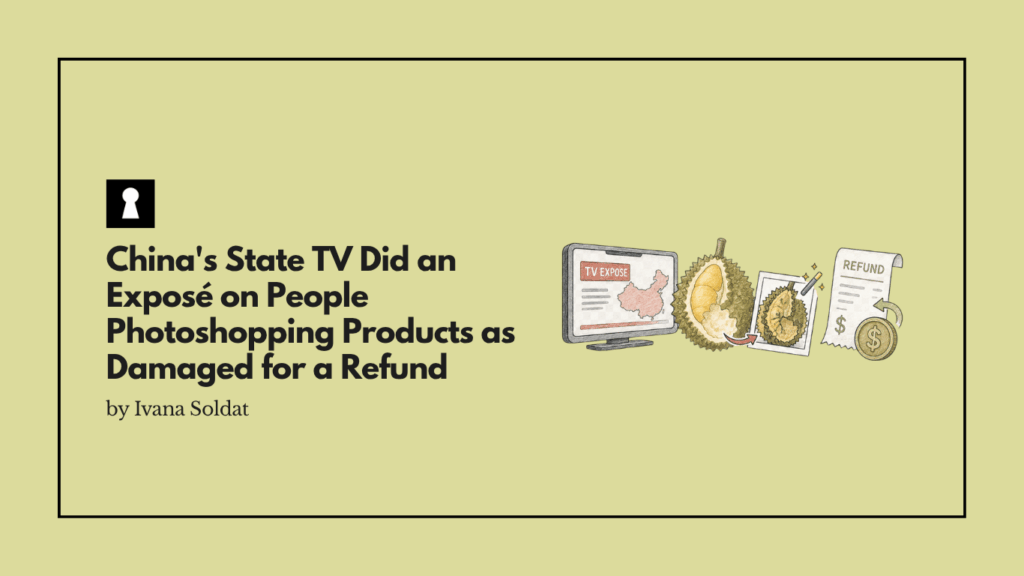
According to the CCTV report, some buyers have been eating the product entirely, then downloading images from the internet and using photo-editing software to fabricate damage or spoilage evidence before filing a refund-only claim. Platforms, operating on automated dispute resolution systems, process the refund without ever verifying that the original product exists in the state being claimed.
Wang Lei, executive chairman of the Puyang City E-Commerce Association in Henan Province, told the programme that the city has more than 200,000 e-commerce operators, most of them selling agricultural and fresh goods. When these small and medium sellers face small-value fraud claims, professional “wool-pulling” (the Chinese internet term for systematic policy exploitation), and fabricated negative reviews, the calculation is almost always the same: fighting back costs more in time, money, and platform standing than absorbing the loss. So they absorb it.
The investigation also highlighted a case where a seller shipped a branded charger and received back a bag of sand, and another where a merchant drove 1,600 kilometres across provincial lines to pursue legal redress over a ¥190 durian claim. The fact that a cross-province legal battle over a single durian is a rational economic decision tells you something about how badly the incentives have broken down.
The Platform’s Fingerprints Are All Over This
A Beijing Internet Court judge who has handled multiple cases of this type told the programme that distinguishing a legitimate complaint from a bad-faith refund claim is actually not difficult. Genuine grievances come with consistent, verifiable evidence and the actual goods available for inspection. Malicious claims tend to produce contradictory or unfalsifiable evidence, and the original product is conveniently unavailable for the court to examine.
The harder question the investigation raises is why platforms keep issuing automatic refunds when the pattern is this obvious. Experts quoted in the report were direct: the refund-only policy was never purely about consumer protection. It was a user-acquisition weapon. Platforms compete for buyers, for traffic, for transaction volume, and a platform with a more generous refund policy attracts more consumers than one that makes them argue their case. The merchants funding that generosity had no say in the arrangement and, until recently, no legal recourse.
Our Take
The West Is One Policy Decision Behind
China’s malicious returns crisis is a preview, not an exception. Refund and policy abuse just became the single biggest fraud threat in global e-commerce for the first time, displacing payment fraud, and the structural reason is identical to what CCTV just spent an episode documenting: platforms across every market have been competing on return generosity using money that belongs to their merchants, and the bill is now coming due at scale.
Amazon introduced its own version of refund-without-return for low-value items years ago, and the “refund fraud as a service” underground it spawned in China is already spreading to Western markets through the same channels. CCTV airing an exposé on this is a sign that Chinese regulators are taking it seriously. The question for every other market is what they’re waiting for.