Most tax compliance stories for ecommerce sellers follow a familiar pattern. A state tweaks its economic nexus thresholds, the compliance burden shifts slightly, sellers adjust their registration and filing. Important, practical, not especially interesting to anyone outside the affected category.
Kentucky’s House Bill 757, taking effect August 1, does contain that familiar element. But it also does something genuinely new in US state tax law, and the two changes together deserve a look that a standard compliance alert would not give them.
The Economic Nexus Change
Kentucky’s current economic nexus standard requires a business to collect and remit Kentucky sales tax if it exceeds either $100,000 in sales or 200 separate transactions in Kentucky in a calendar year. Starting August 1, the 200-transaction threshold is eliminated. Nexus will be triggered by $100,000 in Kentucky sales only.
For most established ecommerce sellers, this change is irrelevant: if you are doing more than $100,000 in Kentucky sales, you already have nexus and this changes nothing. The sellers who need to pay attention are smaller operations doing meaningful Kentucky transaction volume at lower average order values.
Consider a seller doing 250 Kentucky transactions per year at an average order value of $30. Total Kentucky sales: $7,500. Under the current standard, that seller has nexus because they exceeded the 200-transaction threshold. Under the August 1 standard, they do not, because $7,500 is well below the $100,000 revenue threshold. That is actually a simplification for many small sellers.
Kentucky joins a growing list of states that have eliminated transaction thresholds, including California, Illinois, Indiana, Iowa, Washington, and Wisconsin among others. As of April 2026, 15 states plus Puerto Rico and Washington DC still used the dual threshold model. Kentucky will no longer be among them.
The Data Brokering Tax (This One Is Different)
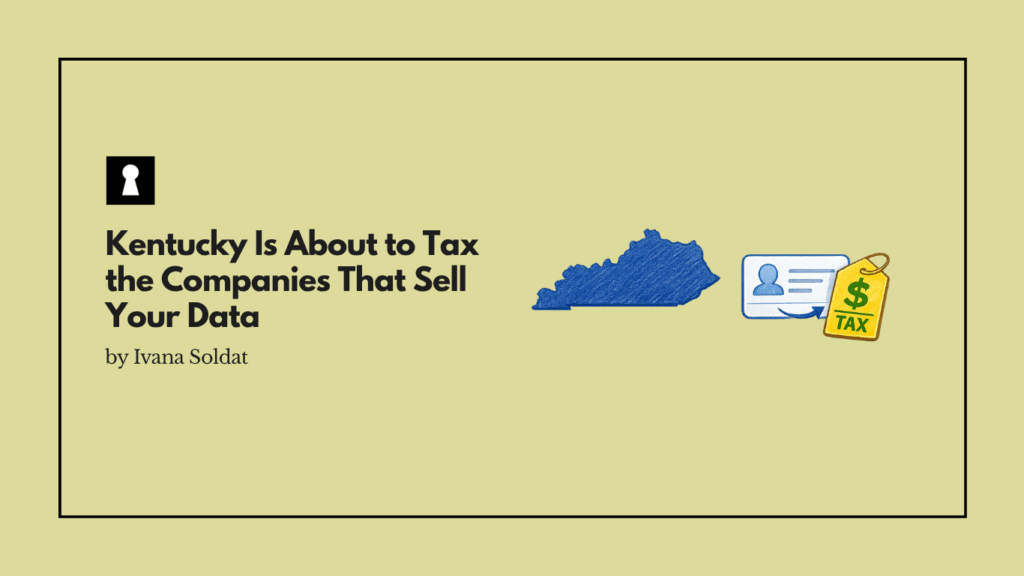
The more significant change in HB 757, from a policy perspective, is the extension of Kentucky sales and use tax to data brokering services. This is not a standard category expansion. It is a meaningful policy statement about what kind of commercial activity a state government considers taxable, and it will be watched closely by other states deciding whether to follow.
Kentucky defines data brokering services as “the act of collecting, aggregating, and analyzing personal data for sale to a third party while possession of the personal data is maintained by the person providing the data brokering services or by the third party, wherever located, regardless of whether the charge for the services provided is on a per use, per user, per license, subscription, or some other basis.”
That definition is deliberately broad. It covers the obvious cases: companies that collect consumer behavioral data and sell it to advertisers, marketing firms that aggregate and resell demographic profiles, lead generation services that collect contact data and sell it to sales teams. It also covers less obvious cases: any service that collects personal data as part of its operation and monetizes that data by providing it to third parties, regardless of how the transaction is structured.
The carve-out is notable: data brokering services provided by state and local government agencies are explicitly excluded. The tax is aimed at commercial data monetization, not at government data sharing.
The Ecommerce Data Layer Connection
The Kentucky data brokering tax is directly relevant to a set of commercial activities that sit inside the ecommerce ecosystem and are not always recognized as “data brokering” in the conventional sense.
Retail media networks, which monetize first-party customer data by making it available to advertisers, are a plausible fit for the Kentucky definition if they are handling Kentucky customer data. We have covered retail media network launches extensively this month, from Home Depot’s Orange Apron Media to The Iconic Media in Australia.
The question of whether a retail media network providing Kentucky customer targeting data to third-party advertisers falls within Kentucky’s new taxable category is one that legal teams at those networks should be asking.
Data enrichment services that append demographic or behavioral data to customer records and sell the enriched data to ecommerce companies are more clearly in scope. List brokers, intent data providers, and audience extension platforms are all categories that the Kentucky definition appears to cover.
Our Take
One State, Two Signals
The Kentucky data brokering tax is small in isolation and significant in direction. It is one of the first explicit state-level attempts to apply sales tax to the commercial collection and sale of personal data as a service category, and it arrives in the same month that New Jersey banned surveillance pricing, the EU AI Act transparency rules took effect for advertising, and the federal government is still debating whether to regulate data brokers at all.
The states are not waiting for federal consensus on data commercialization. They are creating their own frameworks, and Kentucky’s choice to tax data brokering rather than regulate it reflects a particular philosophy: make it a taxable activity rather than a prohibited one, and let the market decide whether the economics still work.
Whether that philosophy spreads to other states depends partly on how Kentucky’s implementation goes, and partly on whether the political pressure around commercial data use continues to build. Both seem likely.