

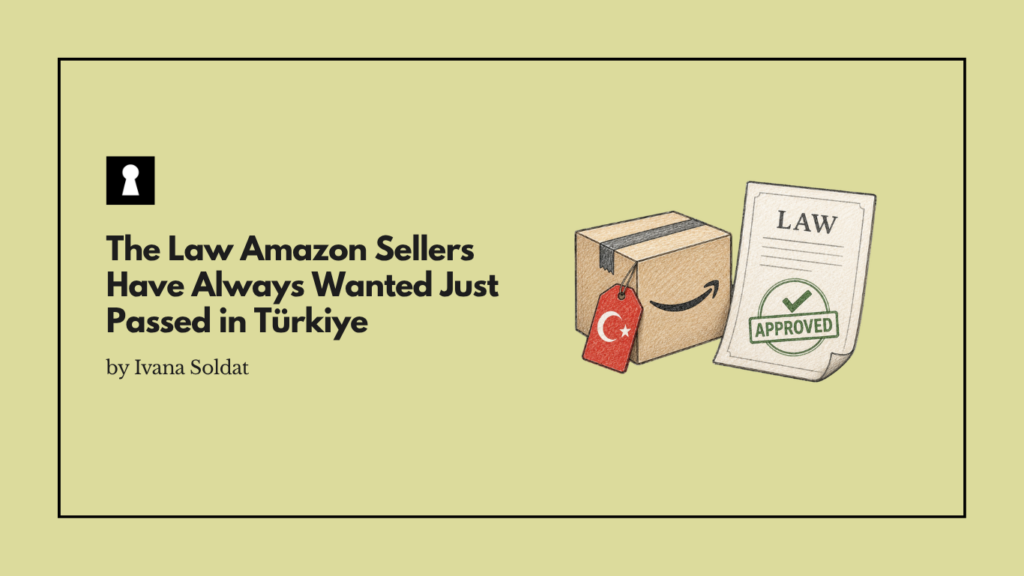
The debate about platform lock-in has been largely theoretical in most markets. Regulators have discussed it. Sellers have complained about it. The EU’s DMA has addressed it partially through interoperability requirements. But no major ecommerce market has enacted a clear, specific right for sellers to port their complete operational data, including customer reviews and questions, to a competing marketplace.
Türkiye is about to.
Türkiye’s Ministry of Trade has prepared a draft regulation introducing seller data portability as a legal right. Medium, large, and very large ecommerce marketplaces would be required to transfer sellers’ data to another platform free of charge upon request. The scope of data covered is broader than any similar proposal elsewhere: product descriptions, product images, sales and return data, customer reviews, and customer questions and answers.
The customer reviews provision is the most significant. Reviews are the moat. A seller who has accumulated five years of positive reviews on a marketplace has built an asset that is structurally tied to that platform. If they want to move to a competitor, they start with zero reviews regardless of how well they performed. The prospect of losing that review history is one of the primary reasons sellers stay on platforms they would otherwise leave. Türkiye’s draft would make those reviews portable.
Why Should You Care?
Türkiye’s ecommerce market is significant: the country has one of the highest ecommerce penetration rates in the MENA region, with platforms like Trendyol and Hepsiburada dominating domestic commerce. The regulatory context is a market where platform concentration has created exactly the kind of seller dependency that data portability is designed to address.
But the significance goes beyond Türkiye. Seller data portability is a concept that seller advocacy groups and competition regulators in the US, EU, and UK have been discussing for years without producing a concrete legislative framework. The Online Sellers’ Bill of Rights Act we covered last month in the US does not include data portability. The EU’s DMA focuses on interoperability for consumers rather than data portability for sellers.
Türkiye is drafting something nobody else has. If it works, if it measurably reduces seller lock-in without creating the operational chaos that platforms will claim it will, it becomes a template. If it creates unexpected problems, it becomes a cautionary tale. Either outcome is useful for the global policy conversation.
The Shipment Compensation Provision
The draft also introduces clearer responsibilities for losses and damage occurring during delivery and returns. Ecommerce marketplaces acting as intermediaries between sellers and courier companies would be required to clearly define compensation mechanisms in their contracts. Platforms that fail to comply could have their practices classified as unfair commercial practices.
This is a direct response to a complaint that crosses every marketplace in every market: when a shipment is damaged or lost, the seller and the customer are often left in a loop between the marketplace and the carrier, each pointing at the other, while the seller absorbs the cost.
The Turkish draft would make the marketplace formally responsible for ensuring a compensation mechanism exists in its carrier contracts, eliminating the gap where responsibility currently falls between two parties.
This connects directly to the USPS APV coding error we covered earlier this month, where a broken verification system resulted in sellers not receiving overpayment refunds for months, with no accountability mechanism. The Turkish draft is attacking the same underlying problem, diffuse responsibility in multi-party logistics chains, through contract enforcement rather than legislative mandate.
The Search Advertising Trademark Provision
The draft includes a restriction preventing businesses from using another company’s registered trademark in search engine marketing without permission, and gives the Ministry of Trade the authority to request removal of infringing advertisements from search engines.
This targets a specific competitive practice: a competitor bidding on your brand name in Google ads, capturing traffic from searches for your products, without any commercial relationship with you. The practice is widespread and in most markets is treated as legal under search platform terms. Türkiye would make it a regulatory violation if the trademark is registered in the Ministry’s system.
Our Take
Turkey Is Writing the Seller Rights Rulebook Nobody Else Has Managed to Draft
The Türkiye ecommerce regulation draft is the most seller-forward regulatory proposal in any major market this year, and it is largely flying under the radar of Western ecommerce policy coverage. The data portability provision specifically, the right to take your reviews, your product data, and your customer Q&A to a competing platform, is the provision that every seller advocacy group in the US and EU has been asking for and no regulator has delivered.
Whether it will work as intended depends entirely on implementation: how the data transfer is formatted, how quickly platforms must respond to requests, what happens when a platform delays or obstructs, and whether the portability is genuinely useful to sellers who move or just theoretically available. The draft goes to consultation before becoming law.
The outcome is worth watching closely, because if Türkiye gets this right, it will not be Türkiye’s regulation for long.