
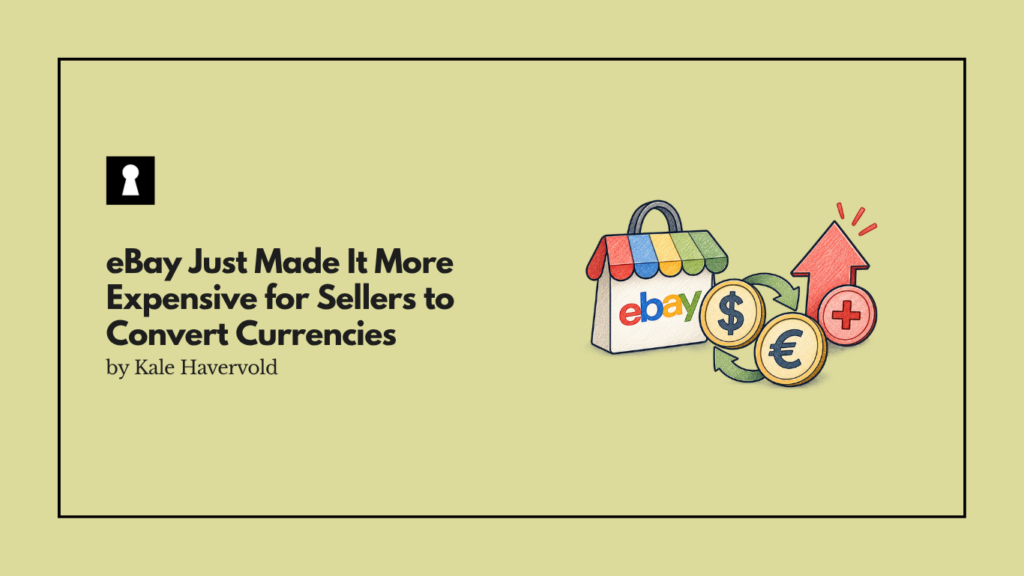
Converting currencies is about to get more expensive for many cross-border sellers around the world thanks to a 0.25% fee increase on eBay. Currency conversion fees are rising in many of the most popular markets on the platform, making things even more expensive for sellers on eBay.
Despite the change impacting millions of sellers across North America, Europe, and beyond, eBay didn’t make a community announcement or seller update about it, which is far from the first time the company has made last-minute changes and updates with little to no notice or announcements.
eBay Raises Currency Conversion Fee Across Markets
In a move that has the potential to impact millions of sellers, eBay is raising its currency conversion fees across many of its largest markets. This includes the USA, Canada, the UK, Australia, Germany, Spain, Italy, and France.
The fee increase begins on October 14th for sellers in the USA and Canada, where the fee will rise from 3% to 3.25%. On November 1st, Australia follows suit and will see its fee also go from 3% to 3.25%.
Next, on December 1st, the UK sees its currency conversion fee jump from 2.5% to 2.75%. The following day, the fee increase kicks in for Italy, Spain, Germany, and France, where it’ll go from 3% to 3.25%.
eBay hasn’t announced the reason for the increase, but it could’ve been done simply to increase revenue, or it may have been implemented to offset rising costs associated with international transactions and/or shipping.
When is The Fee Applied?
This currency conversion fee is applied whenever eBay converts your funds between different currencies. This may be when you list products internationally, in order to pay listing fees, or when sales are made internationally, to convert the funds back to your payout currency from the foreign currency your international buyer paid with.
However, it’s important to remember that this fee is different from the international fee that some sellers may have to pay when selling to another country. For reference, that international fee is 1.65% for U.S. sellers, though it doesn’t apply to eligible sales shipped through the eBay International Shipping program.
The Change Is Sure to Frustrate Sellers
While platform fee increases are needed from time to time as processing and operational costs rise, that doesn’t stop these types of changes from being unpopular among sellers. First, it makes selling internationally more expensive and can quickly reduce profit margins.
It may also lead some sellers to question selling internationally at all, which is especially tough as cross-border ecommerce is expected to grow rapidly throughout the coming years. Sellers will surely want to participate in this growth and reach more markets, but the rising costs of doing so may hold some of them back.
Some sellers may also view this change as nothing more than a cash grab by eBay, and high-volume cross-border sellers in particular are sure to be less than thrilled with the move.
But in addition to being frustrating because it makes selling internationally more expensive, the way eBay introduced the change is also likely to be unpopular. Just like when the company decided to remove Classified Ads for most categories, eBay made this currency conversion fee change without any official announcement for sellers.
While news of the fee increases has broken early enough that many sellers will be aware of them before they go into effect, it would’ve been nice to see an official announcement from the platform instead.
Our Take
Protect Your Margins In the Face of Higher Fees
This currency conversion fee increase is just one more cost contributing to the rising fee fatigue among many ecommerce sellers. As platform fees are hiked, transaction costs increase, software prices rise, and the cost of shipping continues to balloon, many ecommerce brands see their margins eroding right in front of their eyes.
To help shield your margins from these rising costs, make sure to adjust your prices as your fees and costs change, work with multiple carriers to always ensure you get a fair deal, and optimize your packaging and parcel size to ensure you’re not essentially paying to ship empty space in your packages.
Finally, consider bundling high- and low-margin items together to not just protect your overall profitability, but also clear out slow movers and boost average order value (AOV).