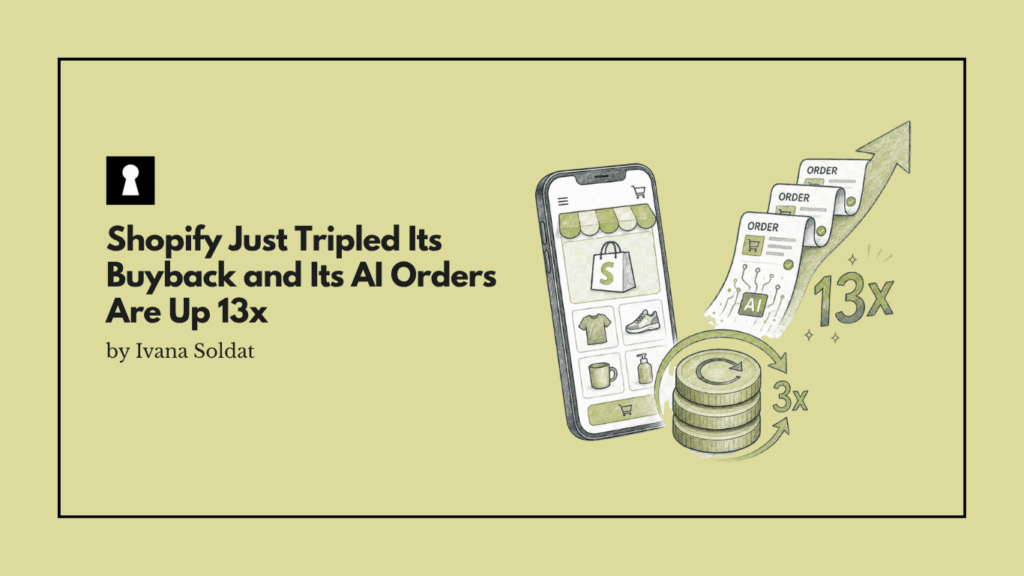
Shopify released a data point that should have stopped the ecommerce industry cold: orders coming through AI-powered search are up 13x year over year on its platform.
And it gets more interesting from there. Those AI-driven orders are converting at a rate 49% higher than traditional search. The average basket size is 14% larger.
Let that sit for a second. Shopify merchants aren’t just getting more traffic from AI channels. They’re getting better traffic. Buyers who arrive through an AI interface are more ready to purchase and they’re spending more when they do.
What This Has to Do With the Buyback
When a company authorizes $5 billion to buy back its own stock, it’s making a statement: we think the market is undervaluing what we’re building. Management rarely does this when they’re uncertain about the future.
The timing here matters. Shopify didn’t raise its buyback in a vacuum. It did it days after publishing data showing that its platform is sitting directly in the path of the biggest behavioral shift in online shopping since mobile. AI is becoming a discovery and purchase channel, and Shopify’s infrastructure is already processing that volume at scale.
The $5 billion authorization isn’t a signal that Shopify is out of ideas for growth investment. It’s a signal that they think the market hasn’t fully priced in what they already have.
The Agentic Storefront Play
Shopify has been building toward what it calls Agentic Storefronts, a setup where products can be discovered and purchased directly within AI conversation interfaces. You don’t go to a website. The AI brings the store to you, and you complete the transaction without leaving the chat.
This isn’t a future roadmap item. It’s live. And the 13x order growth figure is, at least in part, the early result.
The competitive implication is significant. For any merchant not on Shopify, or not set up to be discoverable through AI channels, this is a distribution gap that’s opening in real time. The merchants who figured out SEO in 2010 and social commerce in 2018 had asymmetric advantages for years. This looks like that kind of moment, except the window to act is probably shorter.
What It Means for the Rest of the Market
Shopify sits at an interesting position here. It has 21,000+ apps in its ecosystem, a global merchant base, and now a data advantage: it can see which AI channels convert, at what rate, and for what product categories. That data compounds over time and makes the platform more valuable to merchants who want to be where buyers are going.
The buyback signals internal confidence. The AI order data signals external momentum. Together, they tell you that Shopify’s leadership believes the next phase of ecommerce infrastructure is already running on their platform, and that the market hasn’t caught up yet.
Our Take
Shopify has been Called “the Future of Commerce” for So Long that the Phrase has Lost Meaning
At some point the story needs to stop being a prediction and start showing up where it counts.
We think it’s starting to. A 13x jump in AI-driven orders is the kind of number that gets massaged before it goes into a press release, sure. But even if the real figure is half that, the direction is not in dispute. Buyers are finding products through AI interfaces. They’re converting better. They’re spending more. And Shopify’s infrastructure is already underneath it.
The $5 billion buyback isn’t the interesting part. The interesting part is what had to be true internally for that decision to make sense right now. Merchants sleeping on AI discoverability are making the same mistake people made with mobile checkout in 2012. The window to be early is still open, but it won’t be for long.