
There is a specific kind of frustration familiar to anyone who has bought or sold trading cards online. You list a card. You describe it as near mint. The buyer says it arrived in worse shape than expected. Or you are the buyer, you paid for a card based on a blurry JPEG taken under bad lighting and it arrived with a crease that was invisible in the photos. Dispute. Refund. Bad review. Everyone loses.
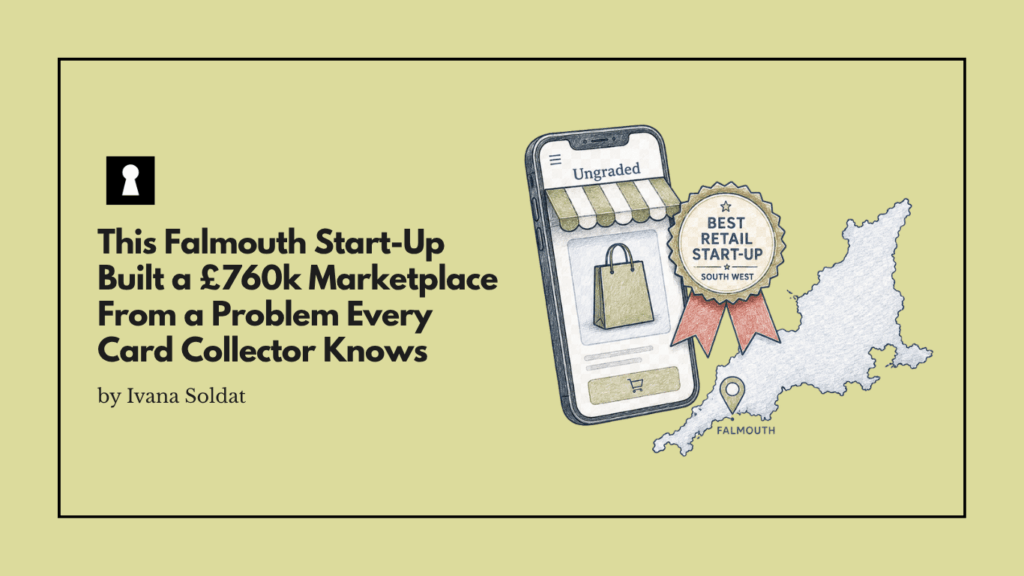
John Brame and Josh Williams decided to fix that. The result is Ungraded, a Falmouth-based marketplace for serious trading card collectors that has just been named Retail & E-Commerce Start-Up of the Year at the UK Start-Up Awards 2026 South West regional final.
The numbers are worth sitting with for a moment: £760,000 in sales, 33,000 cards sold, a team of eight, and the founders were still running the business part-time when they hit those figures. No external funding. No VC round. They built it from the ground up on the strength of one genuinely good idea.
The Model Is Simple. That Is the Point.
Ungraded takes physical custody of every card that passes through the platform and photographs it in forensic detail before it goes on sale. That is the whole concept. They hold the card, document it properly, and buyers get enough visual information to make a confident decision about condition and value.
It sounds almost too simple. But anyone who has spent time on eBay listings for trading cards knows that “near mint” means something different to every seller, and that the standard product photo, one image, taken at an angle, under overhead lighting, tells you almost nothing useful. The condition of a card is everything to a serious collector. Ungraded removes the ambiguity.
The ecommerce lesson here is not subtle: most marketplace trust problems are information problems. The platform that solves the information gap wins the segment.
The Trading Card Market Is Not a Niche Anymore
It is worth understanding the size of the opportunity Ungraded is operating in. The global trading card market has expanded rapidly over the past several years, driven by Pokémon, sports cards, and the broader collectibles resurgence that picked up during lockdown and never really stopped. Grading services like PSA and Beckett have waiting lists measured in months. Resale platforms are doing serious volume.
The secondary market for trading cards is now estimated in the billions globally. In the UK, it is a legitimate and growing category. The buyers are not kids trading in school playgrounds, they are adults spending real money on items they treat as investments as much as collectibles.
That context matters for understanding what Ungraded has built. They are not chasing a hobby corner. They are building infrastructure for a market that is scaling and that currently lacks reliable, transparent retail options.
What Bootstrapping to £760k Actually Means
The part-time founding story is genuinely notable. Most ecommerce start-ups that hit £760k in GMV have either raised money or are running the founders ragged working full-time. Brame and Williams did it without either, which points to a few things.
First, the product clearly has strong word-of-mouth. When you solve a real problem well, early customers tell other customers. That is how you get traction without a marketing budget.
Second, the model has inherent unit economics that work. Taking physical custody of cards creates operational complexity, but it also justifies a margin. Platforms that add real, tangible value to a transaction can charge for that. Ungraded is not competing on price. It is competing on trust.
Third, bootstrapping forces discipline. Every decision has to earn its place. That tends to produce leaner, more focused products than a funded company with runway to burn.
They Are Now Heading to the UK National Final
The South West win sends Ungraded to Ideas Fest in September 2026, the UK’s largest festival for entrepreneurs, where they will compete at the national final. More than 900 businesses were shortlisted across the UK this year from a pool of over 2,000 entries, all started within the last three years, collectively generating over £150 million in annual sales and nearly 5,000 jobs.
Co-founder Josh Williams said the win confirmed that the platform had struck a real chord with customers, and that the team was focused on giving trading card collectors a more transparent and reliable way to buy and sell.
That framing, transparent and reliable, is where this story connects to something bigger. Marketplace trust is the defining ecommerce problem of this era. Consumers are increasingly suspicious of product listings, of reviews, of condition claims. The platforms that build verification and transparency into their core model are not just solving a niche problem. They are pointing at where commerce is going.
Ungraded built that from Falmouth, part-time, with no outside money. That is a story worth paying attention to.
Our Take
eBay Has Had 30 Years to Fix This and Chose Not To
Let’s be direct about what Ungraded’s success is actually saying.
The problem they solved, sellers lying about card condition, blurry photos, no verification, is an eBay problem. It is an every-peer-to-peer-marketplace problem. And it has existed for decades. The fact that a two-person part-time operation in Cornwall built a more trustworthy buying experience than platforms with billions in resources is not a compliment to Ungraded. It is an indictment of everyone else.
The bootstrapping story is also worth challenging a little. Yes, £760k with no funding and part-time founders is impressive. But it also raises the question of what happens next. The trading card market is scaling fast, and the window for owning the trust layer in a high-value collectibles category will not stay open forever. PSA, eBay, and every well-funded competitor are one strategic decision away from copying the model. Ungraded needs to move fast or get acquired, and either outcome is fine, but pretending the part-time scrappy story works forever is naive.
The deeper point is about the collectibles market itself. Trading cards are being talked about like the next sneaker economy, with the same resale dynamics, the same grading obsession, the same tension between passion buyers and pure investors. But the infrastructure is years behind where sneaker resale is today. Ungraded is early. That is the opportunity and the risk at the same time.
The real question is not whether Ungraded deserved to win the award. They clearly did. The question is whether a Falmouth-based bootstrapped team can hold the position long enough to become the category default. or whether they end up being the proof of concept someone better-resourced eventually builds on top of.