
Starting July 1, 2026, buying a $2 component from AliExpress just got a lot more complicated.
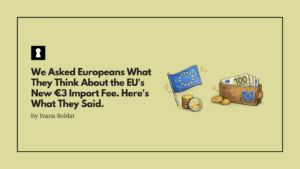
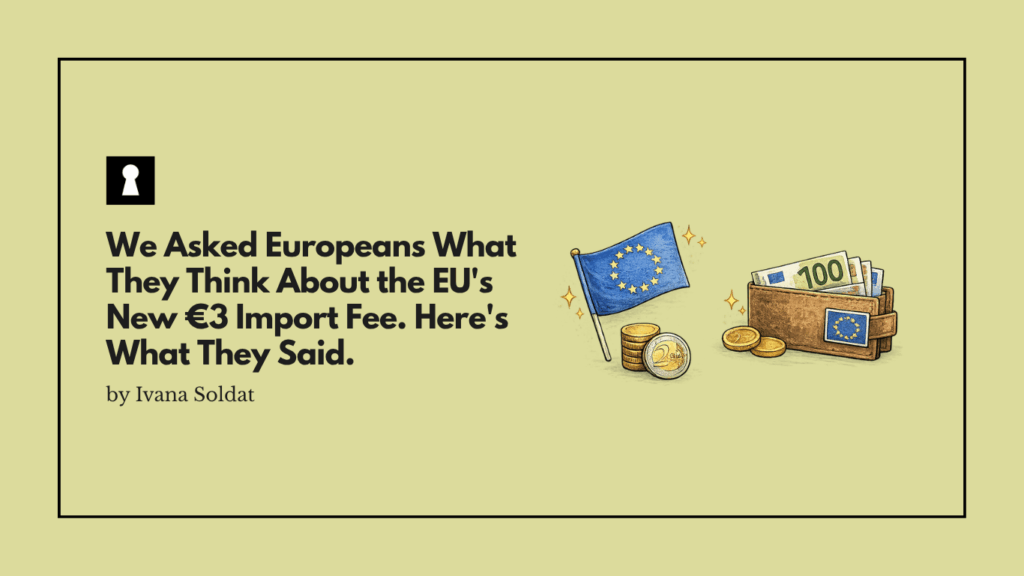
The EU has introduced a flat €3 customs duty per item on all goods valued at €150 or less entering the bloc, one of the most significant changes to EU customs rules in decades. The measure closes the long-standing “de minimis” exemption that allowed low-value goods to enter the EU free of customs duties. And it’s not stopping there: a separate €2 handling fee per consignment is due to follow in November 2026.
The scale of what this affects is enormous. In 2025 alone, almost 5.9 billion low-value items were shipped directly from third countries to EU consumers, without paying customs duties. Temu and Shein are the obvious targets. But the people actually feeling this change aren’t always the ones regulators had in mind. We reached out to Europeans across different walks of life, here’s what they said.
Three Europeans. Opposite Takes.
“A part that costs less than the tax itself becomes infinitely more expensive”
Basil is a soon-to-graduate medical student who builds medical training simulators and kits, sourcing most components from AliExpress because local vendors mark them up significantly.
For him, the fee isn’t abstract.
“Things like power regulators, microcontrollers, wiring, resistors, diodes are all counted as separate categories. A part that costs less than the tax itself becomes infinitely more expensive.”
The €3 charge applies per item based on 4-digit tariff headings, meaning if items fall under different headings within a single shipment, charges stack per heading. For someone ordering a mixed bag of electronics components, that adds up fast.
Basil is skeptical that the fee will redirect spending toward EU suppliers. “Buying locally was and still is a bad idea, since vendors artificially mark up the parts.” His broader concern is about innovation: “Europe needs more innovation. Artificially jacking up the cost of everything would substantially slow it down. And for what? Most of the things bought from China aren’t produced domestically.”
He asked to remain partially anonymous, first name only.
“Shipping within Poland costs less than shipping from China. That’s absurd.”
Not everyone we spoke to sees the fee as an overreach.
KimVonRekt, a consumer based in Poland, thinks the change is overdue, if imperfect. His framing centers on what he sees as an absurd market distortion: “Shipping within Poland costs less than shipping from China. That’s absurd.”
His read on the market impact is blunt: “Sales from China drop. Local middlemen rise. Prices go up but margins stay razor thin as everyone still has the same Chinese product. People stop buying stupid $1 things on AliExpress but large resellers barely notice it.”
He’d prefer a more structural fix: “It’d have been better to base shipping costs 100% on market rates. With the invention of the internet there’s no humanitarian reason for subsidizing postal services, especially China’s.”
“I’ll probably buy less, but I’ll still buy”
Sophie, a university student in France, uses AliExpress primarily for phone accessories, stationery, and replacement parts.
“I’m not happy about paying extra, but I’m also not going to spend €15 locally for something that costs €2 online.”
She expects the fees to change her behavior, though not dramatically.
“I’ll probably buy less, but I’ll still buy. Instead of placing small orders every few weeks, I’ll wait and combine purchases into bigger ones.”
What the EU Says it’s Doing
Officially, the fee is framed around safety and fairness. Targeted inspections across the EU in 2025, covering cosmetics, PPE, food supplements, toys, and electronics, found that over 60% of checked products failed EU standards due to missing labels, forbidden ingredients, or absent safety documentation.
The €3 flat duty is a transitional measure, applying until July 1, 2028, when the EU Customs Data Hub for ecommerce is expected to come online. At that point, normal customs duties based on each product’s classification will apply instead.
What it Means for Ecommerce Businesses
The impact varies significantly by business model. For sellers operating through Amazon FBA, the change is expected to be relatively limited; these businesses typically import goods into the EU in bulk, meaning their products are already subject to standard customs duties.
In contrast, businesses selling directly to EU consumers via platforms like Shopify are likely to be more affected, with individual low-value parcels now attracting additional customs charges.
Large Chinese ecommerce platforms are already adapting by increasing the use of EU-based warehousing, a sign that the calculus on per-parcel costs is already shifting at scale.
The Bottom Line
KimVonRekt’s take cuts through the noise: the big resellers will barely notice. It’s the small buyers, hobbyists, students, indie makers sourcing components, who absorb the actual pain. Whether that’s an acceptable trade-off for a fairer market is, as both our sources make clear, genuinely contested.
The €3 fee is live as of this month. The €2 handling fee is coming in the fall. And the permanent customs framework isn’t expected until 2028. For now, ecommerce is in a transitional period, and not everyone got a vote on it.