
Few technologies have made as big an impact on the ecommerce market as AI has. It’s not only improved the shopping and research experience for customers around the world, but also made it easier for brands to create content, offer great customer service, optimize the supply chain, and more.
But to truly understand the magnitude of AI’s role in ecommerce, you need to look at the numbers. This guide goes over some of the most important and surprising AI ecommerce stats that brands should know.
1. 38% of Consumers Have Used Generative AI for Shopping
Generative AI has quickly turned into one of the best tools for shoppers, as 38% of them have used it when buying items online. Of these people who have used it, 85% said that it improved their experience, and 73% said it’s their primary source of product research.
As for the tasks that online shoppers use AI for, some of the most popular are conducting research (53%), receiving product recommendations (40%), seeking deals (36%), and creating shopping lists (30%).
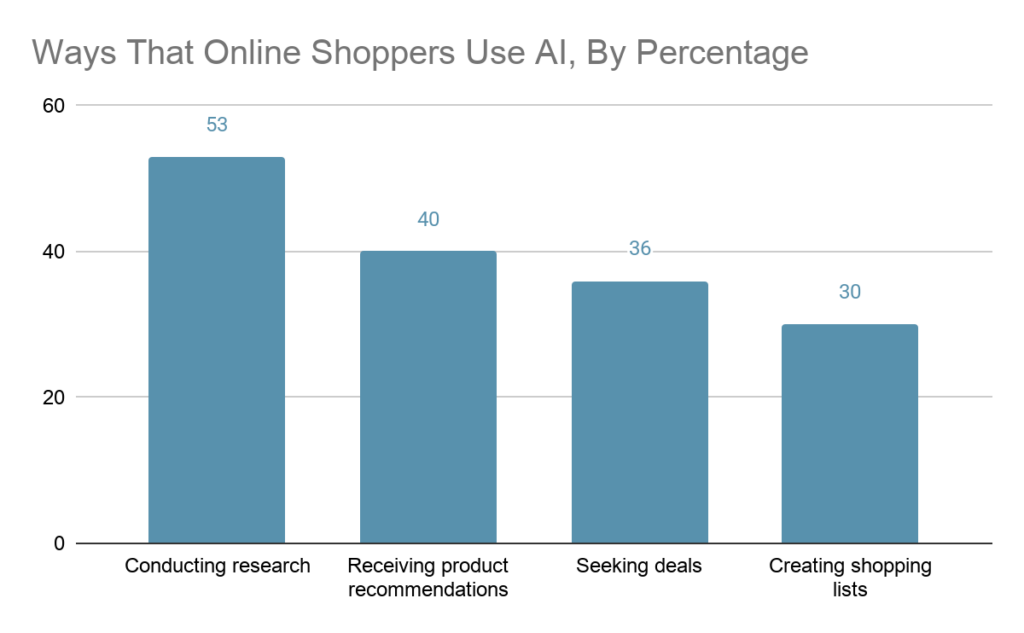
This shows that online shoppers have embraced AI for numerous steps of their online shopping journeys, as it often helps shoppers save time and effort while searching for and/or comparing products.
2. AI Traffic to U.S. Retailers Climbed 393% in Q1 2026
One of the biggest impacts that AI has had on the ecommerce space is driving more traffic to retail sites. In fact, in the first quarter of 2026, traffic from AI sources to U.S. retail sites grew 393% year-over-year. This follows the 693% year-over-year jump during the most recent holiday season for November to December 2025.
These numbers show that more and more people are discovering brands and products through AI, making it easier and quicker for them to find the items they’re looking for.
3. Shoppers from AI Sources Convert 42% Better Than Non-AI Traffic
In addition to traffic from AI sources growing rapidly so far in 2026, this AI traffic also converts better than non-AI traffic. For example, in March 2026, AI traffic converted 42% better, which is a new record high.
While this doesn’t mean brands should completely disregard their traffic from other sources (such as SEO, social media, or paid ads), it shows that they should continue to prioritize AI traffic by optimizing their product descriptions, FAQs, and content for conversational queries.
4. Small Businesses Using AI Earn Almost 500% More Revenue Than Those That Don’t
While small businesses not using AI earn a median revenue of around $90,000, companies implementing AI earn multiple times that, with median revenue reaching $500,000. So while there may be a cost and learning curve involved with adopting AI, it seems that companies that have taken the plunge are being handsomely rewarded with stronger revenue.
5. 66% of Senior Leaders Say That AI Has Led to Significant Productivity Gains
According to a study, 66% of senior leaders state that AI has led to significant productivity gains within their organizations. These gains are spread throughout many business areas, but are not evenly distributed among all types of organizations.
For example, while 72% of large enterprises report productivity gains from AI, only 55% of small and medium enterprises report the same. While there’s a noticeable gap, those numbers are both still fairly impressive and highlight that most companies, big or small, are still seeing better productivity from AI.
6. Around Half of All Businesses Use AI in Three or More Business Functions
All types of businesses are making use of AI in a big way, as around half of all businesses use AI in at least three business functions. Also, more than two-thirds of them are using it in more than one function.
While this is a cross–industry figure and refers to the business landscape in general, it shows the true scale that AI has reached in the business space, and serves as a reminder that while AI is massive in the ecommerce space, it has also carved out a role beyond that.
The figure also shows the high adoption of AI in general, and that the use of AI is broadening within many organizations. While many may have only planned to use it for one thing, the fact that many of them now use it for multiple functions shows the effectiveness of AI and how versatile it is.
7. 76% of Global Ecommerce Brands are Actively Investing in AI
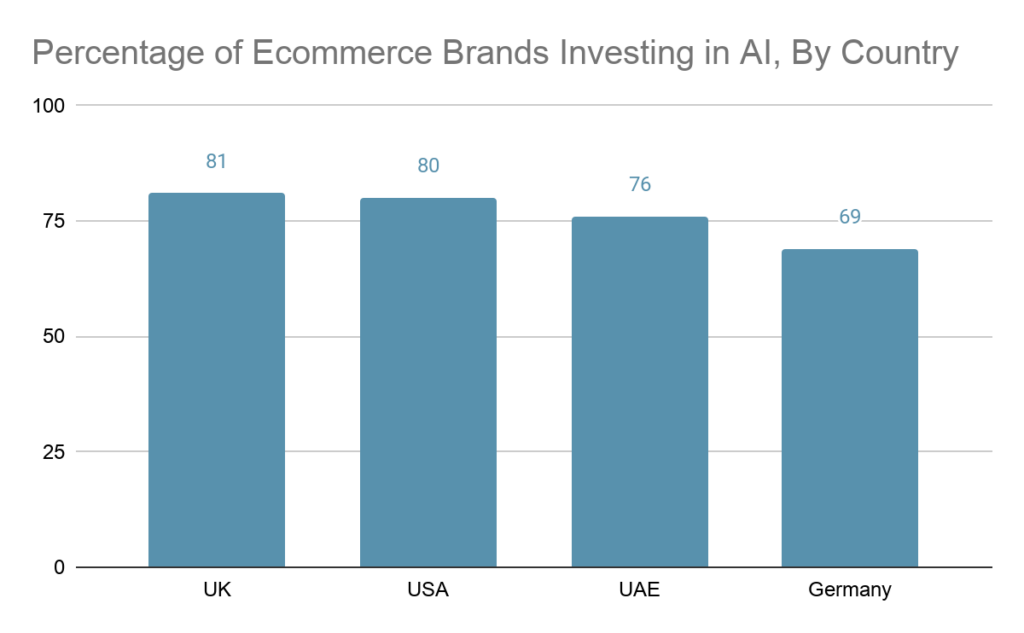
The sheer number of ecommerce brands actively investing in AI shows just how deeply it has penetrated the market and carved out a role for itself. The UK leads the way with 81% of ecommerce brands investing in AI, followed by the likes of the USA (80%), UAE (76%), and Germany (69%).
In terms of the numbers, ecommerce companies worldwide have invested an average of over $291,000 in AI, though this average is expected to rise to over $323,000 over the next year.
8. Customer Support Automation is the Most Popular Use Case of AI for Businesses, at 96%
So while most businesses are investing in AI, what are they using the technology for? Well, the most popular use case for AI is to automate customer service, which is something that nearly every company is doing. In fact, of the companies using AI, 96% of them use it for customer service automation.
The next most common use cases are for AI product recommendations (88%), automated tracking and status updates (69%), and AI-powered personalization (64%).
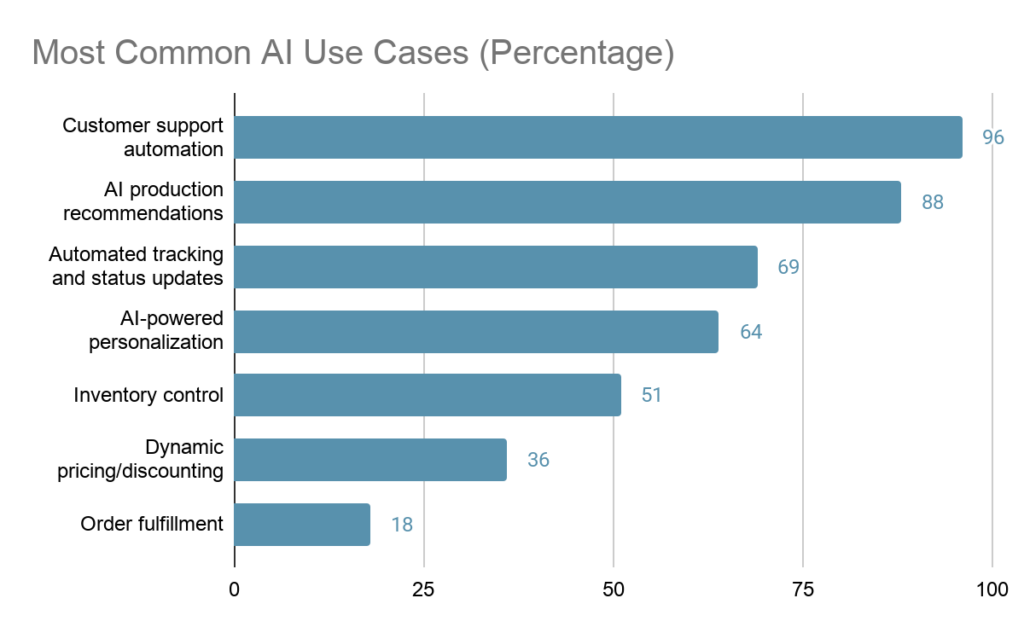
As you can see, while AI is most commonly used to automate customer service and make it more efficient, its usage extends far beyond that as well. In the future, expect to see the use cases of AI expand even further throughout a variety of different business areas.
9. 62% of AI-Enabled Shoppers Use AI For Comparisons
As you could imagine, the reasons and ways that ecommerce shoppers use AI are vastly different from how companies do. Of those who use AI for shopping purposes, 62% use it to compare different products, brands, and models.
Another 55% use it to learn more about a product or category, 46% to get ideas or inspiration for what to buy, and 26% enlist its help to build out or optimize their online shopping basket. Some shoppers also use it for checkouts (23%), repurchases/replenishment (22%), and post-purchase support (19%).
Honorable Mentions
There are also several other AI in ecommerce stats that we felt were worth mentioning. This includes:
- 1 in 5 shoppers have purchased from a brand that they’ve never heard of, because AI recommended it.
- The productivity gains of AI are seen across different departments, as 87% of IT workers say it helps them resolve issues faster, 85% of marketers report quicker campaign execution, and 73% of engineers deliver code faster.
- However, while 95% of organizations have an AI strategy, only 8% have reported a measurable ROI.
- 55% of shoppers aren’t comfortable letting AI agents make purchases on their behalf, and nearly 54% believe that AI could increase the risk of online fraud.
- 58% of shoppers blame the brand when an AI recommendation contains incorrect product information.
While AI is a relatively new technology, these stats and figures show that it’s already had a massive impact on the ecommerce industry and should continue to play a role in it going forward.