
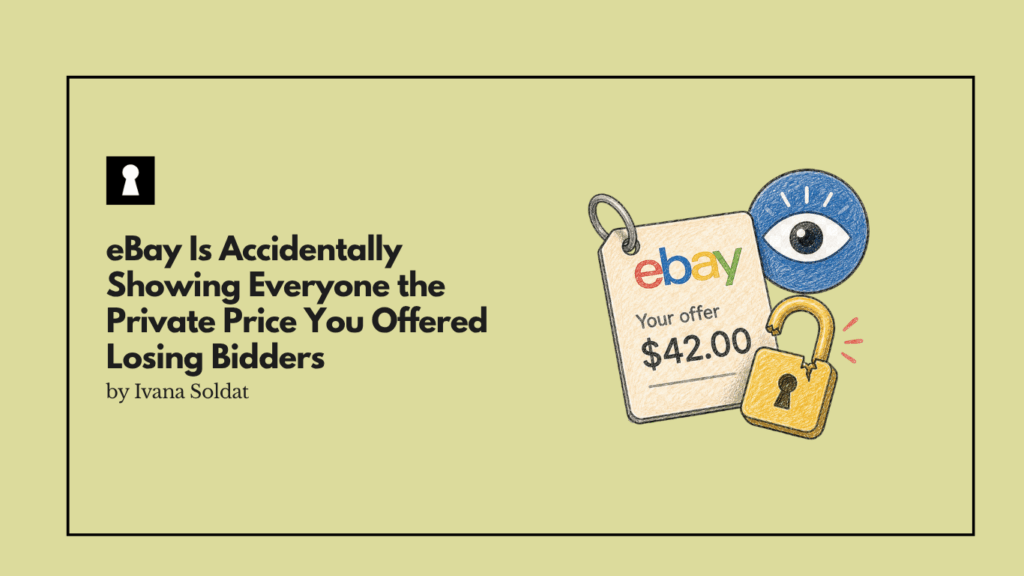
Here is how Second Chance Offers are supposed to work. An auction ends. The winning bidder either does not pay, or the seller has duplicate stock and wants to move it. The seller selects a losing bidder and sends them a private offer to buy the item at the price of their highest bid, which is, by definition, lower than what the winner paid or was willing to pay. The offer goes to that specific bidder only.
When eBay generates this offer, it technically creates a new fixed-price listing behind the scenes, but that listing is explicitly not included in search results and does not appear in the seller’s active listings. It exists only as a private channel between the seller and the specific recipient. That invisibility is the whole point. A Second Chance Offer at a lower price, visible to the public, would tell every other potential buyer exactly how low the seller was willing to go.
That is precisely what is happening right now.
Sellers reporting the issue on EcommerceBytes and eBay’s own community forums say that Second Chance Offers they have sent are appearing in their publicly visible active listings. Anyone browsing the seller’s store, or finding the listing through search, can see the offer, including the discounted price it is set at. The private negotiation has become a public price tag.
Your Pricing Floor Is Now a Listing
The damage here is not just embarrassment. Auction pricing on eBay works on the assumption that the seller does not know in advance what a buyer is willing to pay. The bidding process reveals that information, with the winning bid representing the market-clearing price. Second Chance Offers exist at the intersection of that system and the reality that auctions do not always close cleanly. They are a recovery tool, and their value depends entirely on discretion.
When a Second Chance Offer price becomes public, several things break simultaneously. Other potential buyers now know the seller was prepared to accept a price lower than the auction closing price. Future bidders on similar items from the same seller can use this information to calibrate how low they need to go.
The seller’s pricing floor is exposed. And the losing bidder who received the offer, who was supposed to feel they were getting a private, exclusive second shot, can now see that the “private” offer was visible to everyone.
There is also the shill bidding angle that experienced eBay community members have long flagged around Second Chance Offers. Because the offer is set at the underbidder’s highest bid, a seller who inflated bids through a shill account could theoretically use a Second Chance Offer to extract the underbidder’s true maximum price. That concern predates this bug.
The public exposure of Second Chance Offer prices makes any transaction involving this feature immediately visible in a way that invites scrutiny the sellers involved almost certainly did not intend.
This Bug Has Happened Before
Community threads from earlier years show sellers raising the same concern about Second Chance Offer listings appearing publicly, a sign that either this is a recurring bug that gets periodically fixed and then reappears, or that eBay’s implementation of the visibility controls for these listings is fragile enough to fail under certain conditions. Either interpretation is uncomfortable for a platform where auction sellers depend on pricing discretion as a basic feature of how the format works.
eBay has not publicly acknowledged the current issue or provided a timeline for a fix as of publication. Sellers who use Second Chance Offers regularly and have sent any since the bug was first reported should check their active listings immediately.
eBay Also Had an Outage This Week, and Its Feedback System Has Been Broken for a Month
This Second Chance Offer exposure is the third eBay technical issue to surface in a short window. The platform had a roughly 45-minute outage on the evening of July 14 that prevented buying and selling, with at least one buyer losing a limited-edition collectible because they could not place a bid during the window.
And a seller feedback glitch that eBay confirmed it is investigating has been causing feedback scores to flip-flop since at least mid-June, a problem that matters because feedback scores are one of the primary trust signals buyers use when evaluating sellers before committing to a purchase.
Three separate issues in two weeks. None of them individually catastrophic. Together, they represent a level of platform reliability noise that sellers who depend on eBay as their primary channel notice and remember.
Our Take
eBay Is Having a Week. Sellers Are Noticing.
The Second Chance Offer exposure is the kind of bug that feels minor from the outside and is genuinely damaging to the sellers it affects. Auction pricing strategy is built on information asymmetry, the seller does not know the buyer’s ceiling, the buyer does not know the seller’s floor, and the auction process is the mechanism that resolves that gap.
Second Chance Offers exist at the edge of that system, handling the messy aftermath of auctions that do not close cleanly. Their value is entirely conditional on discretion. A platform that accidentally removes that discretion has not just caused a technical inconvenience. It has broken a trust assumption that auction sellers have relied on for as long as the feature has existed.
The fix is presumably straightforward. The question is how long eBay takes to implement it, and how many pricing strategies get accidentally published in the meantime.