
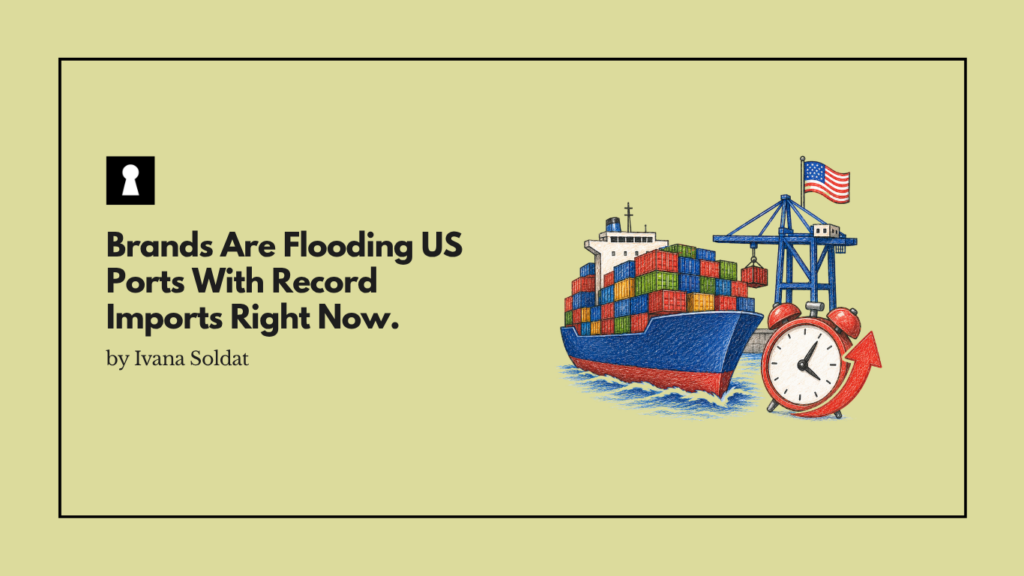
Somewhere in the Pacific Ocean right now, there are an extraordinary number of container ships making their way toward the United States as fast as maritime physics allows. Because brands made purchasing decisions six, nine, twelve months ago, and the prospect of paying a new 10 to 12.5% tariff on those goods when they arrive in August is concentrating minds in a way that no logistics efficiency study ever quite manages to.
According to new data from the Global Port Tracker, published by the National Retail Federation and Hackett Associates, July 2026 is on track to set an all-time record for US import volume: 2.47 million TEUs.
For context, May 2026 came in at 2.24 million TEUs, which was itself a 14.9% increase over May 2025. The number is going up, fast, because the alternative, having your cargo in international waters when new tariffs take effect, is worse.
Everyone Is Arriving at the Same Time
Record import volumes do not distribute themselves evenly across port infrastructure. They arrive all at once because the incentive creating the rush is the same for everyone: a shared deadline, a shared risk, a shared calculation that earlier is better than later.
NRF’s Jonathan Gold put it plainly: “Retailers are trying to get their products here for the back-to-school season as well as the winter holidays, before those higher tariffs potentially take effect. A lot of these companies have made their purchasing decisions six, nine, even 12 months ago. To then get hit with a tariff on top of that is a challenge, so that’s partly why they’re looking to pull ahead.”
The consequence of everyone pulling ahead simultaneously is predictable. More drayage demand. More warehouse capacity pressure. More potential for the kind of cascading complications that a supply chain professional calls “complications” and everyone else calls a nightmare. Gold’s guidance: communicate early with every logistics partner about your plan, warehouse capacity, and drayage needs. The brands who did that are fine. The brands who did not are about to find out what a drayage surcharge feels like during peak congestion.
The Tariff Calendar Is Now a Permanent Feature of Life
The August deadline is not the end of the story. Brazil is facing a proposed 25% tariff potentially finalized by July 15. The USTR has an ongoing Section 301 investigation into “excess capacity and production” across 16 countries including China, Vietnam, South Korea, and the EU. A separate investigation launched in June looks specifically at intellectual property concerns around Vietnamese exports. Any of these could produce new tariff actions on top of the ones already in place.
Gold described the current environment as “the age of disruption”, a phrase that would have felt hyperbolic in 2019 and now sounds like a dry description of operational reality. Making shipping plans under unknown future tariff structures is, he said, “the new normal.” The companies adapting best are the ones building scenario planning into their logistics operations rather than treating each tariff announcement as a surprise.
$104 Billion Sitting in the Refund Queue
One footnote that deserves more attention: the tariff refund process is moving, but slowly. A progress report filed with the US Court of International Trade shows more than $104 billion in both potential and certified refunds have been accepted for processing.
Of that, approximately $71.06 billion has been sent to the Treasury for payment, meaning the government still owes importers roughly $100.65 billion, more than half of what is owed. Nike expects $986 million in refunds. BJ’s Wholesale has similar expectations. The money is coming, but it is coming on government time, which is a different kind of time than cash flow requires.
Our Take
August Has a Deadline. September Has Another One.
The record July import volume is a rational response to an irrational policy environment. Brands cannot predict what tariffs will exist in August, so they are getting their goods in now, before the question becomes relevant to their margins.
The collective result of that rational individual decision is a port system under extraordinary pressure, a warehouse and drayage market running very tight, and an inventory position for many brands that is frontloaded against demand that has not materialized yet.
The Prime Day data we covered last week showed a consumer spending carefully, buying in smaller baskets, and responding primarily to deals. The supply chain data this week shows brands importing at record volume on the assumption that autumn demand will absorb it. Those two pictures are not obviously compatible, and the gap between them is where Q4 planning anxiety is going to live for the next several weeks.