Before going deeper into the numbers, the sourcing caveat belongs at the top, not the bottom. DHL eCommerce publishes an annual trends report, and DHL eCommerce is a cross-border logistics company.
Every trend it identifies, AI needing better trust infrastructure, subscription models requiring reliable delivery, payment flexibility demanding seamless fulfilment, happens to point toward “brands need better logistics partners.” That does not make the data wrong.
It means you read it knowing what the author is selling. With that on the table, the Asia Pacific findings are worth examining because several of the numbers land in genuinely interesting places.
40% Using AI, 62% Won’t Let It Decide
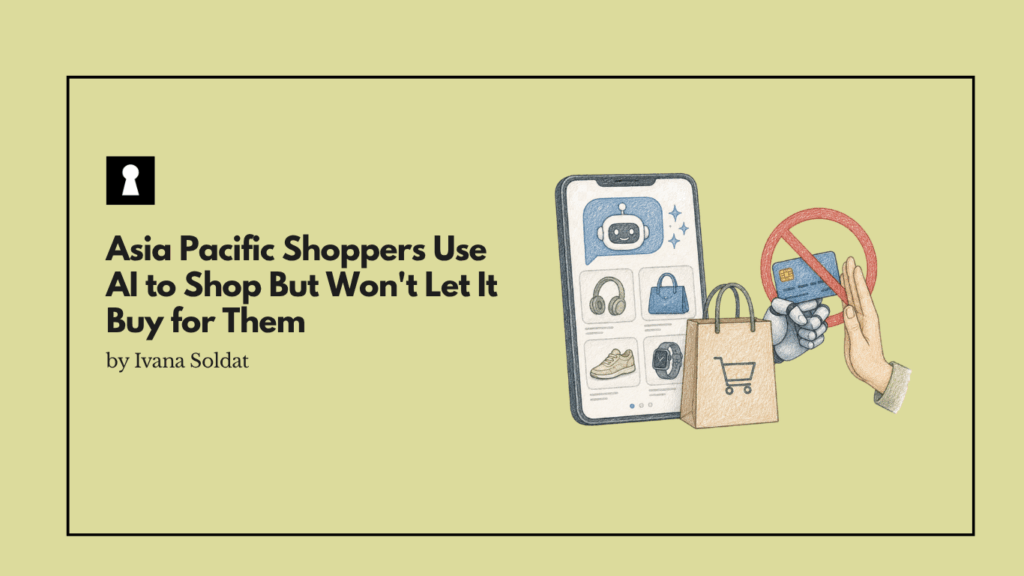
Around 40% of Asia Pacific shoppers have used AI-powered tools such as chatbots and virtual assistants for customer service or recommendations as part of their online shopping journey. Another 37% say they would like to use AI tools in the future. That is a combined 77% of the region either already using AI for shopping or actively wanting to, considerably higher than comparable figures from the US and UK.
However, a clear gap between trust and usage is emerging. While shoppers are actively using AI tools today, their willingness to let AI make purchasing decisions remains mixed, with concerns around privacy cited by 62% of respondents and accuracy cited by 50%.
This is the same pattern we covered in the Nigeria AI shopping data earlier this week: high adoption of AI as a research and comparison tool, sharp resistance to AI as a decision-maker. Shoppers want AI to help them think. They do not want it to think for them. The 62% privacy concern is particularly significant in a region where personal data handling by large platforms has been politically sensitive across multiple markets simultaneously.
The business side mirrors the consumer hesitation, companies in the region are also cautious about AI, with concerns running parallel to their customers’.
Subscriptions Are the New Loyalty Programme Nobody Called a Loyalty Programme
Demand for subscription-based shopping experiences is growing across Asia Pacific, with a large majority of respondents indicating they already hold at least one product subscription. Among them, 35% have three or more product subscriptions. Discounted pricing and loyalty rewards are the top two motivators.
The subscription data deserves more attention than the AI numbers, which are getting most of the coverage. Product subscriptions have been a fixture of Western ecommerce for years. Their growth in Asia Pacific is significant because the region’s dominant ecommerce model has historically been transactional rather than relationship-based.
You go to Shopee, Lazada, or Tokopedia to find the cheapest option for what you need right now. Subscription models change that structurally. A customer on a product subscription is no longer comparison-shopping every cycle. They are committed to a cadence, which is the closest thing to genuine loyalty ecommerce has found outside of Amazon Prime.
40% of shoppers and 53% of businesses already have delivery and returns subscriptions. Over one in ten shoppers now have three or more logistics subscriptions with retailers. The logistics subscription number is the one DHL is most interested in for obvious reasons. But setting aside the commercial angle, it points to something real: consumers in the region are willing to pay for predictable, premium delivery as a standing commitment rather than a per-transaction decision.
Payment Flexibility Has Become a Conversion Requirement
Shoppers across the region continue to transact using credit and debit cards and digital wallets, while adoption of Buy Now Pay Later, cryptocurrency, and biometric authentication is steadily increasing. This trend is particularly pronounced in China, India, Malaysia, and Thailand, where mobile-first commerce is driving payment innovation.
Asia Pacific ecommerce businesses are already offering digital wallets, BNPL, and biometric checkout at rates that outpace Western markets, specifically because consumer expectations are there and competitive pressure to match them is real.
Our Take
The Trust Gap Is Doing a Lot of Work in This Report
The DHL Asia Pacific data is most useful when you look past the three headline themes and notice what connects them: trust. Shoppers use AI but don’t trust it to decide. Shoppers subscribe but the motivator is pricing certainty, not brand loyalty.
Shoppers want payment flexibility partly because familiar payment methods feel safer than unfamiliar ones. The region is not short of adoption appetite. It is short of the kind of trust that turns adoption into durable commercial relationships.
That is a more interesting and more actionable finding than any of the three stated trends, and it is the one the report names but does not fully develop, possibly because “build trust” does not point as cleanly toward a logistics solution as “optimise your delivery subscription programme” does.
The brands that figure out how to build genuine trust with Asia Pacific consumers, rather than just meeting their feature expectations, are the ones that will convert the region’s high adoption rates into high lifetime value. That is harder than adding a BNPL option at checkout. It is also worth more.