
There is a pattern in how economic weakness shows up in ecommerce data before it shows up in headline retail numbers. Basket sizes shrink before transaction volumes fall. Premium categories lose share before budget categories do. And secondhand markets boom precisely when disposable income is under enough pressure that the gap between new and used starts to feel worth navigating.
All three signals are present in China’s mid-2026 ecommerce data simultaneously.
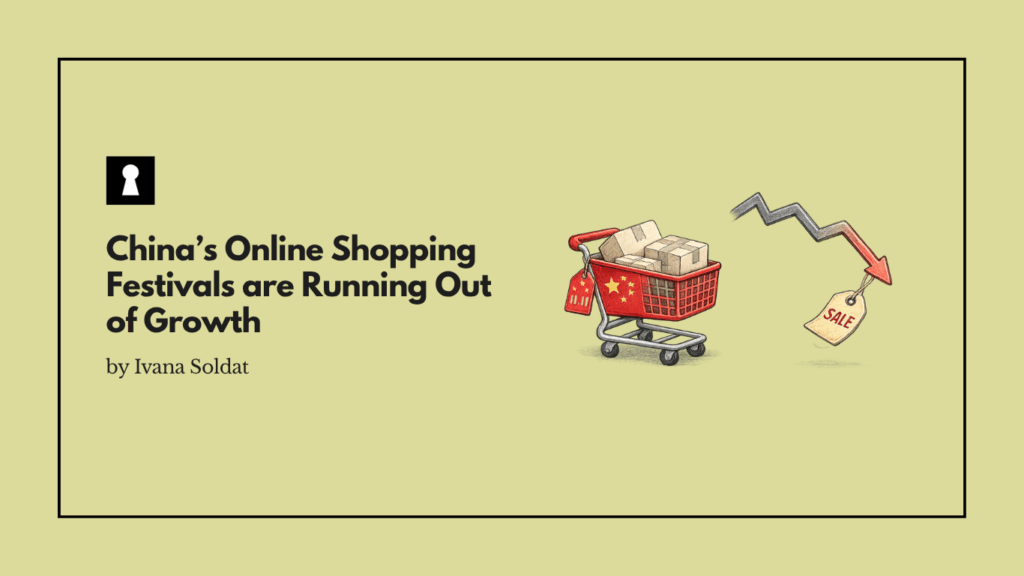
China’s 618 shopping festival, running this year from May 13 to June 18, generated total online sales growth of 4%, according to retail data firm Syntun. In the same festival period last year, growth was 15.2%. Among ecommerce platforms, Alibaba’s Tmall led in sales, followed by JD.com and ByteDance’s Douyin, but the combined segment saw only 0.9% sales growth. The platforms that power the majority of Chinese ecommerce are essentially flat.
Secondhand electronics platform ATRenew said sales of preowned products grew by nearly 80% from a year ago during the 618 shopping period, highlighting demand for lower-cost goods. That number does not belong in the same sentence as 0.9% platform growth unless it is being used to describe exactly what it describes: a consumer base that is still active and still looking for things to buy, but making systematically different choices about what those things are and how much to spend on them.
The Context Behind the Numbers
The 618 data does not exist in isolation. It is the most visible data point in a consumer spending picture that has been deteriorating steadily through the first half of 2026.
China’s retail sales grew just 0.2% year-over-year in April 2026, the weakest reading since December 2022, when the country was still shaking off its final COVID restrictions. And then May delivered the number that made economists pay attention: retail sales fell 0.6% in May compared to a year ago, marking the first decline since China emerged from pandemic restrictions in 2022.
The underlying causes are not mysterious. Persistent deflation, a housing market that refuses to stabilize, weakening job conditions, and elevated household savings rates are all pressing simultaneously.
Car sales in May fell more than 22% year-over-year, extending a streak of double-digit declines to six consecutive months. Home appliances and building materials both posted significant drops. HSBC responded by cutting its full-year 2026 retail sales growth forecast from 5.2% to 2.8%.
Goldman Sachs noted that the divergence between high-tech and AI sectors versus property and consumption industries continues to widen in both industrial production and capital market data. China’s technology and export sectors are performing well. The consumer economy is not.
618 as a Mirror
The 618 festival is useful precisely because it is a designed demand-generation event. Platforms spend heavily on promotion, discounts are deep, and the intent is to pull forward consumer spending that might otherwise not happen. A festival that generates 15% growth one year and 4% the next is not just reflecting an economy that slowed. It is reflecting an economy where even artificial demand stimulus is losing effectiveness.
China’s online retail sales climbed 6.6% in the first four months of 2026, reaching 6.53 trillion yuan, or around $940 billion, according to official data. While overall retail sales grew by only 1.9% during the same period, online continues to outperform the broader sector. Ecommerce is not failing in China. It is the strongest performing channel in a weak consumer environment. The 618 data shows that even the strongest channel is feeling the pressure.
The secondhand market is the clearest expression of what consumers are actually doing. An 80% growth in preowned electronics during a period when new electronics platforms are barely growing means consumers are actively seeking the lower-cost alternative and finding it at scale. This is not fringe behavior. It is a mass market shift that takes years to build into data that significant, and it is a direct signal about where consumer confidence sits relative to new product prices.
The Exporters and the Domestic Economy Are Living in Different Chinas
The detail in the Goldman Sachs analysis that deserves the most attention is the divergence between China’s export and technology economy and its domestic consumer economy. China’s exports are strong. AI and semiconductor-adjacent industries are performing well. The platforms generating ecommerce revenue from cross-border sales are operating in a different environment from the one serving Chinese domestic consumers.
This split matters for any brand or investor looking at China as a single market. The Alibaba that sells to Chinese consumers and the Alibaba that powers cross-border platforms serving European and Southeast Asian markets are experiencing meaningfully different growth conditions simultaneously.
Our Take
China’s Ecommerce Is Outperforming Its Economy. That Is Less Impressive Than It Sounds.
The 618 slowdown from 15.2% growth to 4% is a large and fast deceleration, and it is happening against a macroeconomic backdrop where the structural headwinds are not likely to resolve quickly.
China’s consumer ecommerce platforms are the best-performing retail channel in a weak consumer environment, which is a real achievement and also a description of a ceiling. The secondhand market growing 80% while new product platforms grow at under 1% is the data point that tells you the most about where Chinese consumer psychology is right now.
People are still shopping. They are shopping differently. And the platforms that figured out how to serve that differently, lower price points, resale, trading-down mechanics, are the ones growing. The ones still optimized for the upgrade cycle and the premium purchase are seeing what happens when the consumer decides that cycle is over for a while.