
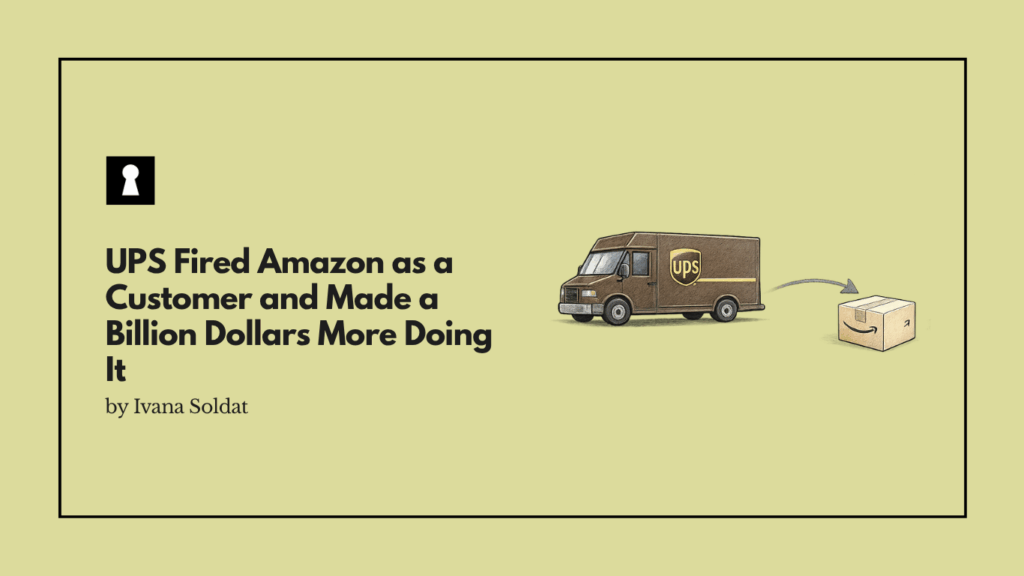
The conventional wisdom about losing your largest customer is that it is bad. UPS spent the past 18 months testing whether that conventional wisdom applies when the largest customer is also your least profitable one.
The answer, based on Q2 2026 results reported on July 29, appears to be no. At least not when the alternative is a leaner, more automated network serving customers who actually pay for the service they receive.
UPS consolidated revenue reached $22.8 billion in Q2 2026, a 7.6% increase from $21.2 billion the year before. Operating margin was 9.2%, up from 8.8% the prior year. That is a meaningful margin expansion for a carrier operating at this scale, and it came in a quarter where total average daily package volume in the US decreased 3.3% year over year.
More volume, less revenue, thinner margins: that was the old UPS. Less volume, more revenue, better margins: that is what CEO Carol Tome has been building toward.
The Amazon Divorce and What It Actually Cost
Tome said UPS executed a “deliberate structural reset” for its US business over the past 18 months, including reducing 2 million pieces per day of what she called “lower-quality Amazon volume.” That helped UPS remove about $4.5 billion in related expenses.
The phrase “lower-quality volume” is doing a lot of work in that sentence. What it means in logistics economics is volume that requires infrastructure, labor, and capacity to handle but does not generate enough revenue per package to justify those costs. Amazon negotiated aggressive rates from UPS over years of volume growth, and the packages UPS was delivering for Amazon were generating returns below what the network could earn from other customers.
UPS Ground’s average daily package volume in Q2 decreased 3.5% year over year, with CFO Brian Dykes attributing the majority of that decline to the reduction in Amazon volume. Strip Amazon out of the numbers and the underlying business grew. That is the whole thesis of the reconfiguration: Amazon volume was crowding out better-margin volume, and removing it created space for customers whose economics actually work.
Who Filled the Gap
UPS SMB average daily volume grew 4.3% year over year. B2B Digital Access Program average daily volume increased 34% year over year. Healthcare revenue reached $3 billion in Q2, with demand for cold chain logistics accelerating. UPS added 27 temperature-controlled cross-dock facilities to its network specifically for healthcare products requiring strict temperature control.
These three customer segments share a characteristic: they pay more per package than Amazon did. SMBs do not have the negotiating leverage of a trillion-dollar company. Healthcare requires specialized handling and chain-of-custody documentation that commands premium pricing. B2B DAP customers are using UPS’s logistics technology platform in ways that embed UPS more deeply into their supply chain operations and create switching costs.
The 34% growth in B2B DAP volume connects directly to the B2B ecommerce piece EcomWatch covered earlier this month. We reported that B2B ecommerce is growing at 14.5% annually and is on track to hit $36 trillion by 2026, driven partly by the 73% of B2B buyers who are now Gen Z and expect consumer-grade digital purchasing experiences. UPS’s B2B DAP is the logistics layer sitting underneath that commercial growth, and its 34% volume increase suggests the B2B ecommerce acceleration is real enough to show up in carrier economics.
The RFID and AI Network That Is Actually Interesting
Most carrier earnings calls are not worth reading for technology insights. UPS’s Q2 call is an exception.
Tome described UPS’s investment in RFID and AI as transformative, comparing RFID to the “eyes and ears” within the network and AI to the brain that transforms data into decisions, predictions, and actions. She called RFID “the most significant package visibility advancement in a decade,” describing a shift from a scanning-based network to a sensing network that eliminates hundreds of millions of manual scans every year.
The practical implication for ecommerce sellers is significant: the promises made at checkout about delivery timing are only as reliable as the carrier’s ability to see and manage what is happening inside its network. A carrier that knows exactly where every package is at every moment, and can reroute dynamically when something changes, is structurally more capable of keeping delivery promises than one that finds out about problems after they have already caused delays.
RFID deployment has been completed across all US delivery facilities and package cars, with international rollout now underway.
The Geopolitical Footnote
Tome noted that fuel price volatility tied to the US and Israel’s war with Iran drove higher fuel revenue and corresponding fuel costs, with UPS fuel surcharges functioning as designed to cover the increase in expenses. This is brief in the earnings call but worth flagging for EcomWatch readers planning shipping costs through the second half of 2026.
The new 10% to 12.5% Section 301 tariffs we covered last week are one cost variable for import-dependent brands. Fuel-driven carrier surcharges are another, and they are moving at the same time.
Our Take
UPS Fired Its Biggest Customer and Got a Pay Rise
The UPS Q2 results are one of the more counterintuitive earnings stories in logistics in recent years. A carrier that loses 2 million packages per day from its largest customer, posts lower total volume, and still grows revenue by $1 billion while expanding margins is demonstrating something important about how ecommerce logistics economics actually work.
Not all volume is equal. Volume that requires infrastructure without generating adequate return is worse than less volume from customers who pay properly. The Amazon relationship, from UPS’s perspective, had become a case where scale was working against them rather than for them.
The reconfiguration is an 18-month bet that a leaner, more automated network serving SMBs, healthcare, and B2B customers at better margins is more valuable than the raw volume numbers the Amazon relationship produced. The Q2 results suggest that bet is paying off.
The question for the next four quarters is whether the SMB and healthcare growth can sustain the momentum as the Amazon exit anniversaries out of the year-over-year comparisons.