
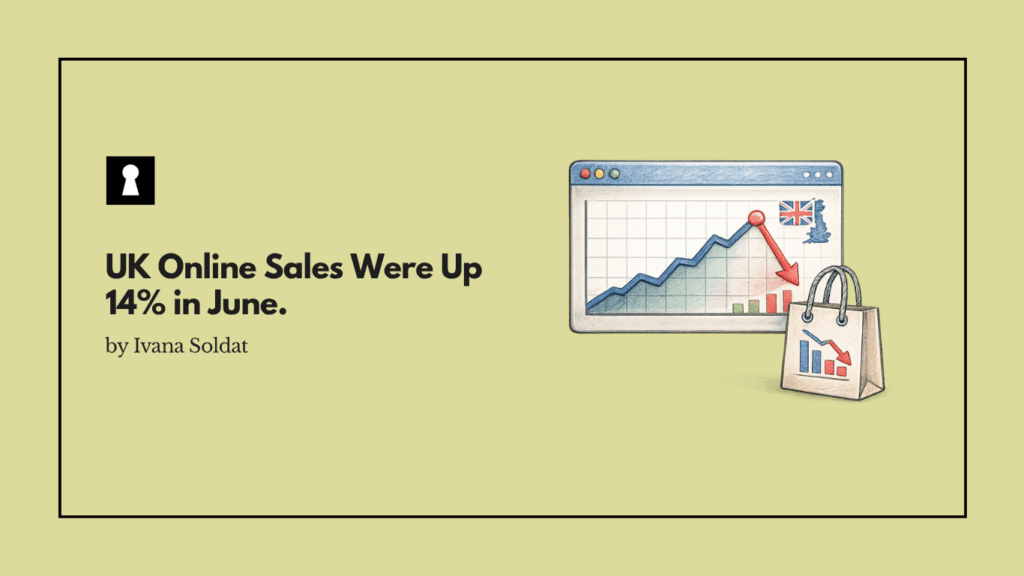
The UK retail data for July arrives with an almost perfect narrative arc. In June, online sales grew 14.4% year on year according to Office for National Statistics figures, a number strong enough to make retail analysts briefly optimistic about the second half of the year. Then July happened.
BDO’s High Street Sales Tracker shows overall retail sales grew 2.7% year on year in July. That headline is modest but positive. The composition underneath it is what matters.
In-store sales grew 3.8% for the month, the best high street performance since January. Online sales also started the month strongly. But both channels followed the same trajectory: a strong first half, then a rapid deceleration that left in-store growth at just 0.09% in the final week and online sales tipping into negative territory at -0.07%.
The Two Things That Drove the Strong Start
Sophie Michael, head of retail and wholesale at BDO, identified two primary demand drivers for July’s strong opening: the World Cup and the heatwave.
The World Cup connection is familiar to UK retail analysts. Major international football tournaments reliably accelerate specific purchasing categories, primarily electronics, beverages, food and grocery, and apparel, as consumers prepare to watch games, host gatherings, and express national identity. The effect front-loads demand that would otherwise be spread across several weeks.
The heatwave connection is more structurally interesting, and connects directly to the AliExpress Italy story EcomWatch covered earlier this month. A spell of unusually warm weather earlier in the summer encouraged consumers to refresh wardrobes, buy cooling products, and make outdoor purchases ahead of schedule. That demand was pulled forward, meaning it happened in May and early July rather than when it would normally occur in late July and August.
As Michael put it: “The spell of unusually warm weather earlier in the summer is likely to have encouraged many consumers to refresh their wardrobes sooner than they normally would, leaving less demand later in the season.”
The Gap the Pull-Forward Left
The mechanism that creates the second-half slowdown from a demand pull-forward event is straightforward. Consumer demand in any given category is not infinite.
A shopper who bought a summer wardrobe in May because the weather was warm is not going to buy another one in late July. A household that bought a portable fan during the heatwave does not need another one when the heatwave ends. A fan who bought a television for the World Cup is not going to buy another when the tournament is over.
Pull-forward demand events create a trough. The trough in late July is that trough. It is not a signal of structural retail deterioration. It is the mathematical consequence of consumers having already bought what they were going to buy.
The question for retailers heading into Q4 planning is whether the trough deepens or recovers once the pull-forward effect dissipates. Michael’s read is cautious: “After a very inconsistent first half of the year, the coming months are likely to prove decisive in determining the health of the UK’s retail sector.”
The Political Layer That Is Making Consumers More Cautious
Pull-forward effects and seasonal patterns explain much of the July trajectory. The BDO commentary adds a third factor that is harder to model: political uncertainty.
The UK has a new Prime Minister, and consumers and businesses are waiting for the Chancellor’s first budget and the potential impact of any fiscal changes. Michael notes that this waiting creates a cautious spending posture for non-essential items, as households hesitate to make discretionary commitments before they know what the budget will mean for their finances.
This dynamic, a government transition creating a spending pause while people wait to understand the new fiscal regime, is a recurring feature of UK retail data following elections and leadership changes. It typically resolves within one to two quarters as the budget is delivered and its implications become clear. Whether the resolution is positive or negative for consumer spending depends on the budget content, which remains unknown.
The June-to-July Swing Is a Warning for Q4 Planning
The gap between June’s 14.4% online growth and July’s near-flat performance is the data point that should be generating the most Q4 concern for UK ecommerce operators. A swing that large in a single month, driven partly by pull-forward effects and partly by political caution, suggests that the underlying demand environment is more volatile and more sensitive to external factors than the June number implied.
For merchants planning Q4 inventory, promotional timing, and marketing spend, the July trajectory argues for conservatism in the near term and flexibility in the medium term. The World Cup and heatwave pull-forward effects will not repeat. The political uncertainty will resolve in one direction or another. The demand that dissipated in late July either recovers as budget clarity arrives or continues to be suppressed if fiscal changes tighten household budgets further.
Our Take
June Was the Outlier, July Is Probably Closer to Normal
The UK July data is a useful corrective to the June optimism and fits the broader consumer picture EcomWatch has been building across multiple markets this month. The US Prime Day data showed record total spending with declining basket sizes.
The German H1 data showed ecommerce outperforming a weak consumer economy. The China 618 data showed flat platform growth with 80% growth in secondhand products. And now the UK data shows a month that started with World Cup and heatwave momentum and ended with online sales turning slightly negative in the final week.
The consistent theme across every market is a consumer who is still buying but buying more carefully, responding to specific demand triggers like warm weather or a major sporting event, and then pausing when those triggers are gone.
That is not a collapsing consumer. It is a cautious one. And cautious consumers require a different playbook than growing ones: more precise promotional timing, less dependence on broad-based demand, and a much clearer articulation of why they should buy now rather than later.