
The tariff refund story in US retail has had two chapters so far. Chapter one: the Supreme Court struck down the IEEPA-backed tariffs in February, meaning retailers that paid them were potentially owed refunds. Chapter two: CBP launched a refund portal in April and began processing claims.
The chapter nobody covered in detail is what happened between the original tariff payments and the Supreme Court decision, when the outcome was genuinely uncertain and some retailers needed cash badly enough to sell the future at a steep discount.
A secondary market emerged for retailers to sell off the economic rights to their potential IEEPA tariff refund claims. At a discount on the full value, buyers offered companies cash in exchange for the rights to those potential refunds. The approach is referred to as tariff refund monetization.
The discount structure reflects exactly how uncertain the outcome looked at the time. Prior to the Supreme Court’s decision, refunds were seen trading at 30 to 40 cents on the dollar, a 60 to 70% discount. After the decision and the establishment of the CBP refund process, refunds were seen trading around 60 cents on the dollar.
Sell before the ruling and you got between 30 and 40 cents for every dollar you were owed if the court ruled in your favor. Sell after the ruling and you got 60 cents. The retailers who sold early were paying a very high price for certainty at a moment when certainty was not available from any other source.
The American Eagle Math
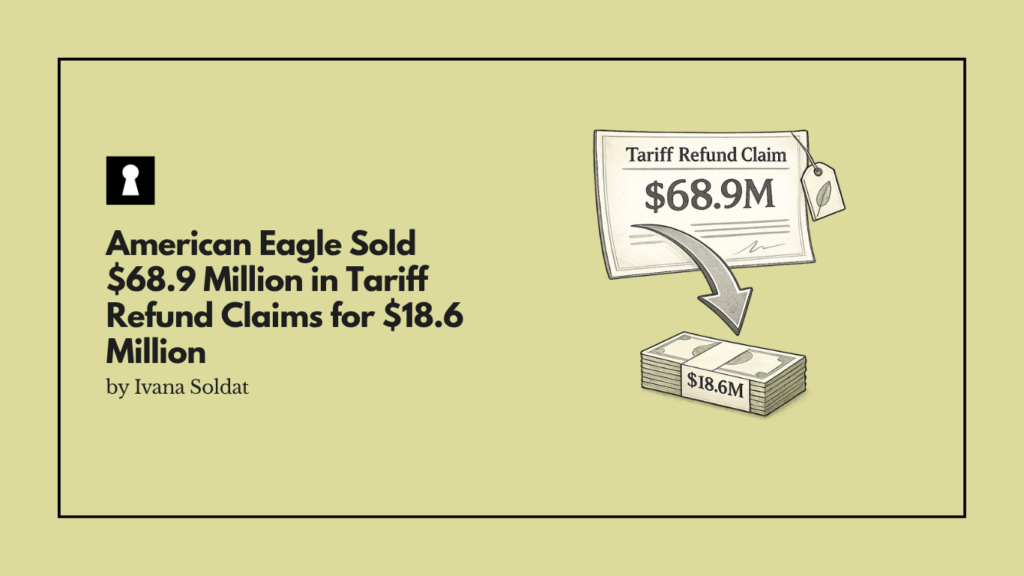
American Eagle sold a portion of its IEEPA tariff refund claims to a third-party buyer. The third party bought $68.9 million of the retailer’s refund claims for $18.6 million in cash. Since the company began receiving refunds from the government, $33.1 million was paid to the buyer as of the filing date of the quarterly report.
Run those numbers. American Eagle received $18.6 million upfront for $68.9 million in claims. That is 27 cents on the dollar. The buyer has already received $33.1 million back in actual refunds from CBP, meaning it has already made $14.5 million on an $18.6 million investment and still has more refunds coming. American Eagle had the cash earlier when it needed it, but at the cost of what looks likely to be $50 million or more in total value.
American Eagle in its Q1 earnings release said it had applied for about $190 million in tariff refunds, with a $140 million anticipated net cash benefit. The $68.9 million it sold represented a meaningful slice of the total potential refund. The decision to sell was presumably driven by genuine cash flow pressure that made $18.6 million now worth more than $68.9 million later, at the risk-adjusted discount rate that applied to the uncertainty at the time.
The Children’s Place and the ABL Credit Facility
The Children’s Place on March 31 entered into a claim sale and purchase agreement with Alnus Investors. Alnus purchased $38.2 million of refund claims at a total purchase price of about $25.7 million, or 67 cents on the dollar. The retailer used the net proceeds to partially pay down its borrowings under its ABL Credit Facility.
The Children’s Place got a better deal than American Eagle because it sold after the Supreme Court ruling had already established that refunds were coming. But getting only 67 cents even post-ruling tells you how significant the uncertainty about timing remained. CBP’s refund process was new, untested, and slow. Getting 67 cents now versus waiting an unknown number of months for 100 cents plus interest was a genuine financial calculation, not obviously wrong.
The use of proceeds is the telling detail. The Children’s Place used the cash to pay down its asset-based lending credit facility. ABL is revolving credit secured against inventory and receivables, typically used for working capital. Paying it down with tariff refund proceeds means the company needed the ABL capacity freed up for operational liquidity. This was not financial engineering. It was a struggling retailer managing a liquidity crunch.
The BJ’s Story: What Happens When You Try to Back Out
The most dramatic episode in the tariff refund monetization market belongs to BJ’s Wholesale Club, which allegedly agreed to a deal and then changed its mind.
Investment firm Oaktree Capital Management sued BJ’s for allegedly backing out of its deal to sell its refund claim. Oaktree said in its New York Supreme Court lawsuit from April that it had an agreement to purchase a $29 million refund claim from BJ’s for about $20 million, or about 70 cents on the dollar. BJ’s allegedly backed out of the deal after CBP announced in April that it would launch a tariff refund portal.
The sequence makes complete sense as a financial decision, even if it is legally problematic: BJ’s agreed to sell at 70 cents on the dollar under uncertainty about the refund timeline. CBP then announced a clear, official refund process. The certainty that BJ’s had been selling at a discount to acquire suddenly became available through the government process itself. Backing out and waiting for the full refund plus interest was clearly the better economic choice, which is presumably why Oaktree sued when BJ’s tried to do exactly that.
The Broader Lesson About Retail Cash Flow Under Tariff Pressure
BDO Managing Principal David Wong explained the underlying calculation: “For the seller, a lot of the risk is purely the economics of that transaction because of the uncertainty on exactly when an importer will receive their tariff refund. That’s been the biggest risk. Do I want to take a discount on the amount that could be refunded to me and get upfront cash today, and how does that compare with the full amount plus interest?”
Grant Thornton’s Lawrence Griff framed the broader context: “For certain retailers, there’s always a need for liquidity and cash.” He added that very cash-rich retailers with easy access to debt markets had no reason to sell at a discount, while retailers with tighter working capital had to price the uncertainty and sell.
The retailers who sold at the steepest discounts are the ones for whom cash flow pressure overrode the financial logic of waiting. That is a direct measure of how much pain the tariff environment created for mid-market retail specifically.
Our Take
This Is Exactly What Cash Flow Desperation Looks Like.
The tariff refund monetization market reveals how unevenly the tariff burden landed. Large retailers with easy access to debt markets and strong cash positions could wait for full refunds.
Retailers with tighter working capital and higher cost of capital had to sell future value at steep discounts to survive the present. American Eagle getting 27 cents on the dollar for $68.9 million in eventual refunds is not a story about a bad financial decision in isolation. It is a story about what cash flow pressure looked like under the IEEPA tariff regime for a company that needed liquidity more than it needed to wait.
The secondary market that emerged to buy those claims at a discount is simply the financial market pricing uncertainty. The discount between what sellers accepted and what buyers ultimately collected tells you exactly how much uncertainty was worth, and who had the leverage to bear it.