
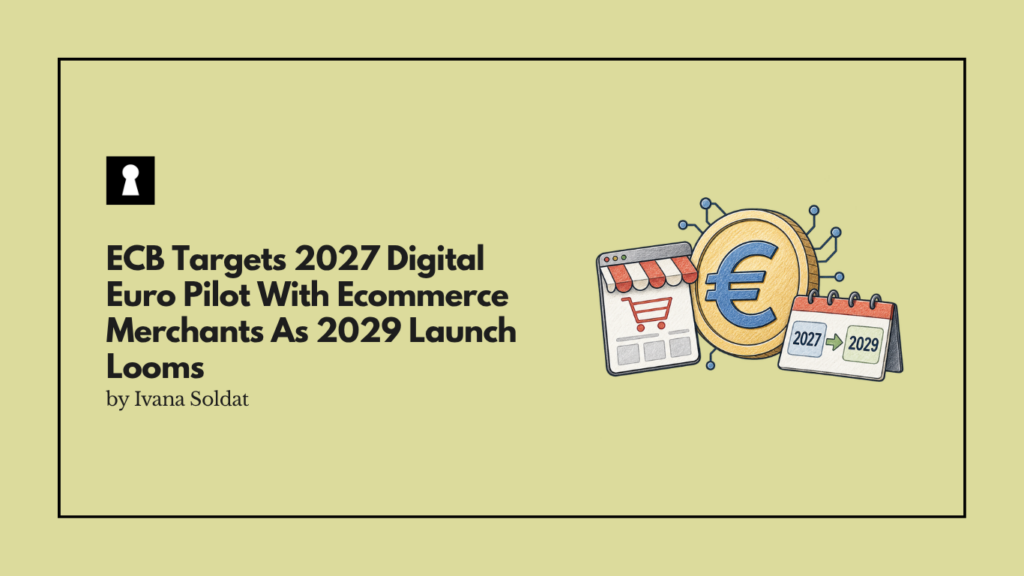
The European Central Bank is moving from theoretical design to practical application by inviting ecommerce and mobile commerce merchants to participate in a digital euro pilot program. Applications for this voluntary, unpaid initiative are due by October 27, 2026, with selected participants working alongside the ECB and national central banks to test a beta version of the currency.
This marks a critical transition for the Eurosystem, shifting the burden of validation onto the very retailers who will be forced to support the infrastructure if the digital euro eventually becomes legal tender.
The Pilot Tests Functionality But Leaves Merchant Fees Unresolved
The primary goal of the 12-month pilot, scheduled for the second half of 2027, is to assess technical functionality and operational processes in real payment environments.
Selected merchants will evaluate customer payment journeys and provide feedback on integration requirements. However, the ECB has remained conspicuously vague on the merchant service charge. While end-user transactions may be free, payment service providers will still need to recover costs, leading to intense lobbying from groups like EuroCommerce for a capped fee of 0.1 percent with a maximum of 4 cents per transaction.
Without a guaranteed low-cost structure, merchants will view the digital euro as a margin-eroding compliance mandate rather than a value-add.
Privacy Concerns Threaten Consumer Adoption At Checkout
A major hurdle for digital currency adoption is consumer trust regarding data privacy. The ECB has stated that the digital euro must ensure high standards of personal data protection, proposing a tiered privacy architecture that offers cash-like anonymity for offline transactions.
Yet, online ecommerce transactions inherently require some level of data sharing to prevent fraud and comply with anti-money laundering regulations. Shoppers accustomed to the seamless experiences provided by established card networks may balk at a central bank-monitored payment flow.
If consumers perceive the digital euro as a surveillance tool, conversion rates at checkout will plummet regardless of technical efficiency.
Integration Burden Falls Squarely On Retailers And Acquirers
Participation in the pilot requires merchants to sign an agreement with the ECB and adjust their contractual relationships with acquiring payment service providers. This is not a simple plugin installation. Integrating a new central bank digital currency requires updates to checkout interfaces, reconciliation systems, and treasury management processes.
For small and medium-sized ecommerce operators, the development cost of supporting a beta currency with no guaranteed volume is prohibitive. The ECB expects merchants to absorb this operational friction voluntarily, banking on the promise of future relevance rather than immediate commercial benefit.
The Digital Euro Is A Sovereignty Play Disguised As Innovation
The broader context of this pilot is European payment sovereignty, an effort to reduce reliance on non-European card schemes and digital wallets. The ECB aims to be ready for a potential first issuance of the digital euro during 2029, assuming the relevant EU legislation is adopted in 2026.
However, building a payment rail to satisfy geopolitical ambitions does not automatically create consumer demand. History shows that forced adoption of overly complex payment methods results in widespread workarounds and consumer frustration.
The digital euro must compete on convenience, not just regulatory mandate.
Our Take
A Central Bank Currency Cannot Mandate Consumer Preference
The ECB digital euro pilot is a classic case of supply-side solutionism. The central bank is building a sophisticated payment rail to solve a geopolitical problem, then expecting ecommerce merchants to bear the integration costs and consumers to overcome their privacy reservations.
Unless the Eurosystem can guarantee near-zero merchant fees and ironclad privacy protections, the digital euro will remain a niche novelty rather than a mainstream checkout option. Retailers should participate in the pilot to protect their interests, but they must fiercely resist any regulatory push that treats their checkout pages as a public utility for central bank experimentation.