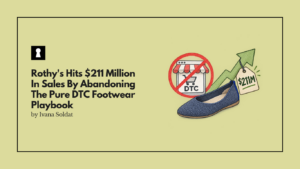

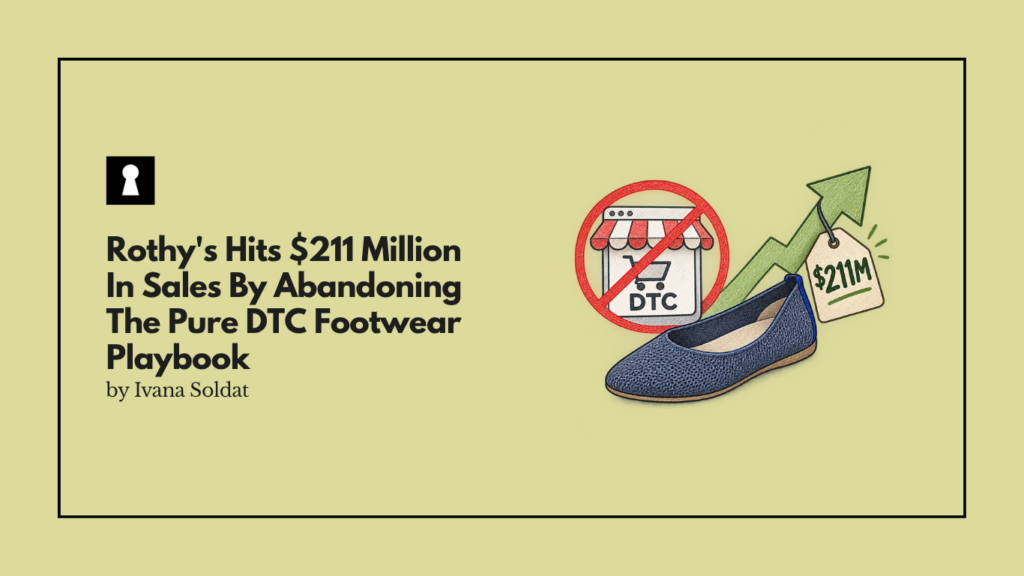
The direct-to-consumer footwear category has become a graveyard for brands that relied exclusively on digital customer acquisition. Rothy’s stands as a rare exception, reporting $210.6 million in revenue for 2024, representing a 16.8 percent year-over-year increase.
This growth was not driven by viral social media campaigns or inflated digital ad spend. Instead, it was fueled by a 20 percent same-store sales growth and a deliberate expansion into wholesale and physical retail.
Allbirds Proves The Pure DTC Footwear Model Is Financially Broken
The contrast between Rothy’s and its most famous peer is stark. Over the five fiscal years ending in 2024, Allbirds lost $419 million on cumulative sales of $1.24 billion and has never turned an annual profit. In the third quarter of 2025 alone, Allbirds saw net revenue fall 23.3 percent to $33 million while posting a net loss of $20.3 million.
Allbirds built its valuation on the promise of digital-native efficiency and sustainable materials, but it failed to account for the compounding weight of customer acquisition costs and return rates. Rothy’s avoided this trap by recognizing early that digital-only scalability is a myth in the footwear category.
Wholesale Partnerships Provide A Necessary Margin Cushion
Rothy’s leadership recognized that relying solely on its own e-commerce site capped its total addressable market and exposed it to volatile digital ad pricing. By forging strategic wholesale partnerships, the brand secured predictable volume and improved unit economics.
This wholesale strategy has managed to keep Rothy’s ahead of a growing number of imitators in the competitive knit ballet flat space. Wholesale channels absorb inventory risk and provide brand visibility in physical environments where customers can actually try on the product, solving the fit uncertainty that plagues online shoe sales.
Controlled Retail Expansion Beats Blind Digital Scaling
Rather than burning capital on broad digital awareness campaigns, Rothy’s has methodically tested physical retail concepts. The company plans to add roughly nine new stores in 2025, building on a fleet that already drives significant same-store sales growth.
Physical stores serve as high-converting customer acquisition channels that simultaneously reduce return rates and build brand legitimacy.
Rothy’s parent company, Alpargatas, reports these figures in consolidated earnings releases, which inherently frame the subsidiary’s performance in the most favorable light to justify their continued investment. However, the underlying metric of positive EBITDA, reaching $17.9 million in 2025, demonstrates genuine operational leverage that purely digital peers lack.
Sustainability Is A Marketing Hook, Not An Operational Moat
The ecommerce industry frequently conflates environmental marketing with operational resilience. Rothy’s famous use of recycled plastic bottles is an effective customer acquisition tool, but it does not lower freight costs or prevent chargebacks.
The brand’s staying power comes from its willingness to adopt unglamorous, traditional retail operations. While other founders were busy raising venture capital to subsidize free shipping, Rothy’s focused on inventory turnover, wholesale margin structures, and physical foot traffic.
Our Take
Survival in Modern Retail Requires Abandoning Ideological Purity in Favor of Unit Economics
The narrative that Rothy’s is a sustainable direct-to-consumer success story is a mischaracterization of its actual business model. Rothy’s is succeeding precisely because it stopped acting like a typical direct-to-consumer startup.
It embraced wholesale margins, opened physical stores, and prioritized profitability over vanity growth metrics. Footwear founders still chasing the pure digital dream should look closely at this pivot.
If your brand cannot survive without subsidizing customer acquisition, your sustainability claims are just expensive packaging for a failing business model.