

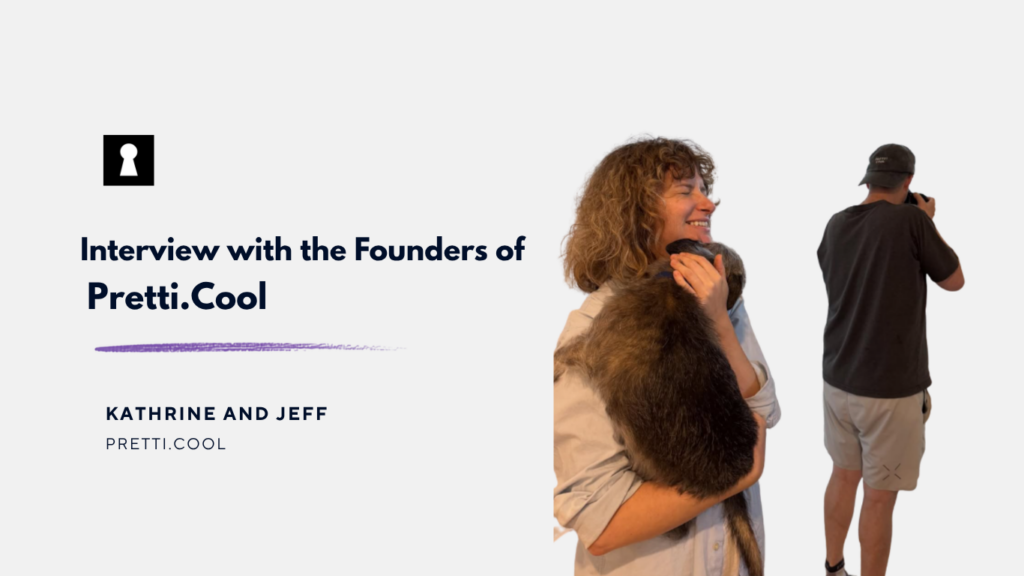
The Houston studio has spent nearly a decade hand-casting playful concrete objects, working with major retailers and hotels, and learning that staying small can be a strategy, not a limitation.
Pretti.Cool began in 2017 as a collaboration between a group of creatives working across apparel, photography, jewelry, painting, textiles, ceramics, and furniture. Gilmer had previously designed womenswear at Abercrombie & Fitch. Her husband and co-founder, Jeff Gilmer, is a photographer.
From the beginning, the group made one decision that would shape much of what followed: they didn’t name the company after any of themselves.
That distance created what Gilmer calls a kind of “freedom to fail.”
“When your own name is on something, every idea gets run through ‘what will this do to my reputation?’ before it gets run through ‘is this fun?’” she says.
Reverse those questions, and suddenly a concrete banana seems perfectly reasonable.
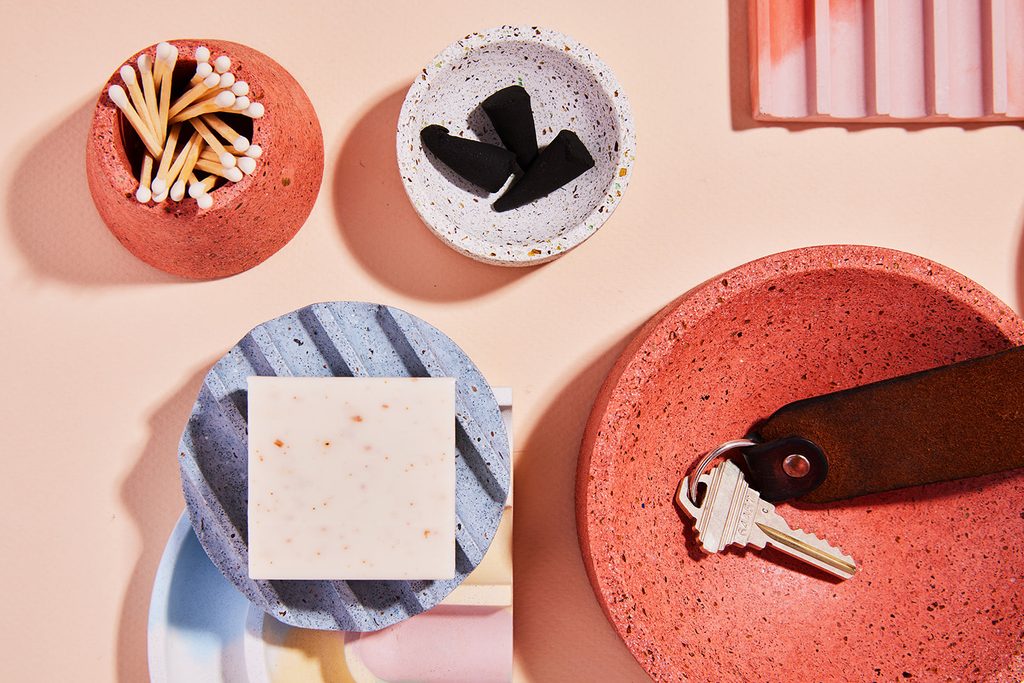
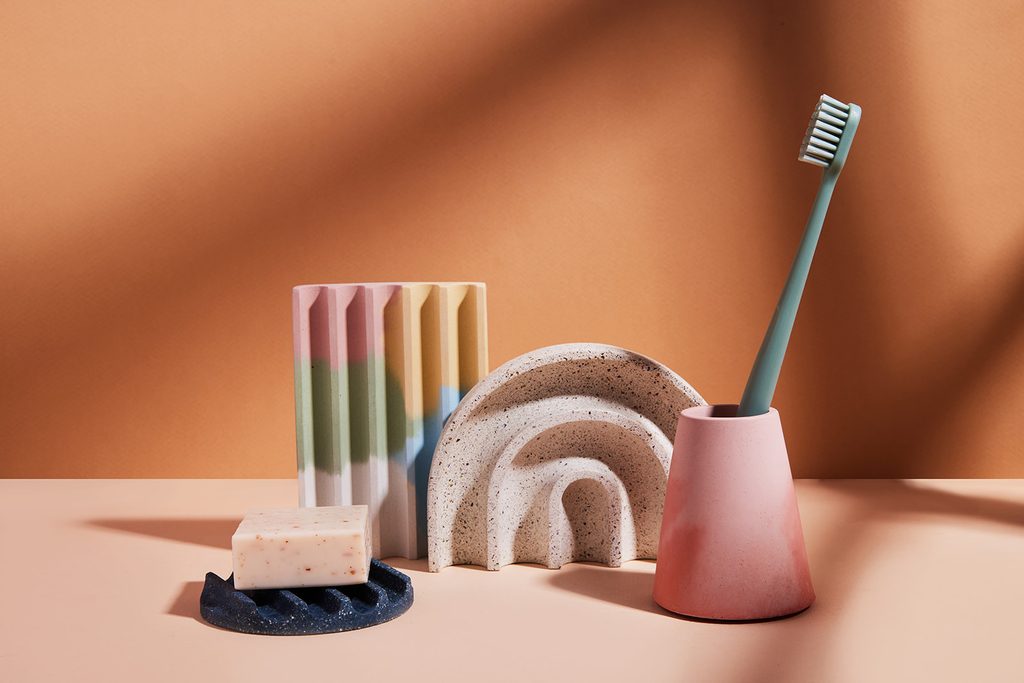
So do vases inspired by trash, rainbow-shaped sponge rests, terrazzo soap dishes, ice buckets and a company name that, according to Gilmer, everyone thought was dumb for about a week before buying the domain.
Some experiments failed. Others that initially seemed like weaker ideas became bestsellers. The important part was creating a business in which trying them did not feel catastrophic.
Small enough to experiment
Nearly a decade later, much of Pretti.Cool’s concrete collection is still cast and finished by hand in Houston.
That production model puts an obvious ceiling on certain kinds of growth. But Gilmer sees the constraint differently.
Making things in-house allows the studio to control quality, protect what makes its products distinctive and, crucially, experiment without committing to enormous production runs.
It has also shaped the kind of growth the company pursues.
Instead of trying to become a factory capable of supplying an endless stream of new SKUs, Pretti.Cool looks for projects suited to the way the studio already operates. A hotel ordering several hundred ice buckets in a single shape and custom color, for example, can be an excellent fit. A mass retailer expecting a constantly changing assortment might not be.
The studio has worked with companies including West Elm and Nordstrom, as well as hotels and brands such as Ace Hotel, Trailborn and Huckberry.
And when an opportunity exceeds the team’s capacity, Pretti.Cool has learned to say no.
“We’ve had to turn down large orders that we knew we didn’t have the capacity to fulfill within their timeline,” Gilmer says. “It hurts to say no, but we also take pride in being able to deliver on-time and to protect the work/life balance of our team.”
That doesn’t mean the company treats local production as a rigid ideology. A recent limited tortoiseshell glass and ceramic collection with FabFitFun was manufactured overseas with the company’s production partners – a first for Pretti.Cool.
The distinction is transparency. The concrete remains cast in Houston, while the studio leaves itself room to evolve.
“I won’t promise ‘forever,’ because I don’t know what the next ten years look like,” Gilmer says. “But I’d rather grow the way we make things than trade it for speed.”
When a small company works with a big one
For a small creative studio, landing a major retailer or hospitality client can look like a milestone that requires suddenly behaving like a much larger business.
Gilmer has found almost the opposite.
“You learn that a big company is mostly a calendar,” she says.
There are deadlines, templates, image requirements, portals and buyers juggling dozens of vendors. The advantage of a small company is not pretending to possess the infrastructure of a global supplier. It is being responsive, flexible and reliable.
“What they want from us isn’t scale – it’s to be the easy one: answer fast, hit the date, ship the spec right the first time.”
Being small can even be part of the reason a company comes to Pretti.Cool in the first place. Hotels want hand-cast objects. Brands want custom colors. They are seeking something that would be difficult to get from a giant standardized supply chain.
“That’s not a limitation to explain away,” Gilmer says. “It’s the reason they called.”
Growing without becoming an influencer
There is another thing Pretti.Cool has resisted scaling: the founders themselves.
Gilmer describes the team as introverts who grew tired of the expectation that running a creative business also means becoming full-time content creators.
For years, their instinct was to let the products speak.
Sometimes that works. A vase shaped like garbage or a rainbow sponge rest has a built-in ability to travel. The humor does some of the promotional work by itself. Strong photography helps too; Jeff photographs the studio’s products, giving the brand a recognizable visual language without requiring its founders to constantly appear on camera.
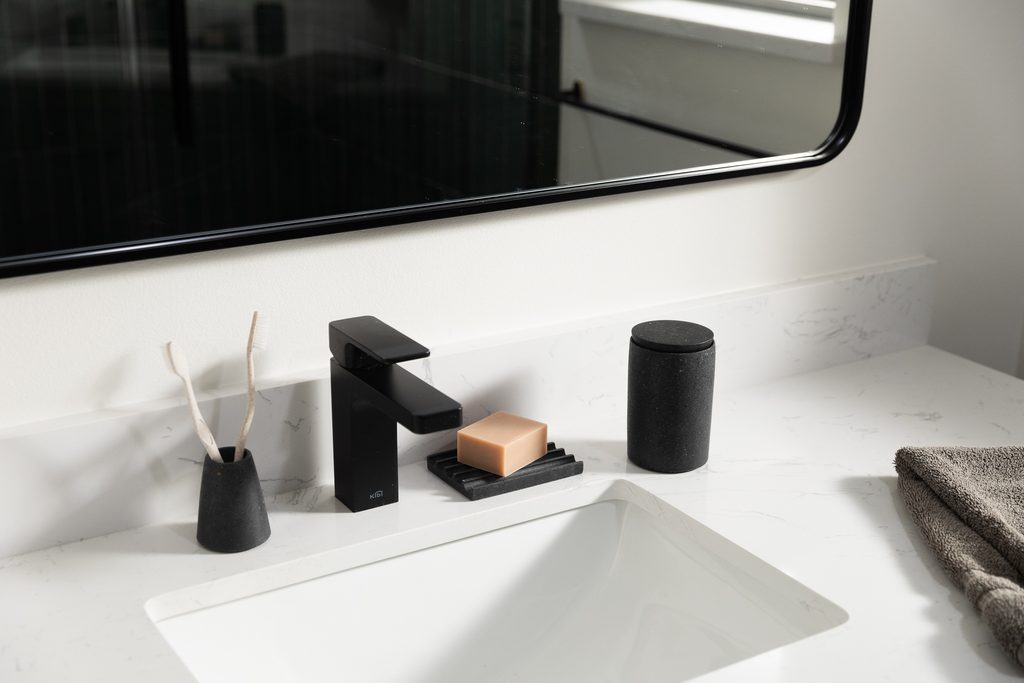
Retail partners have also done something the founders were not naturally inclined to do themselves: put the work in front of a much larger audience.
But Gilmer’s thinking on the subject has changed.
One of the beliefs she held when Pretti.Cool launched, and no longer does, is that good work simply speaks for itself.
“The work speaks for itself only to people who’ve already found it,” she says.
Everything around the product – the photography, its name, the story of where it was made and the people behind it – is part of communicating the work.
For years, she says, one of Pretti.Cool’s strongest differentiators was almost hidden: every concrete object was being hand-cast in Houston by real people customers could conceivably meet.
“It’s the most defensible thing about us and we treated it like a footnote.”
That realization hasn’t turned Gilmer into an aspiring influencer. Instead, it has changed how she thinks about the founder’s job.
Her advice to other introverted entrepreneurs is not to force themselves into roles they cannot sustain.
“Be realistic about your strengths and weaknesses and figure out how to outsource or delegate tasks that you’re not wired to maintain long term because the eventual burnout isn’t worth it,” she says.
Leadership, she argues, does not have to mean becoming the face of everything. It can mean building the right team.
Pull the numbers before the feelings
The same resistance to overreaction shows up in how Pretti.Cool evaluates products.
When something stops selling, Gilmer tries not to immediately interpret it as a judgment on the idea – or on the company itself.
Instead, the studio looks for patterns.
A product that performs on Pretti.Cool’s own website but not through a retailer might have a placement problem. A shape that sells in white but not coral might have a color problem. If every product in a particular channel is down, the problem may be the channel.
“We try to pull the numbers before we have the feelings,” Gilmer says. “It’s cheaper.”
Recently, a retail partner identified one of Pretti.Cool’s categories as a candidate to be dropped. Looking at the actual numbers told a different story: sales in the category had grown five-fold year over year. The decline the retailer was reacting to existed across the broader program, not within Pretti.Cool’s product.
Without the data, Gilmer says, they might have accepted the conclusion that the product itself had failed.
There is a less scientific test too.
Watch what happens when someone encounters the object in person.
“If people pick something up at a pop-up and smile, the idea works and we’ve got a photography or naming problem,” Gilmer says. “If they pick it up and put it down, that’s the idea.”
The expensive lessons
Pretti.Cool’s preference for small bets came partly from learning what happens when those bets become too large.
The studio has discovered the danger of production minimums, particularly early in a company’s life. An idea can feel exciting enough to justify a large upfront commitment long before there is evidence that customers share the enthusiasm.
The same lesson applies to packaging.
At one point, the company ordered custom packaging with minimum quantities in the thousands for each SKU. The corresponding products sold in the hundreds.
The packaging was beautiful.
It also sat in boxes for years.
These days the studio would rather use a stock box with a good sticker than invest heavily in packaging designed for volumes it has no reason to expect.
Software became another quiet expense. Like many small ecommerce companies, Pretti.Cool accumulated monthly subscriptions promising improvements to SEO, speed, syncing and other parts of the business. An audit revealed that some were doing almost nothing.
Gilmer’s test now is simple: ask what the software actually did for the business last month.
The larger lesson is to remain emotionally detached enough to let evidence change your mind.
“Bootstrap wherever you can and try to not become emotionally invested in ideas that don’t have a lot of data to support a huge financial investment,” she says.
The principle applies not only to money but to attention. Early on, it was easy to interpret every bad review or slow sales week as a referendum on the company. Over time, the team learned that what feels personal can often be explained by seasonality, traffic or merchandising.
Defining “enough”
For many businesses, conversations about scale eventually become conversations about size: more employees, more locations, more production, more revenue, more everything.
Pretti.Cool has a different definition.
“Enough,” for Gilmer, is a studio that pays people on time, produces objects the team would put in their own homes and does not require its founders to become influencers in order to survive.
“By that definition we’re already there most months,” she says, “which is both a strange and nice thing to be able to say.”
That doesn’t mean the studio wants to stop growing.
It means growth can take another form.
Pretti.Cool wants more hotel projects. More custom work. More situations where a brand arrives with a colorway and a problem for the studio to solve. A handful of thoughtful product drops each year.
What Gilmer does not necessarily want is a much larger headcount or a factory.
Pretti.Cool started as a way for a group of people to make things together without attaching their individual names to every success or failure. The structure gave them room to experiment.
“It would be okay if it flopped,” Gilmer says.
It didn’t.
The challenge now is keeping enough of that original freedom intact as the business continues to grow.
You can check out more about Pretti.Cool here:
https://www.instagram.com/pretti.cool