
“Kidulting”, adults engaging with toys, games, and playful products traditionally marketed to children, has been documented since the 1950s.
What changed in 2026 is that toy companies stopped treating it as a niche and started treating it as a growth strategy. Birth rates are declining, the child customer base is contracting, and adults have credit cards, disposable income, and a demonstrated willingness to spend on products that deliver escapism, connection, and nostalgia.
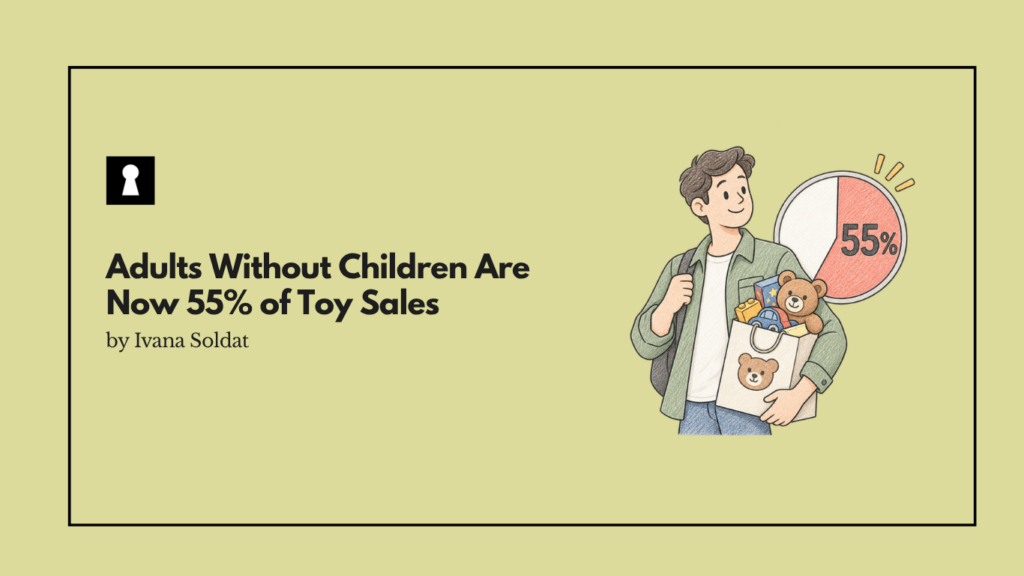
Adults 18 and older drove 35% of toy industry growth through April 2026. Adult-only households accounted for 55% of toy sales, up 16% year-over-year. In the UK, roughly one in every three pounds spent on toys is spent by over-12s for themselves. Nearly half of UK adults bought a toy for themselves or another adult in the past year.
These are not marginal numbers. They describe a consumer segment that has been buying toys all along, that toy companies largely ignored, and that is now being explicitly targeted for the first time with products designed specifically for them.
Why Now
Three structural forces converged to make kidulting commercially significant enough to warrant intentional product lines.
The first is fandom mainstreaming. Nerd culture and fandom culture have moved from niche to mainstream. Collecting Star Wars figurines, building elaborate Lego sets, opening Pokemon cards, behaviours that were once socially marginal, are now normalised in ways that have material commercial consequences.
The second is the pandemic effect. Confined to home with time to fill, a meaningful cohort of adults discovered that building Lego sets was genuinely satisfying, relaxing, mentally engaging, and productive in a tactile way that screen time was not.
The third is the stress and escapism dynamic. “Times of economic difficulty, income being squeezed, the world feeling stressful, toys give this kind of escapism, they give some joy, and they’re a relatively inexpensive purchase,” said EMARKETER principal analyst Carina Lamb on today’s podcast. This is a variant of the lipstick effect we confirmed in this week’s retail earnings roundup: consumers maintaining small affordable luxuries when larger discretionary spending is constrained.
The Products That Are Actually Working
Lego Botanicals drove significant volume growth in building sets, which was the fastest-growing toy category last year. Lego Masters, the television show showing adults building elaborate Lego models, modelled the behaviour publicly and made it socially legible in mainstream culture.
Crayola launched All Grown Up, including alcohol-based markers that are functionally different from children’s products. Play-Doh’s Blooms partnered with the Whitney Museum for its launch and distributed through TikTok before reaching retail. Build-A-Bear created a Bear Cave section on its website explicitly for shoppers aged 18 and older.
The pattern across all four: emotional continuity with a childhood brand, genuine product development for the adult use case, and marketing that meets adult consumers where they are rather than where children’s toy marketing traditionally runs.
The Blind Box Mechanic That Is Already Mainstream Ecommerce
One specific kidulting mechanic deserves attention beyond the toy category: the blind box.
EMARKETER’s Zak Stambor described it precisely: “People love gambling. And this is low-stakes gambling. It creates an element of fun when you don’t know what is in the blind box, when you open a pack of baseball cards. It’s fun, and it’s something to talk about and engage with.”
The blind box mechanic has already migrated well beyond toys. Mystery boxes in beauty and fashion. Subscription boxes with curated surprise products. Limited edition drops where the specific product is only revealed at purchase or delivery. All are the same underlying mechanic: the pleasure of anticipation, the dopamine spike of reveal, and the social currency of sharing what you got.
For any ecommerce brand thinking about product innovation, the blind box mechanic is one of the most commercially validated engagement tools in retail. It drives repeat purchase, social sharing, and the kind of community formation that loyalty programmes spend enormous resources trying to create.
What Non-Toy Brands Should Take From This
“Don’t be blinkered when you’re defining your customer base,” said Lamb. “Toy companies had long thought, ‘We’re a toy company. We serve kids.’ And then you start to look into your data, and you start to see some adults buying Legos.”
The discovery moment is in the data, not in trend reports. Adult-only households were already buying toys before any toy company built products specifically for them. The behaviour preceded the product. The question for any brand is whether there is a consumer segment buying their products in ways they did not design for, and whether building explicitly for that segment would grow the market.
The equivalent question for an apparel brand is whether their category is clothing or self-expression. For a kitchen brand, whether their category is cookware or the ritual of cooking. For a fitness brand, whether their category is exercise equipment or the feeling of physical capability. Each reframe opens a different set of potential customers who share the underlying motivation but do not see themselves in the existing marketing.
The Social Permission Problem Toy Companies Solved
The most nuanced observation from the podcast is Lamb’s point about social permission: “The toy industry hasn’t invented this adults-playing thing. What they’ve helped do is reframe it as something else.
So it’s stress relief, it’s unplugging, rather than immaturity or childishness. Any brand that’s sitting on a behavior that people are already doing but might feel a bit sheepish about has the same opening.”
The behaviour that people feel sheepish about is the signal. The brand that finds language and framing that converts the sheepishness into pride is the one that unlocks a market that was already there.
Our Take
Adults Were Already Buying Your Products. You Just Haven’t Asked Why.
The kidulting trend is most useful for EcomWatch readers not as a toy industry story but as a case study in market discovery. Adults were buying toys before Lego Botanicals existed. They were crafting before Crayola All Grown Up launched.
The toy industry’s achievement is not inventing a new consumer segment. It is recognising an existing one, building products specifically for it, and finding language that converts a behaviour people felt slightly embarrassed about into a mainstream cultural practice. Every ecommerce brand has a version of that story somewhere in their customer data, the adult-only households buying your product, the use case you did not design for but is appearing in your reviews, the demographic purchasing at higher rates than your marketing targets.
The toy industry found its version by looking at who was actually buying. The exercise is the same for any brand willing to look honestly at their data rather than their assumptions.