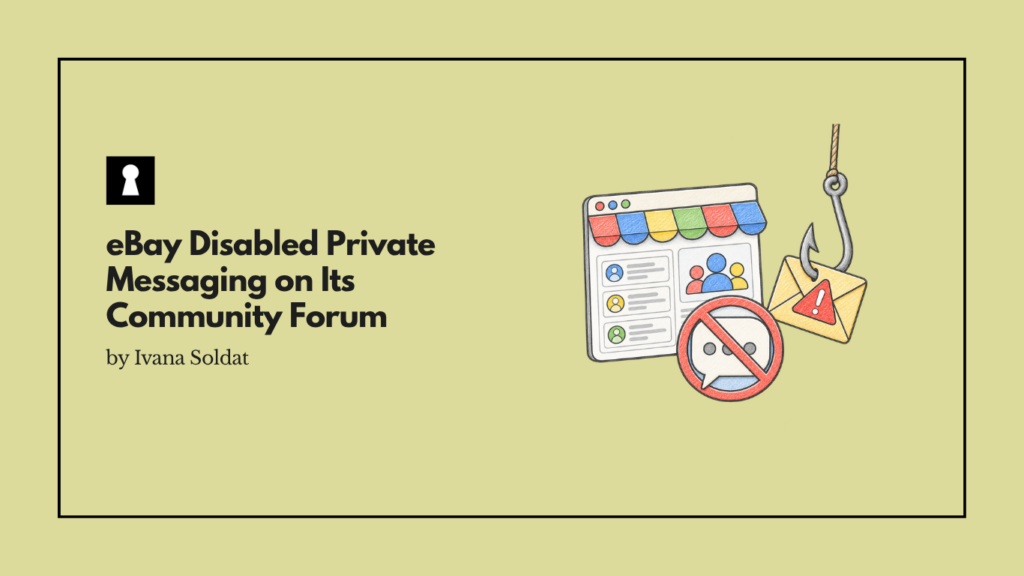
The phishing attempts arriving through eBay Community direct messages are, by eBay’s own admission, “very difficult to identify as phishing attempts.” The platform’s response is to turn off the channel entirely rather than attempt to filter or verify messages within it.
What eBay Is Asking Sellers to Do Instead
Verify links before clicking. Do not enter any sensitive or confidential information on external websites. Inspect the web address for any page asking for personal or sensitive information. Do not grant anyone access to your eBay account. When in doubt, contact the eBay Community team directly at [email protected]. Report suspicious emails by forwarding them to [email protected].
These are the right instructions. They are also the same instructions that have appeared on every major platform’s security guidance page for a decade. The problem is that the consumer who is susceptible to phishing is susceptible precisely because they cannot reliably identify which communications to be suspicious of. The guidance assumes a level of vigilance that the scammers’ techniques are specifically designed to circumvent.
The Infrastructure Gap the Two Stories Reveal
Yesterday, Amazon launched Alexa for Shopping’s message verification feature, which lets any customer ask the AI whether a specific message, email, phone call, or text claiming to be from Amazon is genuine, checking against Amazon’s record of every communication it has ever sent and responding in seconds.
Today, eBay temporarily disabled private messaging on its Community forum because the phishing got too sophisticated to filter.
Both platforms are dealing with the same underlying attack: fraudsters using platform channels or platform impersonation to reach sellers and buyers with convincing fake messages. The difference in response capability reflects a real investment gap in fraud infrastructure.
Amazon’s solution is active and scalable: an AI that grows more effective with every query because each verification request is automatically reported to the fraud team. eBay’s solution is passive and blunt: turning off the channel rather than being able to verify what is flowing through it.
Neither response eliminates the problem. Amazon’s verification tool only helps consumers who know to use it and think to ask. eBay’s channel shutdown protects community forum users while the ban is in effect but does not address the broader phishing problem that extends to email impersonation, fake buyer messages, and the full range of eBay-branded scam communications.
The Timing Is Particularly Notable
eBay is having a complex month. We covered the $55.7 million settlement with EcommerceBytes founders David and Ina Steiner. We covered the Second Chance Offers bug that publicly exposed private seller data for months. We covered the eBay 2026 Holiday Seller Playbook releasing alongside new Seller Hub features.
Into that context arrives a notice that phishing on eBay’s own community platform has gotten bad enough to require shutting down a communication channel. The action is reasonable given the circumstances. It is also a data point about where eBay’s platform security investment sits relative to the fraud environment it is operating in.
For eBay Sellers: What to Watch For Right Now
The immediate risk is Community forum direct messages. The broader risk landscape for eBay sellers includes: fake buyer messages that mimic eBay system notifications, email impersonation where the sender address resembles an eBay domain, fake payment notifications claiming funds are pending, requests to communicate outside eBay, and fake Second Chance Offers sent via external channels.
The advice is consistent with eBay’s notice: verify everything through the official eBay app or eBay.com directly, never click links in messages you did not expect, and never complete a transaction through any channel other than eBay’s official platform.
Our Take
eBay Turned Off Its Forum’s Messages. Amazon Built an AI. Both Are Fighting the Same Problem.
The juxtaposition of Amazon’s Alexa for Shopping message verification launch and eBay’s Community messaging shutdown on the same day is not a story about one platform being good and one being bad. It is a story about what different levels of fraud infrastructure investment look like in practice.
Amazon has invested in a scalable AI-based verification system that gets smarter with every use. eBay has responded to a phishing surge by disabling a communication channel. Both are rational responses to their respective situations. The fraud environment they are both operating in, sophisticated, platform-aware, continuously adapting, is the same.
The question for any platform watching this week’s news is where their own fraud infrastructure sits on the spectrum between those two responses, and whether the answer is adequate for the peak season that starts in eight weeks.