
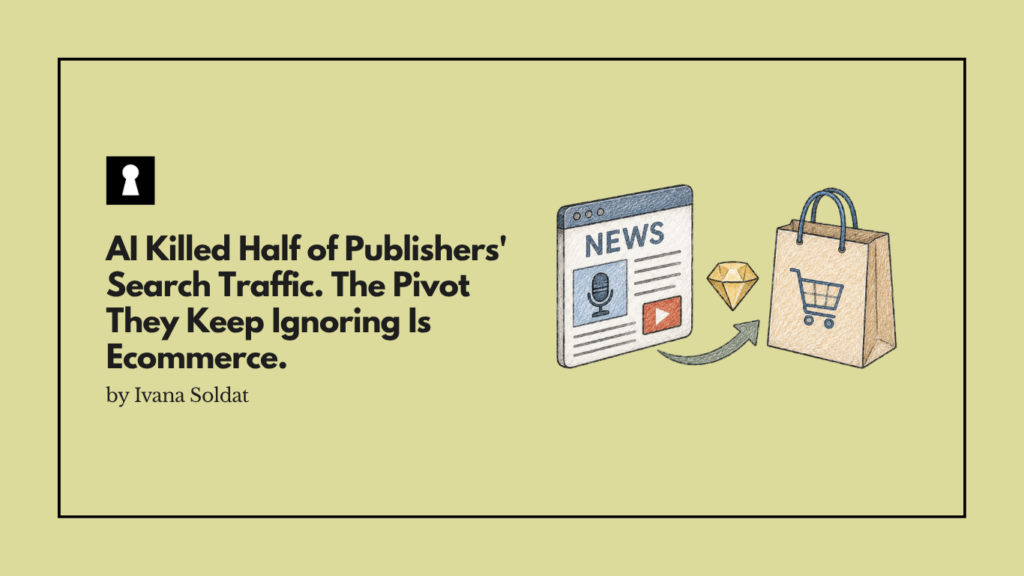
AI-generated search summaries and chat are reducing the number of visitors to publishers’ websites. Reports from the Pew Research Center, Ahrefs, Search Engine Land, and various academic sources suggest that search engine traffic to publisher websites has dropped by 50% or more due to the presence of AI Overviews alone.
That is not a slow decline. That is a structural collapse in the primary distribution channel that most online media businesses were built around, happening on a timeline measured in months rather than years.
The revenue attached to that traffic has followed. Most publishers earn revenue from impression-based advertising. For example, a news site might earn up to $80 per 1,000 sessions. A drop in search engine traffic leads to fewer sessions and, in turn, a corresponding drop in revenue. The standard responses have been depressingly familiar, paywalls that most readers will not cross, newsletters that convert a fraction of the original audience, and desperate SEO chases after whatever the current AI ranking signal appears to favor.
None of them solve the underlying problem, which is that the business model was built on renting audience from Google, and Google has stopped paying the landlord.
What Publishers Have That Retailers Would Kill For
Publishers are well positioned for retailing for at least three reasons: audience, a content engine, and promotional machinery.
Most retailers spend enormous sums on advertising trying to acquire the kind of customer data that publishers have accumulated as a byproduct of running their business. Online publishers are expert at producing content that gets attention, ranks, and converts readers into repeat visitors. And publishers can drive significant promotional attention to things they care about, across email, social, and their own properties.
Taken together, these three assets describe a business that is already most of the way to being a retailer. The question is why more publishers have not made the move.
The Three Models Worth Taking Seriously
There are at least three possible business models for media companies: affiliate listings that earn commissions when shoppers buy, indirect ecommerce such as hosting a marketplace or negotiating commerce partnerships, and direct ecommerce selling physical products akin to a retailer.
Affiliate listings are the lowest-barrier entry. Most publishers with any commerce-adjacent content are already doing a version of this. The ceiling is limited because affiliate commissions are thin and the model requires high volume, but the floor is also low.
Indirect ecommerce, either hosting a marketplace or building commerce partnerships with brands in the publisher’s category, sits in the middle. A cooking publication building a marketplace for kitchen equipment is a natural extension of what it already does. The margin potential is higher than affiliate, the operational complexity is moderate, and the editorial credibility the publisher brings to product selection is a genuine differentiator.
Direct retail, actually buying and holding inventory, is the highest-risk and potentially highest-reward model. It requires a supply chain, fulfilment infrastructure, customer service capability, and working capital. But it also generates the highest margin, the strongest customer data, and the clearest competitive moat.
The Ecommerce Businesses That Already Prove This Works
This is not theory. Several media and content businesses have already made the pivot. The Points Guy built a financial services affiliate business on travel content. Wirecutter was acquired by the New York Times for $30 million in 2016 and generates significant revenue through affiliate commerce. NerdWallet went public as a financial comparison and content platform. The Strategist at New York Media is affiliate commerce woven directly into editorial content.
What these businesses have in common is that they treated commerce as a natural extension of what their audience was already coming to them for, rather than as a bolt-on revenue stream that felt disconnected from the editorial product. The publishers that have failed at commerce have generally done it the other way: slapped a shop onto a content site without thinking through why their specific audience would buy from them rather than from Amazon.
Our Take
AI Just Accelerated a Decision Every Publisher Was Delaying
The practical ecommerce pivot for publishers is not a new idea, and the reason most publishers have not done it is not that they lack the assets. It is that running an ecommerce operation is genuinely different from running a media operation.
The skills, the workflows, the metrics, and the incentive structures are different in ways that are not obvious until you are inside them. A publisher that decides to launch a retail business is not just adding a revenue stream. It is adding a second business that needs its own P&L, its own operations, and its own customer relationships.
The publishers most likely to succeed at this are the ones that treat it as exactly that: not a feature of their media business, but a business that happens to benefit from the audience and content their media operation has built. The AI search disruption has made the question of what to do next more urgent for every publisher.
The answer that most of them have been slowest to take seriously is the one that their existing assets are most directly positioned to enable.