
The Trump administration’s tariff program has been a study in legal persistence. The original Liberation Day tariffs, imposed under the International Emergency Economic Powers Act in April 2025, were struck down by the Supreme Court earlier this year after the court ruled the administration had exceeded its authority.
Replacement tariffs imposed under a different legal reading were ruled unlawful by the US Court of International Trade in May. An appeals court paused that ruling while the administration appealed. The temporary 10% global tariffs that replaced them expired at 12:01 a.m. ET this morning.
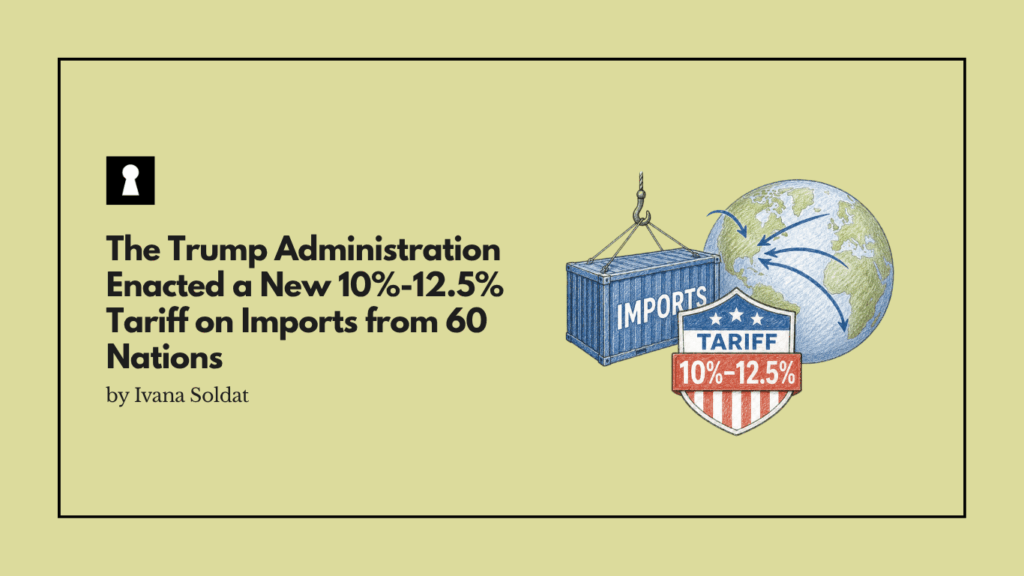
Also taking effect at 12:01 a.m. ET this morning: new tariffs of 10% to 12.5% on imports from 60 countries, imposed under Section 301 of the Trade Act of 1974.
Section 301 is a more defensible legal vehicle than IEEPA. The statute gives the president explicit authority to impose tariffs on countries engaged in unfair trade practices after a formal USTR investigation. The administration concluded that 60 major trading partners have failed to impose and effectively enforce prohibitions on goods produced with forced labor.
The new tariffs apply to 60 trade partners and cover 99.4% of US imports, with exemptions for oil, gas, fertilizer, and products qualifying for duty-free status under the USMCA. NBC News
Who Gets What Rate and Why
The tariff structure has two tiers, and the distinction between them matters for any brand tracking their specific supply chain countries.
Countries that have committed to implementing a forced labor prohibition, including Bangladesh, Canada, India, Mexico, and the United Kingdom, will receive a tariff rate of 10%. Countries that have not made such a commitment will face a slightly higher rate of 12.5%.
For certain non-exempt products from the EU, Japan, South Korea, Switzerland, and Taiwan, the US will charge an extra tax so that the total tariff, including the normal most-favored nation tariff, comes to either 10% or 12.5%.
Vietnam and China are among the countries facing the 12.5% rate. The EU, despite being the largest single US trading partner and having comprehensive modern slavery legislation, faces up to 12.5% on non-exempt products. Australia and New Zealand, which have progressive forced labor frameworks by any independent assessment, also sit in the higher bracket.
The Reaction Has Been Immediate and Angry
Australia’s Trade Minister Don Farrell called the 12.5% tariffs “unjustified” and said Australia has “some of the most progressive legislation anywhere in the world” on modern slavery. New Zealand’s Prime Minister Christopher Luxon called the tariffs “extremely disappointing” and said the US investigation “did not provide meaningful evidence to support claims in relation to forced labour.”
The EU strongly rejected the forced labor characterization, with an EU official telling NBC News: “You can’t say that for the European Union.”
The political subtext is not subtle. Section 301 investigations require a finding of unfair trade practices. Critics argue that the statute is being used to give the administration legal footing for a broad tariff regime that the Supreme Court would not permit under IEEPA. The forced labor framing is the justification that fits within Section 301’s requirements. Whether it reflects the administration’s primary motivation is a different question.
What This Means If You Source From Any of These 60 Countries
For brands sourcing primarily from China and Vietnam, the 12.5% rate replaces the previous temporary 10% rate. The net effect is a modest increase on top of the existing China-specific tariffs that have been in place since 2018. Today’s 12.5% stacks on those.
For brands sourcing from the EU, UK, Japan, and South Korea, the picture is more complicated because the rates interact with existing trade agreements and MFN tariff levels. The USTR’s approach of setting a total tariff floor rather than a flat additional rate means the actual duty increase varies by product and country of origin.
For brands sourcing from USMCA-qualifying Canada and Mexico, the picture is unchanged from yesterday: goods meeting USMCA rules of origin remain duty-free. This is the most significant exemption in the new regime and is worth understanding in detail if any part of your supply chain runs through North American manufacturing.
The Legal Vulnerability Nobody Is Talking About
Section 301 is more defensible than IEEPA, but it is not immune to challenge. The statute requires that tariff actions follow a formal investigation with findings, public comment periods, and determinations that follow from the evidence. Trade law experts have flagged that a Section 301 forced labor investigation targeting 60 countries simultaneously is an expansive use of the statute that could face its own legal challenges.
The administration also cannot provide a revenue estimate for the new tariffs, a USTR spokesperson told CNBC, which is unusual for a trade action of this scope and has drawn its own commentary.
Our Take
The Record Port Imports Make Sudden Sense
The timing of today’s tariff announcement is the most important thing about it for ecommerce operators to understand.
We covered the record July port import volumes earlier this week, noting that brands were racing to get inventory into US warehouses before new tariffs potentially hit. The August deadline supply chain managers were planning around was precisely this one, the expiration of the temporary 10% tariffs and the uncertainty about what would replace them.
Now the replacement is known. It is 10% to 12.5% under Section 301, applied to 99.4% of US imports, with a legal foundation more durable than the one the Supreme Court struck down. For brands that successfully front-loaded inventory into US warehouses before today, the immediate impact is manageable.
For brands that did not, and for those in categories where inventory cannot easily be accelerated, the cost structure just changed again. The age of disruption that the NRF’s Jonathan Gold described earlier this month has not ended. It has acquired a new legal framework.