
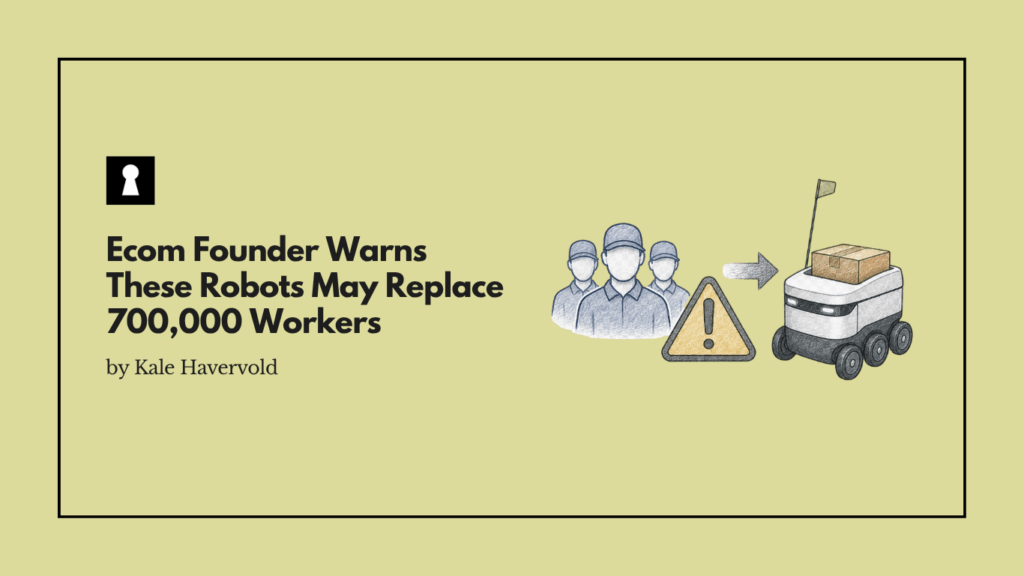
According to expectations from Richard Liu, the founder and chairman of JD.com, one of the largest ecommerce companies in the world, robots will eventually replace the company’s approximately 700,000 delivery couriers.
JD.com isn’t the only company planning to implement robots for deliveries and other purposes, and while many companies focus on the positives of this move, such as lower labor costs and better efficiency, there are also negatives that ecommerce companies need to focus on to make sure that implementing robots actually makes sense for them.
Ecommerce Founder Predicts Robots Will “Sooner or Later” Take Over Deliveries
Being one of the largest ecommerce brands in the world, JD.com makes plenty of deliveries. While these are often handled by one of the company’s 700,000 delivery couriers, Richard Liu, the chairman and founder of the company, expects robots to eventually take over the work.
While he didn’t provide any sort of timeline of when this would happen, he said that “In the future, when robots are delivering parcels, sooner or later, there will be a day when couriers are basically no longer needed.”
However, Liu also wanted to make sure he was clear that this massive change for the company wouldn’t end in mass unemployment for those workers. Specifically, he said that “It will definitely be robots delivering parcels. But I really do not want our 700,000 brothers to go without meals, without jobs.”
As a result, JD.com has entered into agreements with around 120 schools to retrain these couriers for new jobs and work, including repairing and maintaining robots. This is similar to what Liu has said in the past, when he said that the company wouldn’t fire anyone being replaced by robots, instead opting to retrain and reassign them somewhere else.
So while these workers may not be needed for deliveries any longer, Liu seems to still want to do right by them and ensure they still have a job going forward.
Delivery Robots are Growing Increasingly More Common
Despite there being no timeline for JD.com’s eventual move to robotic deliveries, the company’s supply chain and logistics wing, JD Logistics, has said it would buy 3 million robots, 1 million autonomous vehicles, and 100,000 drones through 2030.
Even outside of JD.com, delivery robots are becoming more and more common in ecommerce. For example, Alibaba’s logistics arm, Cainiao, expects over 200,000 unmanned vehicles to be deployed throughout the Chinese logistics industry by 2030.
Other major companies, such as Amazon, are also testing delivery robots. In addition to robots on the ground, Amazon is also taking things to the sky, as it plans to scale drone delivery, as well.
Beyond deliveries, mobile robots that can handle things like stocking shelves, handling inventory, transporting items, sorting and preparing orders, and other tasks are also becoming more popular.
The Benefits and Drawbacks of Using Delivery Robots
There are several reasons why so many companies are testing and/or already implementing robots for delivery and other tasks. By eliminating plenty of human labor, robots have the potential to save businesses thousands of dollars or more.
But in addition to financial savings, using robots may boost efficiency, help companies scale faster, and help a company become more eco-friendly, as many robots run on batteries and don’t produce emissions like most delivery vehicles do.
However, there are also some downsides to these robots, such as their high initial costs, regular maintenance, cleaning, and charging, as well as the public backlash that may come about if city sidewalks are overrun with small robots making deliveries.
Some may also struggle in severe weather and have difficulties dealing with difficult terrain like stairs, uneven ground, unpaved roads, and more.
So before you jump to introduce robotics or other kinds of automation into your ecommerce supply chain, make sure to consider whether it’s actually right for you. If not, you may end up spending a ton of money upfront on robots that don’t improve your operations as much as you were hoping for.
Our Take
The Future Seems Clear, But Not the Timeline
With so many companies showing interest in and testing robots, it seems clear that eventually deliveries, and likely several other parts of the ecommerce supply chain, may soon be automated by robots.
However, what isn’t clear is just how long it’ll take for this to happen. While it won’t happen overnight, it wouldn’t be surprising to see many companies expand the testing they’re doing and start moving delivery robots from the testing and experimental stage to full-on implementation.
As long as the tests and experiments show results that are consistently favorable in terms of performance, cost, and safety, don’t be shocked to see companies go all in on robots, potentially sooner rather than later.