
Surveillance pricing has been one of those practices that everyone in ecommerce knew was happening and nobody could quite prove was illegal. The technology has been available for years. The FTC opened an inquiry into it in 2024. Some retailers have quietly tested it. None of them called it surveillance pricing. They called it personalization, dynamic pricing, demand-based optimization, or simply did not call it anything at all.
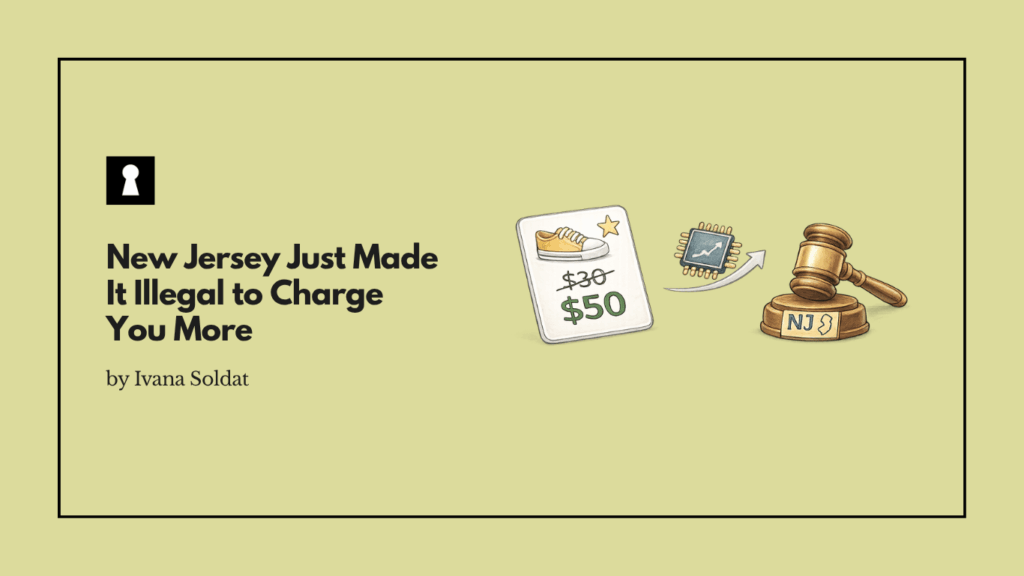
New Jersey has now named it, defined it, and banned it for groceries and other necessities. The Fair Price Protection Act prohibits retailers from using personal information, including online activity, location, purchasing history, or other collected data, to charge different prices for identical products based on what an algorithm predicts a shopper is willing or able to pay.
The law explicitly preserves loyalty programs and general discounts, which do not charge the same customer more but rather offer some customers less.
What Surveillance Pricing Actually Is
The distinction the law is drawing is worth being precise about because it is not the same as dynamic pricing, which is legal and widespread.
Dynamic pricing changes prices based on market conditions: supply, demand, time of day, competitor pricing. An airline that charges more for the last seat on a flight is doing dynamic pricing. A hotel that charges more on a Saturday night in July is doing dynamic pricing. All of that remains legal under the Fair Price Protection Act.
Surveillance pricing is different. It changes prices based on individual customer characteristics: not what the market will bear, but what this specific shopper will bear. An algorithm that has learned from your browsing history that you typically buy premium products, live in a high-income zip code, shop primarily on a weekday morning when you are less likely to price-compare, and have shown low price sensitivity in the past, could theoretically show you a higher price than another shopper seeing the same product at the same moment. That is what the law prohibits.
Governor Sherrill framed it directly: “If businesses want to compete, they should do so by offering better prices, not by finding new ways to squeeze shoppers.”
The Electronic Shelf Label Pause
The law also includes a one-year moratorium on new installations of electronic shelf labels in grocery stores while the New Jersey Innovation Authority studies their effects. Existing labels can continue operating, and stores can repair or replace them. New deployments are paused.
Electronic shelf labels are the digital price displays that replace paper tags and can update prices remotely in real time. Their connection to surveillance pricing is direct: a store with electronic shelf labels and customer-tracking infrastructure can theoretically update shelf prices in real time based on who is in the aisle. The moratorium is a precautionary measure, not a ban, but it signals that the legislature sees the technology as a potential vector for exactly the kind of individualized pricing the law prohibits.
Why New Jersey, Why Now
The FTC’s 2024 surveillance pricing inquiry named eight companies, including Mastercard, Revionics, Bloomreach, JPMorgan Chase, and Accenture, as having provided or developed the underlying technology. The inquiry gathered information but produced no enforcement action.
What made New Jersey move faster than federal regulators is the political context. The price of groceries is the most politically salient consumer issue in the US right now, and the idea that families might be paying more for milk and bread because an algorithm determined they could afford it is precisely the kind of concrete, personal harm that generates legislative momentum faster than abstract privacy concerns do.
Attorney General Jennifer Davenport was specific: “The price New Jersey families pay at the grocery store should be based on the cost of a product, not on what invasive data collection suggests they may be willing to pay.”
The Part That Every Ecommerce Operator Should Read Carefully
The Fair Price Protection Act applies to New Jersey retailers. It applies to groceries and necessities. It does not, on its current terms, apply to national ecommerce platforms selling discretionary goods.
But state legislation in the US has a documented pattern of becoming federal legislation, and the federal government has a documented pattern of following state leadership on consumer protection issues. California’s data privacy law became the template for what is now a patchwork of state laws pointing toward a federal standard. New Jersey’s surveillance pricing ban may be the first iteration of a prohibition that, in five years, looks more like a national framework.
For any ecommerce operator that is currently testing, using, or considering individualized pricing based on personal data, New Jersey’s law is the clearest signal yet of where the regulatory direction is heading. The technology exists. The commercial logic is compelling. The political and legal resistance to it is building faster than most ecommerce operators’ compliance teams are tracking.
Our Take
The Price You See Is Not Necessarily the Price Someone Else Sees
The Fair Price Protection Act is a grocery law in one US state, but it is carrying a broader message about how regulators are starting to frame AI-driven pricing.
The line the New Jersey law draws, between charging less to loyal customers and charging more to vulnerable ones, is a line that the ecommerce industry has been blurring for years by calling both ends of it personalization. The law distinguishes between a discount that benefits the shopper and a markup that exploits what the algorithm knows about them.
That distinction is going to become increasingly important as more states, and eventually federal regulators, decide which side of that line they are on. The ecommerce operators who are building revenue strategies around the second kind of personalization should be paying close attention to New Jersey, not because the law applies to them today, but because laws that start in one state rarely stay there.