
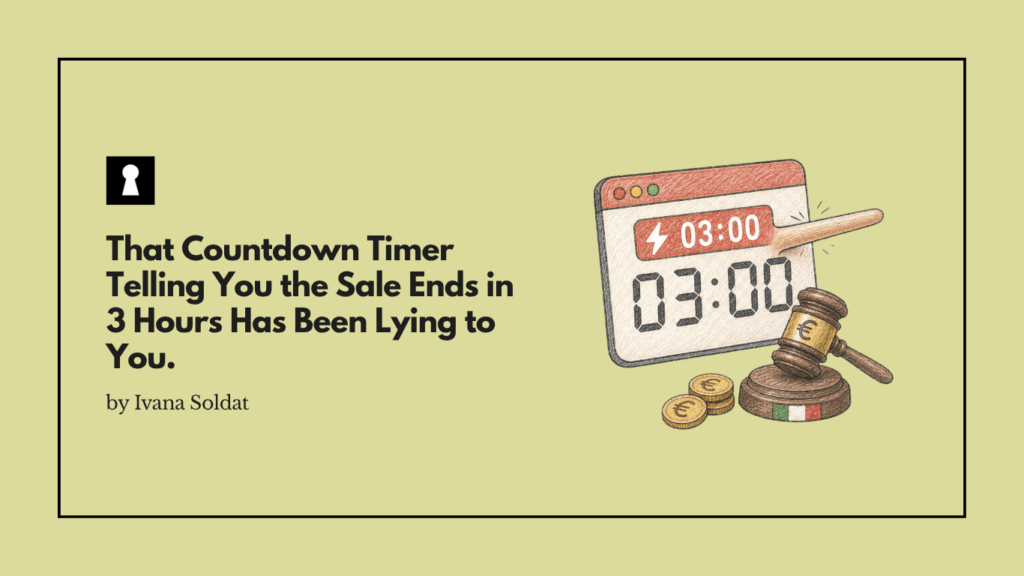
You have seen the timer. Every ecommerce shopper has seen the timer. It sits underneath the discounted price, ticking down to zero, creating the very specific psychological sensation that if you do not buy this item in the next two hours and forty-three minutes, you will lose the deal forever and regret it deeply. The timer hits zero. The deal is gone.
Except, at Deghi, it was not gone. It restarted. Immediately. At the same price. As if nothing had happened.
Italy’s Autorità Garante della Concorrenza e del Mercato found that between early 2024 and the end of 2025, Deghi was running countdown timers on promotional offers that were completely fictional. When the clock ran out, the offer did not expire. The timer simply reset and started counting down again from the same starting point, showing the same price to the next shopper as if they had just caught a fresh deal in its final hours.
The fine: €2 million.
The Dark Pattern by Name
Italy’s antitrust authority did not mince words about what kind of practice this is. The countdown timer trick is a textbook dark pattern, the industry term for interface design deliberately built to manipulate user behavior rather than inform it. The psychological mechanism is well documented: artificial scarcity and time pressure short-circuit deliberate decision-making and push people toward impulse purchases they might not otherwise make. When the scarcity is real, this is aggressive but legal marketing. When the scarcity is fabricated, it is consumer fraud dressed up as a user interface.
The AGCM found that the Deghi countdown mechanism was not an isolated bug or a one-off promotion gone wrong. It was systematic, applied repeatedly across multiple products over nearly two years. That finding is what turned this from a compliance issue into a €2 million penalty.
The Second Violation: Fake Discounts
The countdown timer was not the only problem investigators found. The authority also determined that Deghi’s advertised discount percentages were being calculated against the wrong baseline price.
Under the EU Omnibus Directive on price transparency, which Italy has incorporated into national law, any advertised discount must be calculated against the lowest price the product was sold for in the preceding 30 days. This rule exists specifically to prevent retailers from briefly inflating a price, then discounting back to what was always the normal price and calling it a sale.
Deghi was calculating its discounts against the original launch price of its products, not the 30-day baseline. A product that launched at €500, settled to €350 as its normal price, and then went on sale at €320 could be advertised as a 36% discount using the launch price baseline, rather than the roughly 9% discount it actually represented against what shoppers had been paying for it all along.
The two violations compound each other neatly. The fake countdown creates urgency to act on a discount that is itself artificially inflated. The shopper thinks they are catching a rare deal in its final hours. They are catching neither.
“It Was Just a Technical Glitch”
Deghi’s legal team argued that the countdown restarts were not intentional deception but rather technical anomalies related to how the platform updated its pricing systems. The resets, they argued, were artifacts of different promotional campaigns running sequentially rather than a deliberate manipulation mechanism, and the intent was never to mislead consumers.
The AGCM reviewed the platform data in detail and concluded the opposite. The pattern was too consistent, applied across too many products, over too long a period to be explained by technical error. The authority’s assessment was that the mechanism was not accidental. It was a feature.
Our Take
The Timer in Your Browser Is Probably Fine. Probably.
The Deghi case is interesting beyond the Italian market because fake countdown timers are one of the most widespread dark patterns in global ecommerce, used by platforms and merchants at every scale from independent Shopify stores to major retail brands.
The practice is common enough that most shoppers have developed a vague intuition that the timer is not always real, without ever quite having enough evidence to act on that suspicion. Italy’s antitrust authority just provided the evidence, and the €2 million fine is large enough to land as a real signal rather than a rounding error in a marketing budget.
The uncomfortable question for every ecommerce operator running countdown timers right now is a simple one: if a regulator looked at your timer data for two years, what would they find?