
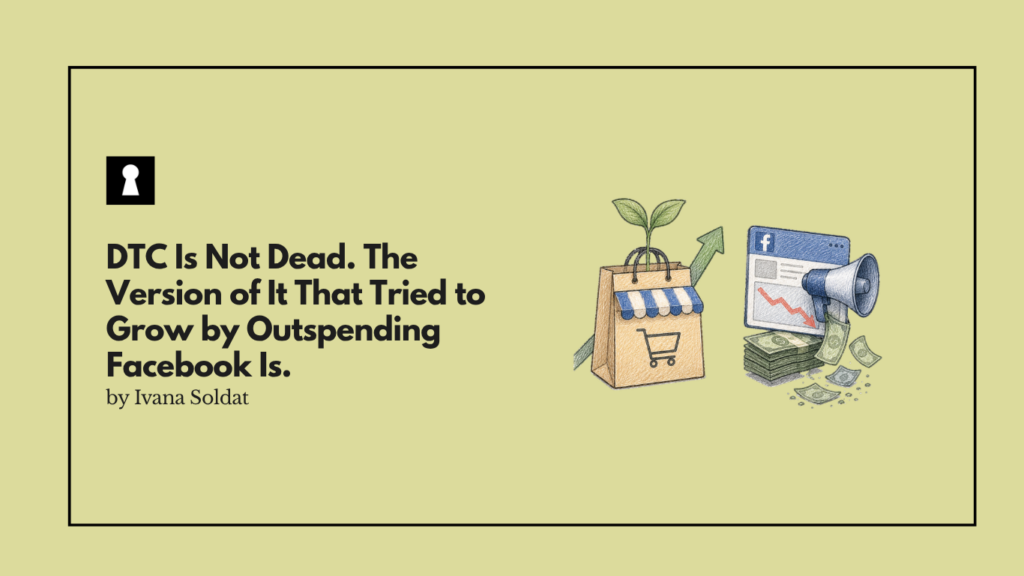
The original DTC model was a marketing arbitrage play dressed up as a brand strategy. Startups like Casper, Warby Parker, Everlane, and Allbirds discovered a window in the mid-2010s when Facebook advertising was cheap, consumer trust in Instagram-native brands was high, and the cost to acquire a customer online had not yet been bid up by the volume of brands chasing the same audiences. They built significant businesses in that window. The window is closed.
Facebook advertising costs have risen to the point where the unit economics that made the original DTC model work no longer function for most product categories. Everlane sold to Shein. Allbirds is now, apparently, an AI company. Both outcomes represent the end of a specific era rather than the end of direct-to-consumer commerce.
DTC Is Now a State of Mind, Not a Channel Strategy
Modern Retail Executive Editor Anna Hensel made the argument that we’ve been building toward across several pieces this month: the channel is not the brand. A company can be meaningfully DTC, building a genuine direct relationship with customers and using that relationship to inform product decisions, pricing, and communication, while doing most of its actual sales volume through Target, Walmart, or TikTok Shop.
The distinction is about purpose. A brand that knows what each channel is for, that uses its own website for relationship depth and data quality, uses wholesale for volume and discovery, and uses TikTok Shop for impulse and launch, is operating a coherent multi-channel strategy with a DTC sensibility. A brand that is purely DTC because it cannot get wholesale placement is not the same thing.
“A successful DTC brand today has a clear understanding of what the purpose of each channel is,” Hensel said.
The Brands Winning Are the Ones That Know Their Customers by Name
Editor Jill Manoff cited an example worth examining closely. Favorite Daughter, the fashion brand from sisters Sara and Erin Foster, is doing something that most ecommerce brands have the data to do but almost none of them actually do: the founder knows the names of her top 20 spenders. She tracks when a customer who has historically bought every two months stops buying and sends them a gift.
This is not scalable in the literal sense. You cannot have a personal relationship with a million customers. But the intelligence that informs that kind of relationship is scalable: the data on purchase frequency, the flag when a high-value customer’s behaviour changes, the intervention that makes the customer feel seen rather than marketed to.
This connects to the Shopify Q2 data we covered earlier this week: AI search tripling orders because it understands intent and constraint better than keyword search does. The brands getting the most from that shift are the ones whose product data is rich enough for AI to query. The brands getting the most from their customer relationships are the ones whose customer data is granular enough to act on. Both require the same underlying discipline: actually paying attention to what your customers are doing and why.
Product Differentiation Is Doing More Work Than It Used To
Special Projects Editor Melissa Daniels made the point that “pretty new packaging” for a standard product is no longer enough to command a premium. This is more urgent than it has been in several years for two reasons.
The first is the consumer caution environment we have been documenting all month. When 38% of US holiday shoppers say tighter budgets will have the biggest impact on their spending, a consumer who was previously willing to pay a small premium for a well-photographed commodity product will reconsider. Genuine product differentiation gives the consumer a reason to spend that is about what the product does rather than what it looks like.
The second is the competitive environment. Temu, Shein, and AliExpress have made commodity products available at prices that eliminate the margin a slightly better presentation used to capture. If your product is not meaningfully different in function, materials, or experience, the pricing gap between your brand and a Chinese platform alternative has narrowed to the point where it no longer justifies the premium for a meaningful share of consumers.
Tin Can, the modern landline cited in the Modern Retail piece, grew through word of mouth by selling something genuinely novel. That is product differentiation working as intended.
The Wholesale Question Every DTC Brand Is Getting Wrong
Senior Fashion Reporter Danny Parisi observed that the most successful DTC-originated brands are running integrated models with a small number of strategic wholesale partnerships rather than staying pure DTC or pursuing wholesale at scale. Universal Standard at Anthropologie. Mejuri at Nordstrom. Both are wholesale placements that provide discovery and credibility without creating channel conflict or margin erosion.
The failure mode is the brand that pursues wholesale broadly, gets into too many doors, loses the scarcity and intentionality that made the brand worth stocking, and ends up in a clearance rack. Wholesale partnership quality matters more than quantity.
Reformation is the outlier: 90% of revenue through its own DTC site, recently went public, genuinely distinctive product with a customer who will seek it out rather than needing to discover it in a department store. There are very few Reformations. The strategic lesson is specific and limited: if your product is distinctive enough and your customer is committed enough, you can sustain a high-DTC model. If you are trying to scale into a mass market, you probably cannot.
Our Take
DTC Is Not a Channel. It Is a Customer Relationship Standard.
The brands that succeeded on the original DTC playbook succeeded because they found a window in the cost-and-attention landscape and moved through it fast. That window is closed.
The brands succeeding now are building genuine customer knowledge, selling differentiated products, and being strategic about which channels serve which purposes. None of those things require venture capital. They require discipline, data literacy, and a willingness to know your customer as a person rather than as a segment. T
he Favorite Daughter founder knowing her top 20 spenders by name is not a strategy that scales infinitely. It is a signal about the kind of attention that earns loyalty in an environment where every brand is optimising for the same metrics and most customers can feel the difference between being marketed to and being known.