
Ecommerce brands have become extremely good at asking AI what customers might want.
Apparently, somebody finally remembered that they could also ask the customers.
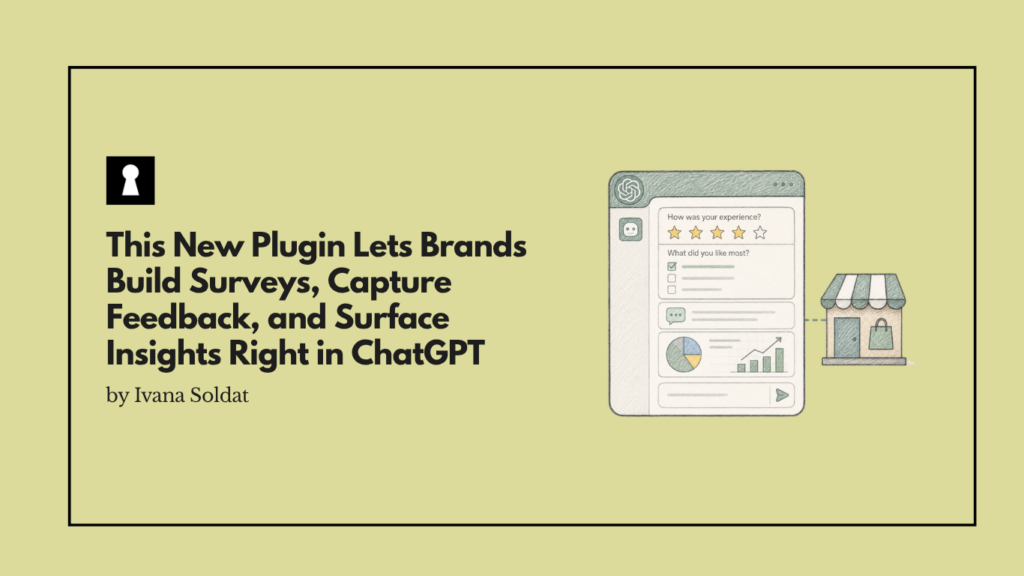
SurveyMonkey launched a new ChatGPT plugin this week that lets users create and edit surveys, publish them, access existing surveys and analyze response data directly inside a ChatGPT conversation. The integration officially launched August 12 and is powered by the Model Context Protocol, or MCP.
The basic pitch is simple: instead of bouncing between ChatGPT, SurveyMonkey, spreadsheets and whatever document someone eventually pastes the findings into, teams can handle much of the process from the same chat.
That could be particularly useful for ecommerce brands, where customer feedback exists everywhere and somehow still manages to be difficult to actually use.
SurveyMonkey Basically Moved The Feedback Loop Into The Chat Window
Once connected, the SurveyMonkey plugin can turn a natural-language request into an actual survey.
A user could ask ChatGPT to create a post-purchase survey, refine one of the questions, add a product-feedback question and then generate a shareable survey link without opening SurveyMonkey separately.
When responses arrive, the process also works in reverse.
ChatGPT can pull SurveyMonkey response data back into the conversation, summarize results and surface recurring themes or patterns. It can also search existing surveys in a connected account, so users don’t necessarily need to remember that somebody named the customer-satisfaction survey “CX FINAL v2 USE THIS ONE.”
SurveyMonkey says users can also combine information from previous surveys with other sources when analyzing results, rather than treating every new survey as an isolated research project.
That’s where this starts becoming more interesting than simply having AI write ten survey questions.
AI could already do that.
The useful bit is connecting the questions to actual customer responses.
Asking AI What Customers Think Is Not The Same As Asking Customers
There is an increasingly strange habit developing inside companies.
Someone wants to know why customers are abandoning checkout, what they think about a new product or whether a price increase will annoy them.
So they ask ChatGPT.
That can be useful for generating hypotheses. It is considerably less useful as evidence of what actual customers believe.
SurveyMonkey itself makes essentially that distinction in explaining the new integration: AI can generate a plausible answer based on existing patterns, but that answer isn’t feedback from the people actually buying the product.
For ecommerce companies, the difference matters.
A model can suggest that customers might be returning a dress because of sizing.
A survey can tell you that 43% of respondents think the sizing chart is confusing, 28% say the product looks different from the photos and somebody named Deborah is furious about the zipper.
Deborah is data too.
Ecommerce Brands Have No Shortage Of Things They Should Probably Ask About
The obvious use case is post-purchase feedback.
A brand could create a short survey asking customers what influenced their purchase, whether the product met expectations, how they found the sizing or quality and what nearly stopped them from buying.
But the more interesting applications happen before and around the transaction.
A skincare brand testing a new product could survey existing customers about ingredients, packaging and expected price before ordering 20,000 units.
A fashion retailer could ask shoppers why they abandoned a particular collection.
A subscription company could survey customers who canceled.
A brand getting buried in returns could ask customers what actually went wrong instead of trying to reconstruct consumer psychology from a drop-down menu containing “other.”
SurveyMonkey says the plugin can also pull NPS results and summarize themes from open-ended responses, which is potentially useful for brands collecting hundreds or thousands of written comments that otherwise get read once by an intern and then peacefully retire inside a dashboard.
Open-Ended Feedback Just Became A Lot Less Painful
This may be the feature ecommerce teams get the most value from.
Numbers are relatively easy.
If 62% of customers select “satisfied,” everyone can understand 62%.
Open-ended answers are messier.
Customers say the same thing in 40 different ways. Some write one sentence. Others write what appears to be the opening chapter of a memoir.
Analyzing that manually takes time, which means businesses often collect qualitative feedback and then barely use it.
The SurveyMonkey integration lets ChatGPT analyze responses and summarize recurring themes directly within the conversation. SurveyMonkey specifically highlights extracting themes from open-ended NPS responses as one possible workflow.
For ecommerce teams, that creates some fairly practical questions you could throw at the data:
- What are the three most common complaints about shipping?
- Why are customers returning this product?
- Which feature do customers mention most positively?
- Do first-time buyers complain about different things than repeat customers?
- What should we fix first?
Suddenly, the survey stops being a PDF somebody presents during a quarterly meeting.
It becomes something teams can interrogate.
The Survey Can Now Start Five Minutes After The Argument Does
Speed is another underrated part of this.
Traditional customer research tends to have a certain amount of ceremony attached to it.
Decide what you want to know. Create the survey. Argue about the wording. Build it. Send it. Wait. Export responses. Analyze them, and all the other extra steps.
SurveyMonkey says ChatGPT can ask clarifying questions, create a structured survey inside the connected account, edit or reorder questions, publish it and later analyze the results within the same conversation.
That could make lightweight customer research practical for decisions that previously felt too small to justify a full research project.
- Should we offer this color?
- Why aren’t people buying the bundle?
- Would customers rather have free shipping or 10% off?
- Does anybody actually want the feature the product team has been discussing for three weeks?
You can just ask.
Preferably before manufacturing 5,000 of them.
There Are A Few Asterisks Hiding Under The Shiny New Button
The plugin does have limits.
SurveyMonkey says availability starts with its Basic plan and above for customers hosted in its US data center, while specific functionality depends on the user’s existing SurveyMonkey plan and permissions. The plugin also currently cannot edit a live survey once that survey has already collected responses.
Users connect it through ChatGPT’s Plugin Directory and authorize access to their SurveyMonkey account. According to OpenAI’s current plugin documentation, plugins can connect ChatGPT with external apps and actions, with availability and permissions varying by plan, workspace settings and administrator controls.
There is also a larger limitation that no AI integration fixes:
A bad survey is still a bad survey.
Ask leading questions, survey the wrong customers or collect 14 responses from people who all bought during the same Black Friday promotion, and ChatGPT can summarize the results beautifully.
They can still be rubbish.
The Real Opportunity Is Closing The Gap Between Feedback And Action
Ecommerce brands already collect an absurd amount of customer information.
The problem is often not acquiring another piece of information. It is getting the information in front of the person making the decision before that person has already made it.
Putting SurveyMonkey inside an AI workspace potentially shortens that distance. A marketer planning a campaign could pull recent customer feedback before writing the brief. A product team discussing a new feature could create a validation survey immediately. A founder wondering why repeat purchase dropped could inspect recent survey responses during the same conversation where they’re looking for explanations.
That is a much more compelling use of AI than simply asking it to impersonate the customer.
Our Take
Brands Don’t Need More AI Opinions, They Need More Customer Opinions
There is something slightly ironic about AI making surveys more useful.
The technology industry’s current instinct is to put artificial intelligence between businesses and almost every decision they make. Then perhaps, somewhere near the end, remember there is an actual human holding the credit card.
SurveyMonkey’s ChatGPT plugin is interesting because it runs in the opposite direction. Instead of using AI to replace human input, it uses AI to make collecting and interpreting human input easier.
That is probably the healthier model.