
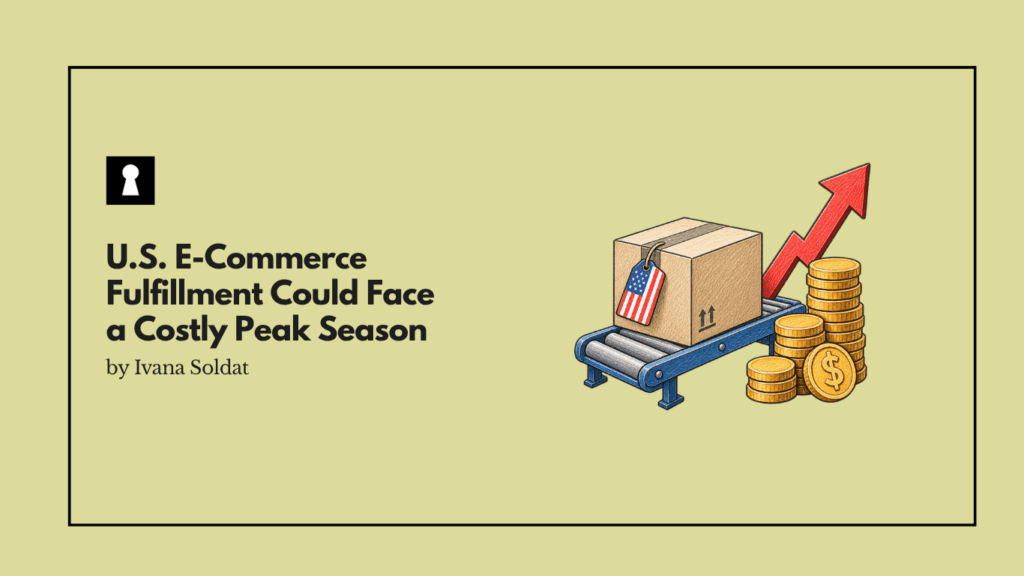
The data from August 2026’s freight market contains a paradox that should make any ecommerce logistics planner stop scrolling. According to the US Bank Freight Payment Index released this month, national freight shipments fell 2.8% year over year in the second quarter of 2026, while freight spending rose 28.1% over the same period. Shippers are paying nearly 30% more to move roughly 3% less freight.
This is not what a soft freight market is supposed to look like. A soft freight market means more trucks than freight, which means lower rates and easier capacity. What August 2026 is demonstrating is that capacity can tighten and costs can rise even as volume falls, when the tightening is driven by structural factors rather than demand surge. The structural factor here is the inventory that brands front-loaded before July’s tariff deadline, which has absorbed warehouse capacity across the country without yet flowing through to its final destination.
In the Midwest specifically, the picture is worse: shipment volume dropped 3.7% quarter over quarter, the steepest regional decline in the country, while spending still ran 22.9% above last year.
Where July’s Inventory Actually Went
The Logistics Managers’ Index for July tells the story of where the front-loaded inventory is sitting. The overall index eased to 68.9 from June’s 71.1, still higher than any reading between 2023 and 2025. The internal composition is the real story.
Inventory levels among downstream retailers swung from strong expansion at 66.0 in June to outright contraction at 46.3 in July. Upstream levels barely moved. The likely explanation: the inventory retailers pulled forward ahead of July’s tariff changes is sitting with wholesalers and manufacturers rather than flowing through to store shelves. It has been acquired but not yet distributed.
Meanwhile, inventory costs kept climbing to 77.0, now running 22 points ahead of inventory levels, well above the LMI’s historical average gap of 13 points. Companies do not need dramatically more inventory for the cost of carrying it to rise dramatically. Warehousing capacity contracted to 46.3, its tightest reading since March 2024, with upstream capacity contracting even more sharply at 42.4.
Whoever is holding this inventory right now is finding less room to put it and paying more per square foot to keep it there.
The Warehouse Crunch Is Real and Getting Worse
National industrial vacancy fell to 6.5% in Q2 2026, its first quarterly decline since 2022, while leasing activity rose 18% in the first half of the year. Third-party logistics providers are still the largest source of leasing demand.
Chicago, which sits at the centre of US inland freight flows, is tightening even faster. JLL’s Q2 report puts local vacancy at 4.5%, down from 5.0% a year ago, on a fourth straight quarter of leasing above 10 million square feet.
New construction starts climbed 18% year over year in Q2, and developers are signalling a meaningfully bigger 2026 build-out than last year. That additional supply will eventually provide relief. Projects beginning now will not be operational in time for this year’s peak season.
Transportation Costs Are Not Coming Down Fast Enough
DAT dry van spot rates eased modestly off July’s highs but were still running 45% above last year as of early August. The load-to-truck ratio is up 74% year over year. The 10 states that carry a third of all US van freight were running at $3.06 per mile, up nearly 48% year over year.
By early August, national dry van rates had eased further to roughly $2.32 per mile. That is real relief from the July peak, but capacity has left the market faster than rates have cooled, which means the rate relief that normally follows a volume decline has been delayed and compressed.
Ocean Volume Is Declining But the Inland Pressure Remains
US containerized imports hit 2.5 million TEUs in July, the fourth-highest July on record despite a 4.3% year-over-year decline. The NRF and Hackett Global Port Tracker now projects a steady falloff: 2.22 million TEUs in August, 2.16 million in September, 2.13 million in October, 2.03 million in November, and 2.06 million in December.
Declining ocean import volume does not translate directly to declining inland pressure. Inventory that has already arrived still has to get warehoused, allocated, and moved. The import surge of June and July has already cleared the port gates. It is now the inland logistics network’s problem.
The Section 301 Tariffs Have Closed the Uncertainty Window
The tariff uncertainty that drove July’s front-loading is no longer uncertain. New Section 301 duties took effect July 24 on 60 trading partners covering 99.4% of US imports. That is a landed-cost reality now.
The brands that timed their inventory pull-forward correctly are sitting on stock they acquired at pre-tariff costs, which gives them a margin advantage relative to brands that will need to replenish at higher tariff-inclusive costs during peak season.
The brands that missed the window are heading into peak season with a structural cost disadvantage at the product level that will show up in their promotional economics.
Our Take
The Next 90 Days Are Going to Be the Most Expensive in Recent Memory for Ecommerce Logistics
The August 2026 freight and warehouse picture is the direct consequence of what EcomWatch covered when we reported on the record July port volumes: brands made a rational decision to front-load inventory before the tariff deadline, and the cumulative effect of that collective rational decision is a logistics network that is simultaneously holding more inventory than it was designed for, charging higher rates for the reduced capacity available, and heading into peak season with less flexibility than the headline volume numbers suggest.
The brands that navigated July well have a cost advantage. The network they are navigating has absorbed a structural shock that has not fully resolved. Warehouse space is tight, truck capacity is tight, costs are elevated, and the peak season demand surge has not yet started.
That combination is not a reason to panic but it is a reason to finalize your Q4 logistics commitments immediately, because the optionality that exists in August will not exist in October.