
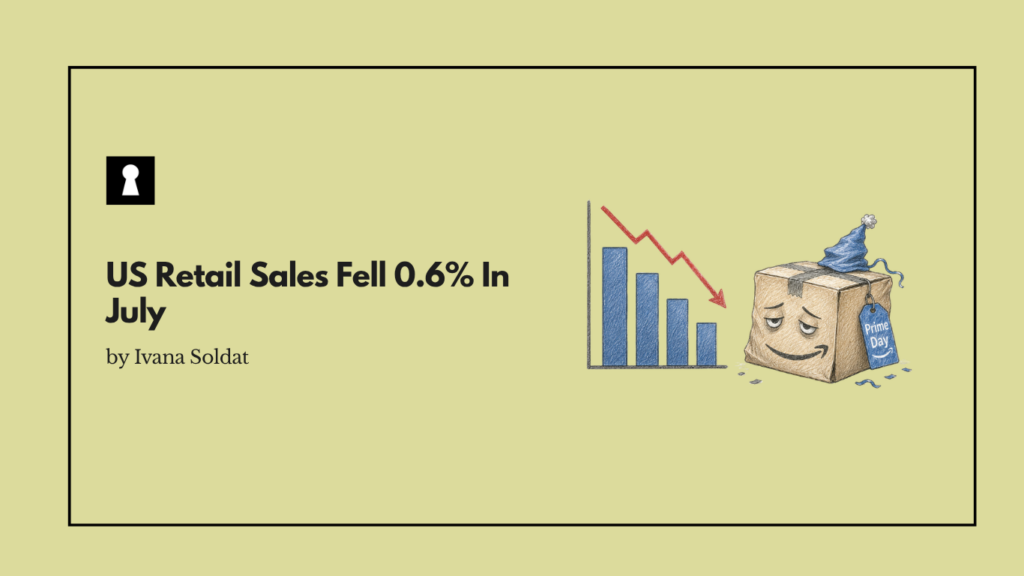
US retail sales fell 0.6% in July to $763.6 billion, reversing June’s 0.2% increase and coming in well below economists’ expectations for a small gain. Even so, Americans were still spending 5% more than they were a year earlier.
So, yes, the consumer blinked.
But this does not yet look like the moment everyone collectively canceled their Amazon subscriptions, stopped going to restaurants and began growing potatoes in the backyard.
A large chunk of July’s weakness came from a few categories with unusually convenient explanations, particularly online retail.
E-Commerce Didn’t Collapse, June May Have Stolen July’s Wallet
Nonstore retailers, the Census category that includes much of e-commerce, saw sales fall 2.2% from June. That sounds fairly brutal until you look at the calendar.
Amazon shifted its Prime Day event into June this year, with other large retailers running competing promotions around the same period. The result was effectively a retail sugar rush: shoppers who might ordinarily have bought something in July were given a very persuasive reason to click “Buy Now” several weeks earlier.
Then July arrived and discovered somebody had already eaten the snacks.
That makes the 2.2% online decline considerably less dramatic than it first appears. It may say less about collapsing demand than about what happens when the industry’s biggest retailers become increasingly good at moving demand around the calendar.
And that matters.
Retailers have spent years conditioning shoppers to wait for events, coupons, flash sales and suspiciously urgent countdown timers. When enough spending gets dragged forward into one promotional window, the following month’s data is almost guaranteed to look sickly by comparison.
Cars And Gas Helped Make The Headline Look Worse
Online shopping wasn’t the only drag.
Sales at motor vehicle and parts dealers dropped 1.8%, while gasoline-station receipts fell 0.9%. Electronics and appliance stores were also down 0.5%.
That combination matters because the headline retail-sales figure measures dollars spent, not simply how many things consumers bought. The Census figures are seasonally adjusted but not adjusted for price changes, meaning movements in prices can make spending appear stronger or weaker even when consumer behavior itself hasn’t shifted by the same amount.
In other words, a lower gasoline bill can technically make retail sales look worse.
Once autos and gasoline are removed, sales fell a much smaller 0.2%, suggesting July was soft without necessarily being catastrophic.
Shoppers Were Still Happy To Buy Clothes And Dinner
The decline also wasn’t remotely universal.
Clothing and accessories sales increased 1.9%, health and personal-care stores gained 0.7%, while furniture and home-furnishing sales rose 0.3%. Restaurant and bar spending increased 0.5%, continuing a run of monthly gains.
That is a strange-looking consumer recession.
People may have bought fewer cars and fewer products online after June’s promotional frenzy, but they were still spending money on clothes, personal care and eating out.
The more cautious signal comes from the so-called retail control group, which strips out several volatile categories and feeds more directly into estimates of consumer spending in GDP. That measure declined 0.4% in July.
So there is genuine softness underneath the promotional-calendar weirdness. It just isn’t quite the same thing as shoppers suddenly slamming their wallets shut.
The Consumer Is Slowing Down, Not Disappearing
Retail sales were still 5% higher than a year earlier, despite July’s monthly decline. The three-month May-through-July period was also 6.3% above the same stretch of 2025.
That leaves retailers with an annoyingly nuanced answer.
Consumers are spending.
They are also becoming more selective about when, where and on what they spend.
For e-commerce businesses, that distinction matters more than the headline decline itself. If major promotional events increasingly pull purchases forward, month-to-month comparisons become noisier, and brands that mistake promotional timing for permanent demand can end up making very expensive inventory decisions.
A 2.2% drop in nonstore retail sales does not automatically mean e-commerce demand fell off a cliff.
It might mean shoppers bought the cliff on sale last month.
Our Take
Retail Has Created A Consumer Who Refuses To Pay Full Price
July’s retail report looks ugly enough to generate “the consumer is finally cracking” headlines, but the underlying picture is much messier.
There are signs of moderation. The control group weakened. Autos fell. Electronics slipped. And after several strong months, households may simply be showing a little more restraint.
But e-commerce’s particularly sharp decline deserves a different interpretation.
The industry has spent years teaching consumers that there is always another Prime Day, member event, flash sale, holiday promotion or 20%-off email waiting around the corner. That strategy is fantastic at manufacturing enormous shopping days. It is considerably less useful when retailers then stare at the following month’s numbers and wonder where everybody went.
The controversial version is that e-commerce may not have a demand problem nearly as much as it has trained customers to believe that buying anything at full price is for suckers.
And if retailers keep concentrating demand into bigger and bigger promotional spectacles, July-style “slumps” may become less of an economic warning and more of a bill the industry keeps sending itself.