
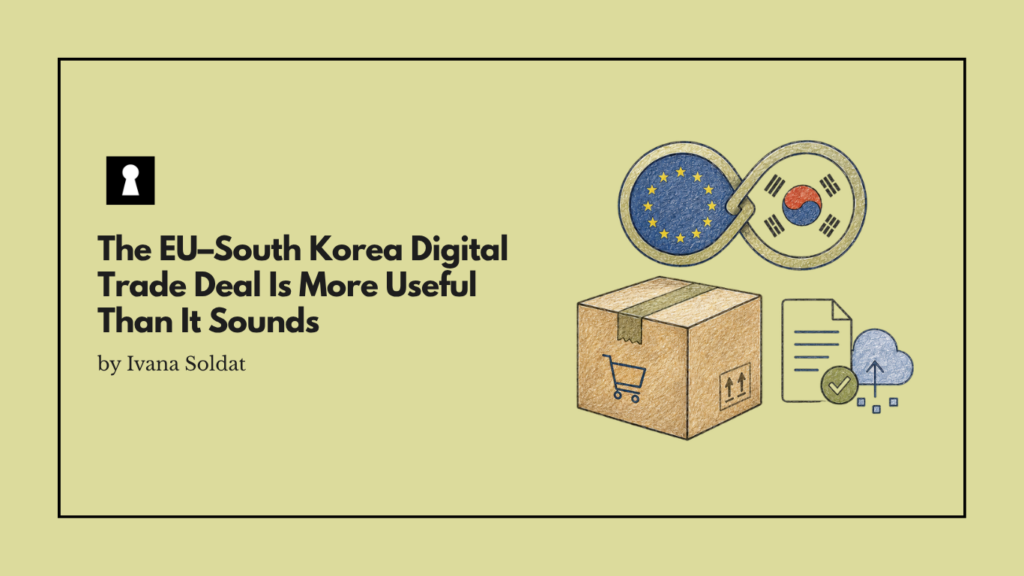
The agreement does a few things that ecommerce operators should genuinely care about.
First, it limits data localisation requirements. If you’ve ever tried to expand into the EU or Korea and been told you need to store customer data locally, build local infrastructure, or jump through a dozen bureaucratic hoops just to process a transaction, this is aimed at reducing exactly that friction. Companies will be able to handle data across borders without spinning up an entirely separate local operation just to stay compliant.
Second, it protects source code and trade secrets more formally between the two markets. Quietly huge for any tech company operating across both regions.
Third, it pushes electronic signatures, digital customs procedures, and electronic payments as the standard. Less paperwork. Fewer “please fax us this form” moments. That alone should be cause for minor celebration.
On top of that, there’s a cybersecurity cooperation angle, shared frameworks, coordinated incident responses, and a general agreement to not let the digital trading environment become the Wild West. The two sides also launched a broader South Korea–EU Competitiveness Partnership covering AI, supply chains, critical minerals, and investment. It’s a lot of ambition stuffed into one signing ceremony.
Why Now
Because global digital trade is moving faster than the rules were written to handle. Data flows, cloud services, AI-powered platforms, and cross-border payments are now the backbone of ecommerce, and the agreements governing them were, in many cases, written when the primary concern was whether your JPEG would load on a 56k modem.
Both the EU and South Korea are large, sophisticated, tech-driven economies that have historically been more interested in regulating the internet than making it frictionless. A deal that explicitly commits both sides to reducing cross-border barriers is a meaningful shift in posture.
What It Means in Practice
For ecommerce businesses operating in or expanding into either market, the implications are more operational than philosophical.
Data localisation has been a genuine cost driver. If you sell into the EU, you’re already navigating GDPR. If you sell into Korea, you’re navigating PIPA. Having both sides commit to not stacking additional infrastructure requirements on top of that is a real cost reduction, even if the savings won’t show up on a spreadsheet immediately.
The digital customs piece matters too. Cross-border ecommerce lives and dies on how painful import and delivery processes are. Electronic customs procedures, when they actually work, reduce clearance times and cut operational overhead. It’s not glamorous, but it’s the kind of thing that determines whether a customer in Seoul or Stuttgart gets their order in three days or three weeks.
Our Take
Read the Annexes, Not the Press Release
Everyone will focus on the geopolitical headline, two major democratic economies deepening ties as digital trade splinters along US/China fault lines. That framing isn’t wrong. It’s just not the most useful lens for ecommerce operators.
The more interesting question is whether this deal actually accelerates cross-border commerce between the two regions, or whether it becomes one of those agreements that exists on paper while the real barriers, such as customs delays, payment friction, localisation compliance costs, quietly persist anyway.
The honest answer is that it depends on implementation. Trade agreements are promises. The regulatory agencies, customs authorities, and payment networks that execute on them are where good intentions go to die slowly.
That said, the direction is right. Reducing data localisation friction, harmonising digital customs, and building shared cybersecurity standards are exactly the levers that make cross-border ecommerce less painful. If even half of this gets implemented cleanly, it’s a meaningful win for any business operating across the EU–Korea corridor.
The businesses that benefit won’t be the ones who read the press release. They’ll be the ones who read the annexes.