
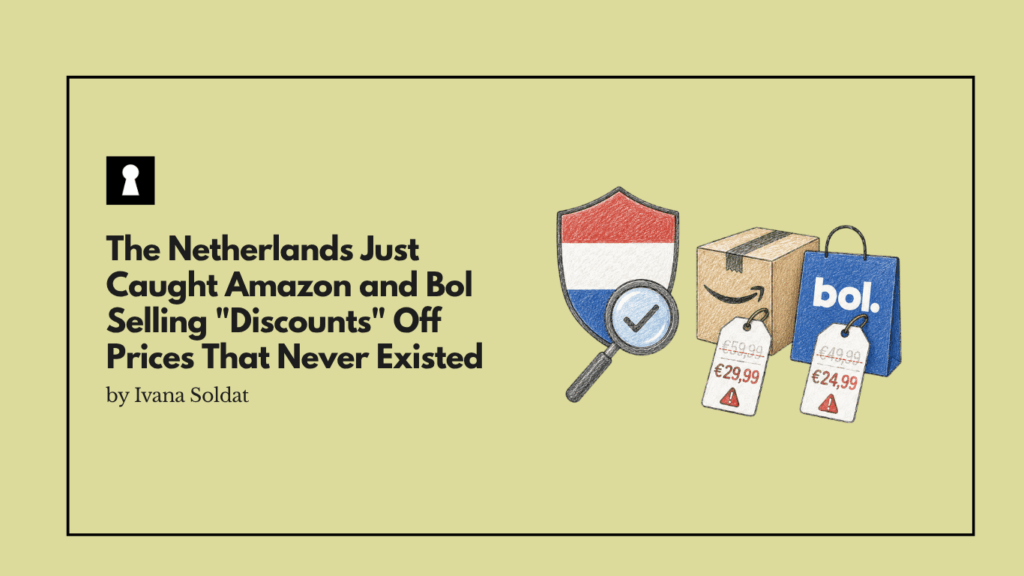
A JBL Charge 6 speaker listed on Amazon Netherlands at €147 with a 26% discount. The Consumentenbond checked the price history. For almost the entire month before the promotion, the same speaker was selling for €133. To advertise a 26% discount from a price that barely existed, Amazon needed the “original” price to be higher than the price it was actually selling at. So the price went up, briefly, before the sale began.
A Samsung television on Bol, listed at €349 with a stated saving of 12% against a “usual price” of €399. The Consumentenbond checked 60 days of price history. The television had never been sold at €399 in that window. The “usual price” was not the usual price. It was a number that made the discount calculation produce a result that would attract clicks.
These are not edge cases. They are the two examples the Consumentenbond chose to illustrate a broader pattern documented across two months of systematic price monitoring on both platforms.
Two Months, 1,142 Products, and a Clear Pattern
The Consumentenbond tracked prices on 1,142 popular products at Amazon Netherlands and Bol between April and June 2026. Of those, 323 appeared as a promotion at least once during the monitoring period.
At Amazon, 46 out of 113 checked promotions did not comply with EU price transparency rules. That is 41% of Amazon’s promotional listings failing the legal standard. At Bol, 62 out of 210 checked promotions were non-compliant. That is 30% of Bol’s promotional listings.
The applicable rule is the EU Omnibus Directive, transposed into Dutch law, which requires that any advertised discount must be calculated against the lowest price at which the product was sold in the preceding 30 days. The rule exists to prevent exactly what both platforms have been documented doing: raising a price shortly before a promotion so that the discount percentage looks larger than it is in relation to what consumers were actually paying.
“The Measure Is Now Full”
The Consumentenbond has done this kind of research before and it has worked. Coolblue and Wehkamp, two other major Dutch ecommerce players, both made pricing changes after the organisation raised similar concerns. Amazon and Bol have apparently not followed the same arc.
Sandra Molenaar, director of the Consumentenbond, was direct: “We have been researching fake promotions for years and address shops when they do not comply with the rules. At Coolblue and Wehkamp this led to adjustments earlier it can be done. But Amazon and Bol keep stubbornly luring customers with these practices, despite these shops knowing the rules.”
The organisation has formally demanded that both platforms comply with price regulations and provide honest representations of the price advantage in their promotions. “If they do not, we will take legal action,” Molenaar said.
Bol’s response was the standard corporate non-denial: the platform does not recognise the picture that it deliberately lures customers with fake promotions, it finds it important that customers can trust the prices they see, it has received the findings and will study them carefully, and it operates in accordance with applicable laws. Amazon had not issued a public response at time of publication.
Black Friday Is Already in the Crosshairs
The Consumentenbond announced it will conduct new price measurements ahead of Black Friday and will also check other retailers for potentially misleading discounts.
The timing is deliberate, Black Friday is when the discount machinery runs at its most aggressive, when promotional claims are most likely to be exaggerated, and when consumers are most susceptible to a countdown and a percentage.
The organisation is announcing it will be watching, specifically during the period when the temptation to inflate discount claims is highest.
Same Trick, Different Country, Bigger Targets
This is the third fake discount enforcement action to land in EcomWatch’s coverage in the past month. Italy’s AGCM fined Deghi €2 million for countdown timers that reset at zero and discount percentages calculated off launch prices rather than the legally required 30-day baseline. Italy’s anti-shrinkflation decree, which took effect on July 15, created disclosure requirements for hidden quantity reductions. And now the Netherlands, where the EU’s price transparency rules are being enforced against two of the largest ecommerce operations in the country.
The geographic spread is the signal. This is not a Dutch quirk or an Italian regulatory enthusiasm. It is EU consumer protection law being enforced with increasing seriousness across multiple member states simultaneously, against the platforms that most consumers use most of the time.
Our Take
The “26% Off” That Required a Price to Never Actually Exist
The Consumentenbond’s case against Amazon and Bol is straightforward in the facts and significant in what it represents. These are not obscure platforms or edge-case sellers. They are the two largest ecommerce operators in the Dutch market, running promotional pricing mechanics that the EU explicitly prohibited when it passed the Omnibus Directive.
The fact that they are still running those mechanics two years after the rules took effect, after the same organisation successfully changed behaviour at Coolblue and Wehkamp, suggests that the expected cost of compliance has been calculated against the expected cost of enforcement, and enforcement has been winning.
Legal action by the Consumentenbond would change that calculation. The platforms know the rules. The question is whether they have been doing the math correctly about the consequences of ignoring them.