
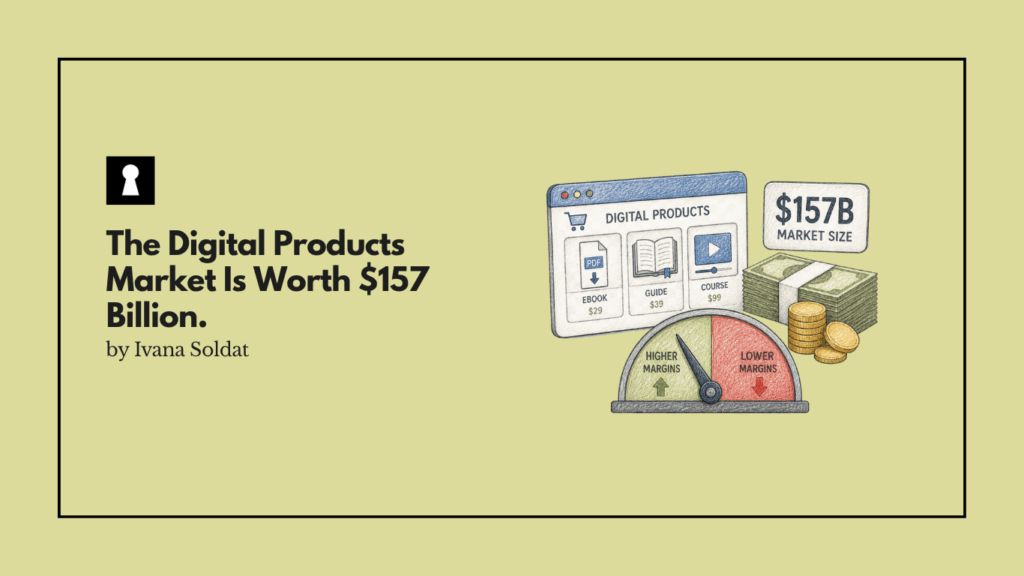
There is a version of selling digital products that feels like printing money. You make the thing once. You sell it a thousand times. You do not restock inventory, ship anything, or manage returns in any meaningful sense. The economics are genuinely different from physical commerce, and the platform you choose to sit between you and your buyers determines how much of that margin you actually keep.
The digital goods market is projected to reach $157 billion in 2026. Templates, ebooks, courses, software, design assets, music, and licensed content are all growing categories. The platforms competing for sellers in this space have proliferated to the point where the choice itself has become a meaningful business decision that most creators and digital sellers make badly, usually by defaulting to whatever they heard about first.
Here is the landscape as it actually stands in 2026, organized around the question that matters most: what are you optimizing for?
If You Want to Validate Fast Without Spending Money Upfront
Gumroad is the default for a reason. You can have a product live and purchasable in fifteen minutes with no monthly fee, no setup cost, and no technical knowledge required. The tradeoff is the fee structure: 10% of every sale plus $0.50 per transaction.
On a $10 ebook, Gumroad takes $1.50. On a $100 course, it takes $10.50. The math gets uncomfortable at scale and on higher-priced products, but for a first product where you do not yet know if anyone will buy it, the zero-upfront model removes the risk of paying for a subscription while validating demand.
Payhip offers a closer fee-to-feature ratio than Gumroad for most sellers. Its free plan takes only 5% per transaction rather than 10%, and its paid plans starting at $29 per month drop the transaction fee to zero entirely. It handles VAT collection for EU customers automatically. For a new seller testing a first product, Payhip typically beats Gumroad on fees while offering comparable simplicity.
If You Want Zero Transaction Fees and Can Handle a Monthly Cost
Sellfy has built its positioning almost entirely around the zero transaction fee promise: you pay a flat monthly subscription starting at $22 per month, and every dollar of revenue above that is yours minus standard payment processing.
The catch is a sales cap, the entry plan limits you to $10,000 in annual sales, and even the top-tier plan caps at $200,000. For anyone under $200,000 in annual digital product revenue, Sellfy’s fee structure is often the most favorable available.
If You Are Selling Courses or Building a Community
The course and coaching platform category operates on different logic from pure digital download platforms. Kajabi, Teachable, and Podia bundle course delivery, community tools, email marketing, and website hosting into single products that cost more upfront but eliminate the need to manage multiple tools simultaneously.
Kajabi starts at around $69 per month and takes no transaction fees. Teachable has a free plan that takes 10% per transaction, dropping to zero on paid plans starting at $39 per month.
The relevant question for course sellers is not which platform has the lowest fee but whether the all-in-one bundling is worth the premium compared to assembling separate tools for hosting, email, and community. For anyone building everything from scratch who does not want to manage integrations, the bundled platforms reduce complexity at a real but justifiable cost.
If You Are Selling Software or SaaS and Need Global Tax Handling
This is the category where platform choice matters most and the generic options fail most visibly. Selling software subscriptions to customers in 70 countries means managing VAT in the EU, GST in Australia, consumption tax in Japan, and a growing list of US state sales tax obligations that vary by product type and buyer location. Most platforms do not handle this automatically. Two do it well.
Lemon Squeezy and Paddle both operate as Merchant of Record, meaning they take on the legal responsibility for tax collection and remittance in every jurisdiction. You sell, they handle the tax.
The fee for this service is built into their transaction percentages, typically 5 to 8%, but for software sellers who would otherwise need a dedicated tax compliance tool or accountant, the all-in cost is often lower than the alternative.
If You Are Already on Shopify and Want to Add Digital Products
Shopify’s transaction fee is zero on its own payment processing and it has no ceiling on annual sales volume. For sellers with existing physical product operations on Shopify who want to add digital products, staying on Shopify and using a digital delivery app is typically the path of least resistance.
The monthly platform cost is already being paid, the customer data stays in one place, and the checkout experience is consistent.
The case against Shopify for digital-only sellers is straightforward: $29 per month is expensive when you are still validating whether your first product will sell anything. Pay-as-you-go fee structures like Gumroad or Payhip’s free plan are better starting points for pure digital sellers with no existing Shopify presence.
Who Owns the Customer Relationship
The fee comparison is the part everyone focuses on. The question that matters more long-term is who owns the data from your buyers. Marketplace platforms like Gumroad and Creative Market give you access to buyers but retain the customer relationship at the platform level. Your own storefront on Shopify, Payhip, or Sellfy means the buyer’s email, purchase history, and relationship belong to you.
This distinction is largely irrelevant when you are selling your first hundred units. It becomes critically important when you have a ten-thousand-person customer list that you want to market new products to, when you want to run a relaunch campaign, or when a platform changes its fee structure and you need to migrate.
The sellers who built their businesses on marketplaces and then tried to move their audience discovered that the audience was not theirs to move.
Our Take
The Platform You Outgrow Is Not the Platform You Should Have Chosen
The digital products platform market in 2026 has a tool for every situation and a genuinely confusing pricing landscape that makes direct comparison difficult. The practical framework that works for most sellers: start on whatever platform gets your first product live fastest with the least upfront cost, usually Payhip or Gumroad.
When your monthly revenue from digital products exceeds what a paid Sellfy or Payhip plan costs, switch to one of those and eliminate the transaction fee. When you want to own your customer data and your brand fully, migrate to Shopify or a self-hosted WooCommerce setup. The platforms at the beginning of that journey are not bad choices.
They are starting points, and the mistake is treating them as permanent infrastructure rather than the validation tools they are.