
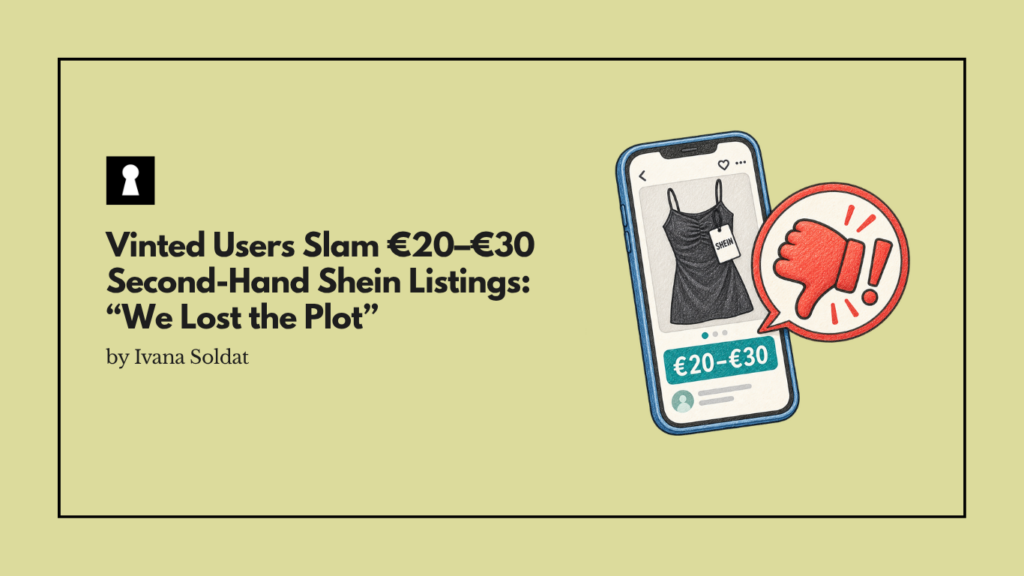
The discussion began on the unofficial r/Vinted subreddit on August 22, when a user posted four screenshots of listings under the title “we lost the plot.” The accompanying caption criticized what the poster described as “20-30 bucks for resold second hand plastic by shein.”
The issue was not that the items were being passed off as a more expensive brand. According to the discussion, the listings identified the clothing as Shein. Instead, users objected to the resale prices themselves.
One commenter pointed to items that remain available from their original retailers being offered second-hand at the same price or higher. Another described seeing a used eyeshadow palette listed for around €50 despite claiming that a new one cost €30.
Others shared similar experiences beyond Shein. One user said they had encountered a football shirt listed for £110 despite finding it at conventional retailers for roughly half that amount. Another claimed to have seen an in-stock Hollister item originally priced around $30 advertised for roughly $300 as “vintage.”
These examples are individual Reddit users’ accounts and have not been independently verified.
The Real Cost can Be Higher than the Listing Price
Part of the frustration comes from the economics of buying through a resale marketplace.
Vinted charges buyers a mandatory Buyer Protection fee, while buyers also generally cover shipping. That means a second-hand item listed only slightly below its original retail price can ultimately cost almost as much as buying it new.
The trade-off can become more significant with clothing. Under Vinted’s standard return policy, an item that simply does not fit or that a buyer does not like cannot automatically be returned. In those circumstances, the private seller has to agree to accept the return.
That point was raised directly in the Reddit discussion.
“Why would I buy the item that retails for 80 for 65,” one commenter asked, when fees and shipping could bring the final cost close to the original retail price while leaving the buyer with fewer return options?
Vinted Itself Recommends Discounts from Retail Prices
Interestingly, Vinted’s own guidance suggests sellers generally price used goods below their original retail value.
For items described as new or like new, the platform recommends roughly 60% to 80% of retail price. For products in “very good” condition, its suggested range is 40% to 60%, falling to 20% to 40% for items in good or satisfactory condition.
Those are recommendations, however, not fixed pricing rules. Vinted also says sellers can choose their own asking price within the platform’s permitted range.
That distinction became part of the Reddit argument.
“They’ve labeled it Shein, what’s the issue?” one user wrote, arguing that sellers should be able to decide how much they charge.
Another commenter gave a considerably less diplomatic assessment: “The issue is biblical levels of greed.”
Why Shein Makes the Debate Particularly Contentious
Shein’s low original prices make the resale calculation especially visible.
Numerous products from labels sold through Shein, including DAZY and ROMWE, routinely sell at single-digit or low-double-digit prices. That does not establish the original retail price of the specific garments shown in the Reddit screenshots, but it helps explain why users reacted strongly to second-hand Shein listings approaching €20 or €30.
One Reddit user who said they also resell unwanted Shein products wrote that they typically price their own bags and accessories at only €2 to €3.
Others argued that the responsibility ultimately falls on buyers to check what an item originally cost before purchasing it.
And technically, a high asking price alone does not demonstrate that a seller has violated Vinted’s rules.
There would be a separate issue if someone were purchasing products in bulk specifically to resell commercially through a standard account. Vinted identifies practices such as bulk purchasing and dropshipping as indicators of commercial selling and says such activity can result in listings being removed or accounts being restricted. Nothing in the Reddit post establishes that the sellers shown were operating commercially.
Our Take
Second-Hand Doesn’t Always Mean a Better Deal
There is nothing inherently wrong with a seller asking whatever price they believe the market will bear. If someone wants to list a €10 top for €30, the marketplace can ultimately decide whether that price makes sense.
But this controversy points to a broader problem with second-hand platforms: “used” no longer automatically means “cheaper.”
As resale marketplaces have grown, they have increasingly become places for price speculation as much as bargain hunting. The problem is particularly obvious with ultra-fast-fashion brands, where the original retail price can already be extremely low.
A buyer who sees a €25 second-hand top may reasonably assume they are getting a discount simply because the product is being sold on Vinted. After buyer fees and shipping, however, that same item can end up costing more than a new version sold directly by the retailer.
That is not necessarily deception. But it does mean buyers need to treat resale platforms less like digital thrift stores and more like open marketplaces where price and value are two very different things.
There is also an opportunity here for platforms such as Vinted. Better price transparency, including easier access to original retail prices, warnings when comparable new products are available for less, or stronger brand filtering, could make it harder for inexperienced shoppers to assume that second-hand automatically means a bargain.
The Reddit thread may be about a handful of Shein tops, but the argument underneath it is much bigger. At what point does resale stop being about extending the life of a product and simply become retail arbitrage?