
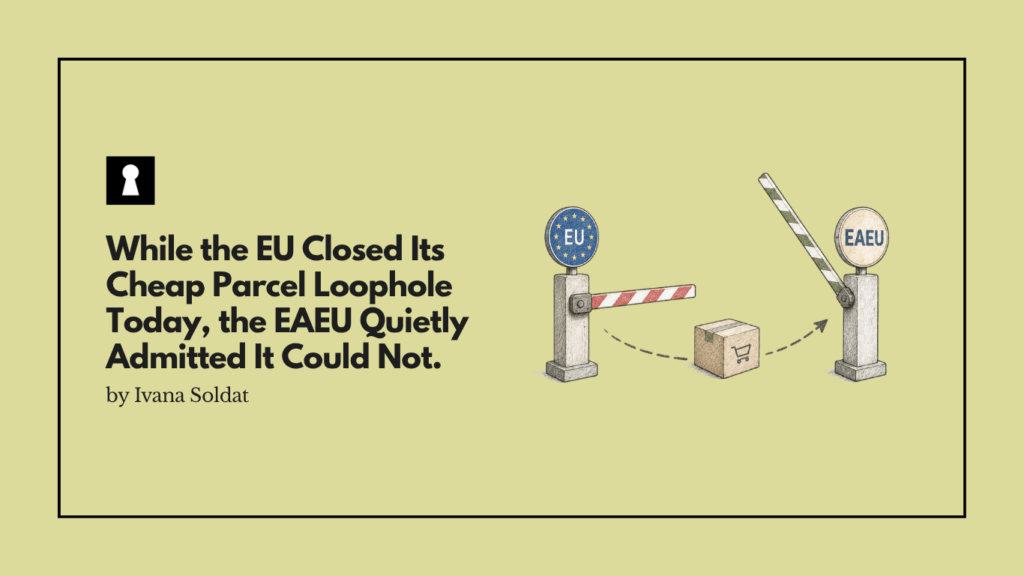
July 1, 2026 was supposed to be a significant date for two major trading blocs simultaneously. In Brussels, the EU’s new customs duty framework for low-value parcels went live as planned, ending a long-standing exemption that had let billions of packages from Chinese platforms arrive duty-free.
In Moscow, the Eurasian Economic Commission was meant to be launching its own equivalent reform: a new regulatory framework for cross-border ecommerce that would require citizens across five countries to declare all online purchases from outside the bloc, and impose new duties on goods from Amazon, Temu, AliExpress, and other non-EAEU platforms.
The EU launched on schedule. The EAEU did not.
The Eurasian Economic Commission confirmed today that the new ecommerce regulations will only come into effect after the corresponding amendments to the EAEU Customs Code have been approved by all member states, and that process is not yet complete. No revised launch date was provided.
What the EAEU Reform Was Actually Supposed to Do
The reform has been years in the making. EAEU member states signed the protocol introducing the changes back in December 2023, and Kazakhstan, which became the last of the five countries to ratify the new Customs Code, completed that step in late 2025.
The regulatory framework at the bloc level was largely in place: the Commission set a duty-free import threshold of €200 per purchase, above which a customs duty of 5% plus nationally applicable VAT rates would apply, with a minimum of €1 per kilogram. Any purchase from a foreign marketplace, regardless of value, would require a digital declaration.
The July 1 launch date had been publicly confirmed by the Commission as recently as January 2026. What happened between January and today is what the official statement leaves diplomatically vague: member states have not completed the national legislative alignment required to bring the new Customs Code provisions into force simultaneously across the bloc.
The Delay Is Worth More to Some Than Others
Within the EAEU, goods moving between member states remain fully exempt from the new duties and declaration requirements regardless of when the reform takes effect. That exemption is permanent, by design. What the reform targets is purchases from outside the bloc: Amazon, eBay, Alibaba, Temu, Shein, and their equivalents.
Russian marketplaces, specifically Wildberries and Ozon, operate extensively across the entire EAEU territory. Astana, Kazakhstan’s capital alone, has 159 Wildberries and 128 Ozon order pickup points. Both platforms are already deeply embedded in consumer habits across Kazakhstan, Kyrgyzstan, Armenia, and Belarus in ways that Chinese and Western competitors are not.
Every month the EAEU reform is delayed is another month that Amazon, Temu, and AliExpress continue operating under the same duty-free conditions as Wildberries and Ozon, which means another month during which the competitive playing field stays flat rather than tilting in Russia’s domestic platforms’ favor.
Put plainly, the new rules, when they eventually take effect, will raise the cost of buying from non-EAEU platforms while leaving intra-EAEU purchases untouched. The delay benefits the platforms that are currently most disadvantaged by the status quo. It benefits least the platforms that stand to gain most from the eventual reform.
The Consumer Math Is Complicated
For ordinary shoppers in Kazakhstan or Kyrgyzstan, the calculus is genuinely mixed. Kazakh officials say that price changes will be minimal for most shipments since the majority of orders do not exceed €200 and therefore are not subject to the new duties.
That framing is technically accurate but incomplete. What the reform adds for sub-€200 purchases is not a duty but a declaration requirement, and declarations are not free. Logistics operators like DHL and FedEx have indicated that filling in a declaration will cost €6 to €8 per shipment. On a €10 order from AliExpress, that is a 60 to 80% surcharge before the package has cleared customs.
The government says it will be digital and simple. The operators say it will cost money regardless.
Same Problem, Different Bloc
The structural challenge the EAEU is running into is not entirely different from what the EU experienced with France’s now-suspended national parcel tax. Designing a customs framework that captures revenue from high-volume, low-value cross-border ecommerce without pushing that volume onto platforms or routes that avoid the system entirely is genuinely difficult.
The EU is trying to solve it with a bloc-wide €3 flat duty and monitoring for rerouting. The EAEU was trying to solve it with a declaration-plus-duty framework that requires all five member states to align their national law simultaneously. Five-country simultaneous alignment, it turns out, is hard.
Our Take
Russia’s Marketplaces Win Every Month This Takes Longer
The EAEU ecommerce customs delay is not simply a story about bureaucratic slowness, though it is also that. It is a story about who benefits from regulatory timing in a market where the platforms that stand to gain most from a new rule are the ones most closely associated with the regulatory bloc overseeing its implementation. Wildberries and Ozon do not need the EAEU reform to succeed in Kazakhstan or Kyrgyzstan.
They are already there. What the reform does, when it finally arrives, is raise the cost of their competition from outside the bloc. Every month of delay is a month that competition gets to play by the same rules as the incumbents. That is not nothing, and it is worth naming clearly even if the official explanation is simply that the paperwork is not finished yet.