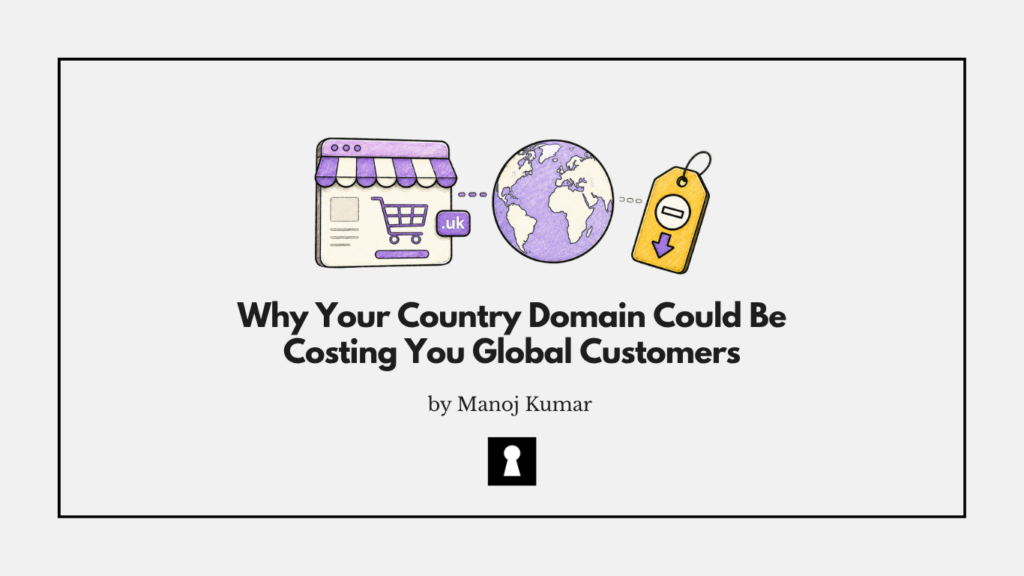
Your ecommerce brand domain extension is likely repelling international buyers without you even realising it. If your store runs on a .co.uk or .com.au domain, and you wonder why global traffic converts at half the rate of domestic traffic, despite similar ad spend, the domain is a likely culprit.
Consider a scenario: A shopper in Canada lands on a .co.uk store via Instagram. The UI is clean. Product display looks perfect, but something feels off. They leave the website even before viewing a single product. Why? It’s the two letters at the end of your website URL.
Country-code top-level domains, or ccTLDs, target a specific region where your brand operates. It has SEO benefits and, as your brand grows, it helps build authority and trust.
Google uses ccTLDs as a strong indicator for geo-targeting content. That means your brand with a .co.uk domain could, algorithmically, have less visibility for buyers in Germany, the United States or Australia. Different search indices and ranking signals in these countries will place your website in search results accordingly.
So, how can you fix the problem of bouncing international traffic, and when does it make sense to implement your overseas growth strategy?
The Brand Operator Concern
A Reddit thread in r/ecommerce gained traction among store operators this week, who observed that their country-specific domain extensions could be quietly bleeding international sales.
European operators, in particular, are talking more about it because many brands across Europe run their ccTLDs for domestic traffic and a separate .shop for international buyers.
So even though your UK brand has free worldwide shipping, your target buyers in Germany or Australia may never find out about it because of your domain. Those who land on your website may subconsciously think of it as a country-specific website that’s not for them, affecting trust and click-through rate.
The industry benchmarks support these arguments. The UK tops the average ecommerce conversion rate at 2.6-4%, followed by Germany and Australia at 2.22% and 1.78%, respectively. A UK brand may have a higher conversion rate in the country, but in Australia or Germany, it’ll be starting at a disadvantage due to the lower average conversion rate, even before the domain filter kicks in.
Major cross-border operators solve this problem by creating a separate store on the .com domain, while maintaining ccTLDs for local SEO in their primary market. Brands like ASOS, headquartered in the UK, and Zalando, based in Germany, both follow this approach.
Their primary presence is .com, but ccTLDs point back to localised versions rather than operating as separate stores. Google’s own international targeting guidelines confirm this.
While Google has now consolidated its search engines under .com, the search engine giant still considers ccTLDs (.de, .co.uk, .fr, etc.) as a strong signal for geo-targeting content in Search Console. This means the ccTLD you registered for domestic credibility may be the ceiling on your international growth.
The .com vs ccTLD Debate
Brands that make cross-border shipping a growth strategy are addressing this problem with three distinct solutions. First is having two different domains — one for your primary customers and another for your global shopping customer base.
Your existing domain still operates in its local market and doesn’t have to weaken your position in the local market with a generic or .com domain. A separate .com domain allows your brand to be visible internationally for a wider audience.
Some operators run both simultaneously: a .com as the primary global store and a ccTLD for local SEO in its primary market. This can be done when a brand wants to cater to a wider audience from the start or becomes too big for one particular geographical location. For an example, Zalando’s website takes you to its main .com domain, but the open page lets you choose from 27 European countries where it ships products.
This leads to the specific country domain, removing any chances of target customers bouncing away. The switch from ccTLD to .com comes with a tradeoff of 6 to 12 months of SEO risk before your global sales start picking up.
“We are a small fashion brand operating in the UK. As soon as we switched to .com in 2023, our sales dropped massively before rising to the previous levels in the next eight months. It eventually increased by 34% in the 15 months of that shift,” says a founder on one of the Reddit forums.
The third solution is a subdomain or subdirectory structure. It removes the need for domain migration, and is the cleanest solution to the problem as it allows one .com domain but multiple localised experiences. For example, Nike uses nike.com/gb/ in the UK, while H&M uses hm.com/de/ in Germany.
A sub-directory structure acts as an organised folder within the primary website. It keeps the country-specific subfolder integrated with the main website, keeping the unified authority intact. This structure allows Google to treat all sub-directories as part of one primary domain, preserving the authority your brand has built over time. Sub-directories can be managed within a single CMS, making it easier to track user behaviour under one Google Analytics property.
They are not perfect, however. Localising content for each country requires a lot of editorial effort, and sometimes, the URL structure becomes complex at scale.
What to Do If You are on a ccTLD
The decision to migrate to .com from your existing TLD domain depends on demand. Is it from one specific country or multiple geographies? If your demand is coming from a specific location, it is best to strengthen your position in that market before expanding. The general operator consensus suggests not to panic-migrate as the impact on the existing business is high.
If you are not ready for a complete shift to .com, it’s better to add hreflang tags, which signal to Google that your store serves multiple markets and can partially offset geographic suppression. Making a swift change to .com means sacrificing years of domain authority and backlinks built on your ccTLD.
You can also use a sub-directory like hm.com/en-gb/ for UK buyers. This helps you separate a large section from the main website and builds SEO authority while improving search rankings.
One metric should simplify the decision for you: is your website generating 20% traffic from outside your ccTLD home country? If it’s a yes, making a full .com migration makes sense.
In essence, there’s no clear answer to the ccTLD problem, only trade-offs. The website’s traffic data points to the solution: if the demand is coming from primarily one location, it’s best not to experiment at this stage, but if international traffic is already arriving and not converting, a domain review is overdue.