
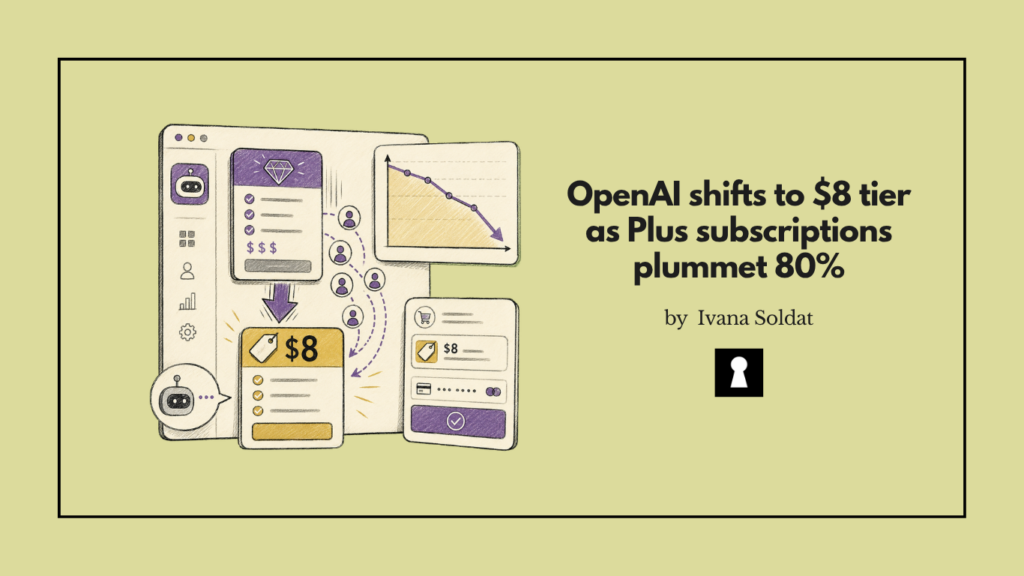
OpenAI is projecting a dramatic restructuring of its consumer subscription base in 2026, with its lower-priced ChatGPT Go tier expected to account for 112 million subscribers by year end while its premium $20-per-month Plus plan shrinks by 80% to approximately 9 million users, according to internal projections obtained by The Information.
The $8-per-month Go tier, which launched as a more accessible alternative to the flagship Plus subscription, is forecast to represent 92% of all paying ChatGPT subscribers by the end of 2026, up sharply from just 7% in 2025. Total consumer subscribers are expected to more than double to 122 million this year, with the company projecting growth to 306 million by 2030.
OpenAI anticipates overall revenue will more than double to $30 billion in 2026 and reach $284 billion by 2030, suggesting the company believes volume growth at the lower price point will more than compensate for the decline in premium subscriptions.
Why AI Subscription Prices Are Falling Across the Industry
The shift reflects a broader recalibration in the generative AI market as companies test pricing strategies against consumer willingness to pay and competitive pressure from free alternatives. Google’s Gemini, Microsoft’s Copilot, and Anthropic’s Claude all offer free tiers with varying capabilities, creating downward pressure on subscription pricing across the sector.
The 36-fold projected increase in Go subscribers from 2025 to 2026 suggests OpenAI has encountered significant price resistance at the $20 monthly tier, even as enterprise and API revenue streams have grown. The company’s decision to position Go as a mainstream offering rather than a limited introductory product signals recognition that the mass market for AI tools sits closer to $8 than $20 per month.
Moffett Nathanson analyst Michael Nathanson highlighted the competitive challenge, noting that “with Alphabet in this game with Gemini, the majority of Gemini users are using it for free” and that “it’s going to be a challenge to compete with Alphabet.”
AI Pricing Shift Makes Advanced Tools More Accessible to Merchants
For ecommerce operators, the pricing shift makes advanced AI tooling meaningfully more accessible. At $8 per month, ChatGPT Go becomes a viable subscription for individual merchants, small team members, and mid-market sellers who previously balked at $20 monthly per seat.
The move could accelerate AI adoption across product description writing, customer service automation, email marketing copy, and basic image generation for smaller operations that have treated AI as a nice-to-have rather than essential infrastructure.
The collapse in Plus subscriptions also suggests that many users, including ecommerce professionals, found the $20 tier either too expensive for the value delivered or redundant given improving free alternatives.
Merchants currently paying for Plus should evaluate whether Go meets their operational needs, particularly if they use ChatGPT primarily for text generation, research, and content creation rather than the most cutting-edge model capabilities that may remain exclusive to Plus or enterprise tiers.
The pricing environment also raises questions about the durability of AI tool costs. If OpenAI is projecting massive subscriber growth at $8 while premium tiers decline, other AI vendors may follow with similar pricing adjustments. Ecommerce operators building budgets around AI subscriptions should anticipate continued price competition and avoid locking into annual contracts at current rates without clear value justification.
How Rival AI Platforms Are Pressuring OpenAI’s Pricing Strategy
OpenAI’s pricing strategy comes as competition intensifies across consumer and business AI markets. Google has aggressively expanded free access to Gemini, integrating it across Workspace, Search, and Android. Anthropic offers a free Claude tier with generous usage limits. Perplexity and other AI search tools provide free research capabilities that overlap with common ChatGPT use cases.
For enterprise buyers, including larger ecommerce companies, Microsoft’s Copilot for Microsoft 365 at $30 per user per month represents a different value equation, bundling AI directly into productivity workflows rather than as a standalone chat interface. It’s worthy to note that 75% of consumers are open to agentic commerce, reducing potential friction in adopting AI embedded within existing workflows.
Shopify, Amazon, and other platform providers are also embedding AI features directly into merchant dashboards, reducing the need for separate subscriptions for specific tasks like product title optimization or inventory forecasting.
The gap between OpenAI’s $8 Go tier and $20 Plus tier is unusually wide, suggesting potential for further segmentation or bundling as the company refines its positioning against both free competitors and premium enterprise alternatives.
How to Assess AI Tool Value Across Your Ecommerce Stack
Ecommerce operators currently using ChatGPT Plus should assess whether their workflows require the premium tier or whether Go provides sufficient capability at less than half the cost. Teams with multiple users should calculate total subscription costs across employees and compare against embedded AI features already available in existing ecommerce platforms, email marketing tools, and advertising dashboards.
Merchants should also monitor how OpenAI differentiates Go and Plus over the coming months. If advanced features like priority access to new models, higher usage limits, or integrations remain Plus-exclusive, the value gap may justify the higher price for power users. If differentiation erodes, the case for Plus weakens further.
The broader pricing instability in the AI market suggests merchants should remain flexible in tool selection rather than standardizing on a single vendor. Free tiers from Google, Anthropic, and others can serve as fallback options if subscription costs rise or if specific vendors throttle usage on lower-priced plans.
Outlook
OpenAI’s internal projections reveal a company betting that AI subscription growth lies in accessibility and volume rather than premium pricing. The 80% decline in Plus subscribers indicates the market has spoken on willingness to pay, at least at current capability levels.
For ecommerce merchants, this creates a near-term window of lower-cost access to AI tools, but also signals an unsettled market where pricing, features, and competitive dynamics remain in flux. The key question for operators is not whether to use AI tools, but which tier, from which vendor, delivers the best cost-to-value ratio.