
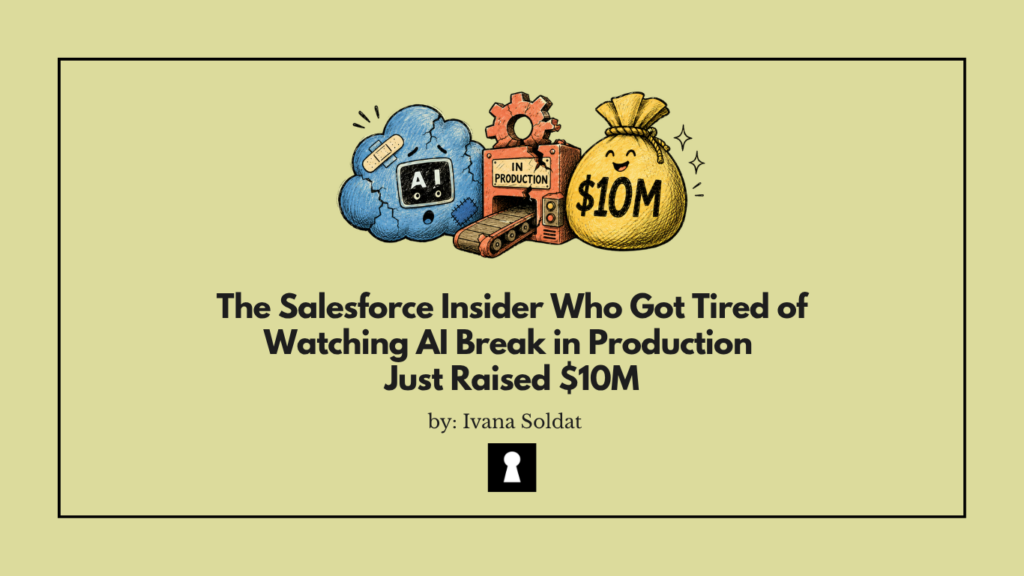
Tribal is betting that enterprise AI keeps flopping not because the models are bad, but because nobody bothered to actually understand the systems they were dropped into.
Tribal, an Israeli enterprise AI startup founded in 2025, has closed a $10 million seed round led by Team8, with participation from DYDX Capital and a group of angel investors.
The company is building what it calls a metadata-native AI agent platform, designed to make AI agents actually work inside the labyrinthine systems enterprises have spent decades building.
The founding team reads like a who’s who of people who had a front-row seat to enterprise AI failing. CEO Yoav Kolodner spent years as VP of Engineering at Salesforce. COO Yakir Daniel previously built and sold Spot.io and Swordfish to NetApp and Huawei. CTO Lior Sidi led AI teams at Wix, and watched firsthand what happens when agents have no idea what system they’re living inside.
The Problem: Enterprises Are Messy, Agents Are Naive
Most AI agents are pointed at enterprise systems the way a new intern is pointed at a 20-year-old filing cabinet. They have no idea what’s in there, what depends on what, or what will break if they touch the wrong thing. Tribal’s core technology, which it calls a Metadata Fabric, maps an organisation’s full metadata layer in minutes, covering custom objects, automations, permissions, business rules, and dependencies.
This matters because the gap between building an AI prototype and actually shipping it into a live production system is, as Kolodner’s team puts it bluntly, “brutally hard.” Tribal claims to close that gap by making agents organisation-aware before they ever touch anything live.
“Infrastructure without organisational context is just plumbing.” – Yoav Kolodner, CEO, Tribal
Agentforce’s Awkward Timing
Tribal’s pitch lands at a particularly opportune moment. Salesforce has been heavily pushing its Agentforce platform, but the reality of deploying it inside customised enterprise orgs has been messier than the marketing suggests.
Governance hurdles, dependency conflicts, and data quality issues mean most teams stall well before anything goes live. Gartner has predicted that more than two in five agentic AI projects will be scrapped by end of 2027.
Tribal is essentially positioning itself as the thing that makes Agentforce actually work inside your specific, customised, years-of-accumulated-workarounds Salesforce instance. The company’s agents are also designed to work across ServiceNow, SAP, NetSuite, and Workday, which suggests a broader play beyond any single platform.
Early Customers Are Already Talking
Tribal already has paying customers including ADAMA, ProDriven Brands, Dot Compliance, and WalkMe. The CIO of ADAMA noted that the platform allowed his team to move significantly faster and serve users across 19 countries with improved confidence. ProDriven Brands used it to replace years of brittle workarounds with cleaner, maintainable architecture.
The company plans to use the new funding to expand its product across those five major enterprise platforms and accelerate hiring in the US. With 15 people currently based in Israel, there is clearly a lot of scaling still ahead.
The Vibe-Coding Backlash, Enterprise Edition
There is a broader narrative here worth watching. The founding team has explicitly called out the failure of “vibe-coding” tools inside enterprise environments. Those tools, they argue, overlook organisational knowledge, governance, and the kind of production infrastructure that makes real systems tick.
It is a bet that the next phase of enterprise AI will not be won by whoever has the flashiest demo, but by whoever can actually survive contact with a live SAP environment. If Tribal is right, $10 million might just be the start of something considerably larger.
Our Take
We Think This One Is Worth Watching Closely
The enterprise AI market is littered with startups that solved the demo problem and quietly died on the deployment floor. What makes Tribal different is the founding team’s uncomfortably specific knowledge of exactly where things break. Kolodner did not read about Salesforce’s complexity in a blog post. He built inside it for years.
The metadata-first approach is also genuinely differentiated. Most agent builders assume a clean, well-documented system. Tribal assumes chaos, and builds for it. That is the more honest starting point, and probably the more defensible one.
The $10M seed is modest by today’s standards, which actually works in their favour. They have paying customers, a clear technical thesis, and a problem so obvious that half the Salesforce admin community has been screaming about it for two years. If they can ship fast and stay focused, this could become one of the more important infrastructure bets in enterprise AI.