
The quick commerce market in India is highly competitive and sees many companies fighting for growth and success. While some giants in the space, such as Walmart and Amazon, pour massive capital into rapid and widespread expansion, Swiggy is taking a different path.
Instead of chasing pure sales volume through major discounts and aggressive spending to expand, Swiggy is moving towards a more sustainable approach, led by profitability.
The Rapid Expansion of Quick Commerce in India
The quick commerce industry in India has grown rapidly recently, and this makes sense, as delivery speed is one of the most important elements of online shopping for consumers. This market has evolved from simple grocery delivery, as platforms offer rapid delivery (often 15 minutes or less) of electronics, essentials, snacks, medicine, beauty products, and more.
The scale is expanding, as more and more people look to the convenience of quick commerce to get the items they want, faster than ever.
This Growth Has Triggered an Infrastructure Race
While this growth is obviously great for companies in the quick commerce space and useful for consumers, it has also led to major competition and a massive infrastructure race. For example, companies like Amazon, Walmart’s Flipkart, and Reliance Retail are all looking to carve out a higher share in the market.
Walmart is bullish on the quick ecommerce segment, and it, as well as Reliance and Amazon, are aggressively investing in the quick commerce space in India.
The quick commerce sector in India also has the eyes of global tech investors like SoftBank, Temasek, and others, who have poured a ton of money into the space, hoping that India’s cheap delivery, dense communities, and strong digital payments ecosystem are the perfect breeding ground for quick commerce success.
But as the competition heats up, and each player spends more, markets more heavily, and gives deeper discounts to attract more customers, it becomes harder and harder to achieve profitability while competing like this.
Swiggy is Practicing Discipline Among the Chaos
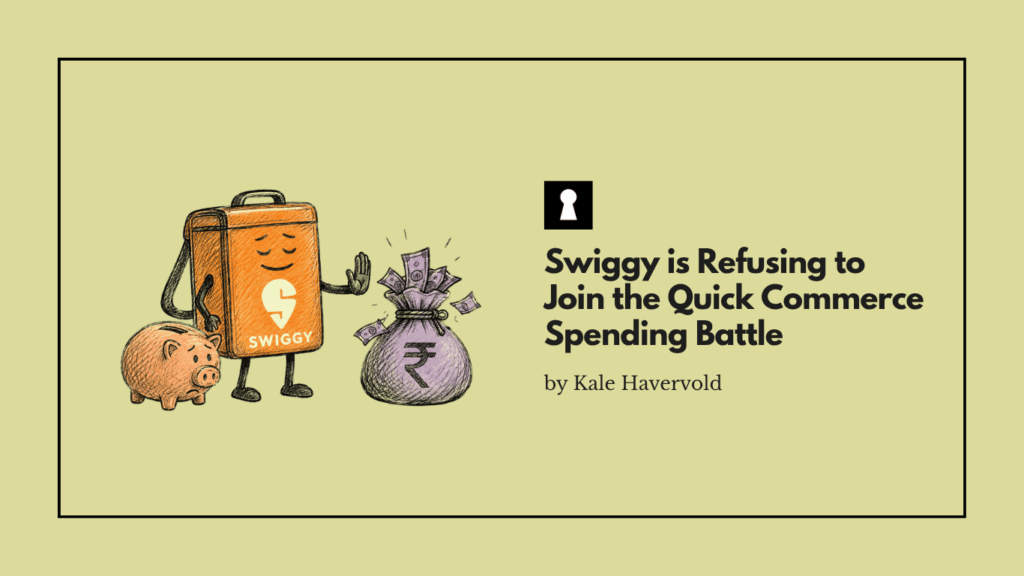
However, while hypergrowth at any cost may have once been the name of the game in this space, and many competitors are still competing directly, Swiggy has a different plan. Instead of joining in on this aggressive spending war with the likes of Amazon, the company has decided to prioritize profitability, sustainability, and building a financially durable company.
For example, while Swiggy’s Instamart operates around 1,100 dark stores across India, it has only added seven stores in the March quarter, which is much fewer than many of its rivals that are expanding more aggressively.
This is an intentional move by the company, as it has said it’s willing to sacrifice a few short-term customers, rather than chase unsustainable growth based on things like discounts. Specifically, Swiggy CEO Sriharsha Majety said that “Joining the spending only postpones the problem,”.
Also, not many other companies have the deep pockets and financial resources of the likes of Amazon and Walmart, so trying to keep up with them in a spending war isn’t likely to be very successful.
However, this more careful and measured approach of Swiggy may be a sign of things to come, as many believe that the market is shifting from purely expansion to being more about financial stability and sustainability as the quick commerce market in India matures.
The Challenges of Quick Commerce in India
In addition to competition heating up in the space, Swiggy is also dealing with other pressures and challenges. For example, investor confidence is becoming more sensitive. Quick commerce investors aren’t just happy with expansion anymore, and they want proof that companies can generate sustainable margins.
Also, there are governance challenges, such as a recent shareholder vote about Swiggy’s governance restructuring, which failed. The restructuring was connected to strengthening the company’s operational flexibility.
While the market could still grow rapidly over time, the real test in the space isn’t about evaluating demand or expanding, but about building a sustainable and durable business that can keep up with customer preferences, demands, and expectations.
Our Take
Growth At All Costs or Sustainable Expansion?
It’s clear there are two major approaches to quick commerce in India. While companies like Walmart and Amazon are prioritizing rapid expansion and throwing money at the space, Swiggy has decided to take a more profit-driven and careful approach.
Rapid expansion may help get more customers and market share immediately, but you’ll need plenty of funding to keep it up, and also need a plan to keep people around, not just bring them in with initial discounts and huge marketing pushes. If you have very little to offer beyond that, you may find it hard to keep customers loyal.
On the other hand, a slow and more methodical approach may sacrifice some short-term growth and success, but help with profitability and allow for a more durable company that’s able to stand the test of time.
Only time will tell which approach is more successful in this battle for long-term market share in the competitive quick commerce landscape in India.